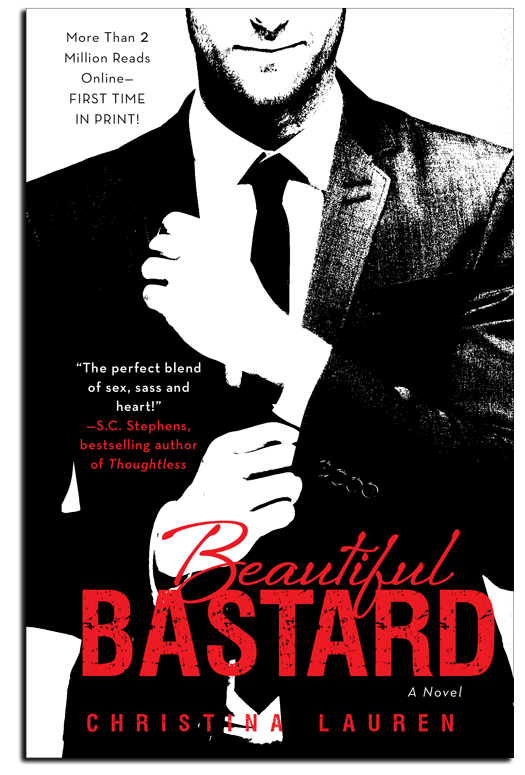
Another title that came up as a potential 50 Shades readalike was Beautiful Bastard, a Twilight fanfic-turned-book that was co-written by two women under the name Christina Lauren. Reviews online range from glowing to vituperative, depending on where the writer stands on the idea of publishing fan fiction. I am not going to dive in to that particular can of worms here, but instead try to give an idea of the book’s merit as a work of fiction (whether some ideas or characters are “borrowed” or not) and as a 50 shades readalike.
Chloe Mills is very close to finishing her MBA, but first she’s got to complete her internship as an assistant under the most demanding, arrogant, and rude boss ever known: advertising whiz kid Bennett Ryan. He may look like a god (her nickname for him is “Beautiful Bastard”), but he acts like a devil, offering Chloe constant criticism and pushing her to her limits. She rises to the challenge and isn’t afraid to give as well as she gets--even during an encounter in the conference room, in which their constant antagonism takes an abrupt turn into panty-ripping sex.
Despite their continued professed dislike for one another, each subsequent encounter leads to the same frenzied coupling, resulting in a stack of shredded lingerie in Bennett’s drawer and serious questions for Chloe about what exposure of their non-relationship would do for her reputation and future job prospects. Bennett has all the power and has already established himself in the man’s world of advertising, while Chloe is merely his assistant. From these inauspicious beginnings, will they be able to find their way to a meaningful relationship?
Grade: B+
Perhaps surprisingly, I really enjoyed this book. The structure is a little bit unconventional, as it alternates between Chloe and Bennett’s first-person perspectives--perhaps because of the tandem authorship? Despite the power imbalance, it’s clear from the outset that Chloe and Bennett are equally smart and driven; they are each other’s match and would be bored by someone who didn’t challenge them. Their gradually increasing intimacy and realization that their encounters are doing the opposite of “getting it out of their system” is actually quite sweet.
Things that make this a good 50 Shades readalike: the obsession with fancy underwear; their power dynamic; the sheer number of times they have sex; the fact that it also began as Twilight fan fiction. Unlike the E.L. James books, however, there isn’t a great deal of working through emotional traumas from the past. For me, this was a welcome relief, as was the fact that Bennett expressed his emotions first. Also, aside from their predilection for having sex in public places, Bennett and Chloe aren’t particularly kinky.
ETA: My review of the next book in the series, Beautiful Stranger, is here.
The audio version of this book review is now live.
Book Review Index
Showing posts with label Fan Fiction. Show all posts
Tuesday, April 23, 2013
Monday, April 8, 2013
Book Review: Gabriel's Inferno [2011]
On the list of 50 Shades readalikes I’ve read so far, Sylvain Reynard’s Gabriel’s Inferno has by far the least explicit sex, but it also has some of the most sensual scenes and language. Originally written as Twilight fan fiction, the book and its sequel were both best-sellers for their pseudonymous Canadian author. Some spoilers below.
Julia Mitchell is an American graduate student newly enrolled at the University of Toronto and writing her thesis on Dante. Professor Gabriel Emerson is the instructor for her Dante seminar. Due to several unfortunate coincidences, they do not get off to a good start, and Professor Emerson acts like--as described quite often in the text--an ass. What takes some time to become clear is the details of their shared past; six years before the story opens, Julia and Gabriel shared one perfect (chaste) evening which she has never forgotten. Professor Emerson, however, is a creature of some dark and lustful habits, and believes that their meeting was a product of his drug-addled imagination.
Once this misunderstanding is cleared up, Gabriel is determined not to let Julia stray far from his side again, but there are various complicating factors: she is still enrolled in his class, which makes any relationship between them a violation of university policy; he is burdened by secrets that he is convinced make him unworthy of her love; her abusive ex-boyfriend resurfaces to cause trouble; she’s a virgin who finds it hard to trust his attraction to her . . . the list goes on. But it’s a romance, so you know they will manage to be together in the end (unlike the first 50 Shades book).
Grade: B+
My primary irritation with the book had to do with the “we met six years ago and I remember but you don’t remember me and I’m not going to tell you” plotline that consumes so much of the first part of the narrative. Julia spends so much time waiting for him to figure it out, and I’ve never liked it when romances use that kind of narrative device to create tension. However, once they got over that hump, I was able to get on board and appreciate the slow unfolding of their relationship. And I do mean slow.
The type of reader who prefers their romances to start fast, with sex in the first few chapters, should stay far away from Gabriel’s Inferno. By the time they were preparing to have intercourse for the first time, it was disc 16 (out of 16) in the audio version. This chastity, of course, makes the book very different than the 50 Shades books (although I don’t know yet what happens in the sequel, Gabriel’s Rapture, or in the forthcoming Gabriel’s Redemption). In an interview with USA Today, “Sylvain Reynard”--a male pseudonym that many consider to be hiding a female author--addressed his views on writing explicit sex:
“I think that leaving things to the imagination is what creates seduction. Sometimes one can have too much of a good thing. Part of the thrill of sex is the anticipation, so as a writer I'm conscious of that fact. In my view, sex is a mystery. If one focuses on the mechanics of sex or the awkwardness of two human beings communing physically, it takes away from the mysterious and sometimes transcendent aspects of it.”
After recently reading so many books with incredibly detailed sexual encounters, I appreciated this refreshing approach. I listened to the audio version, and the narrator was above average, especially when describing intimate scenes.
As for similarities to 50 Shades, Gabriel has many of the same controlling tendencies (bordering on asshole, until he tempers them) as Christian, as well as a taste for expensive things. Julia is a virgin, but not an innocent, and she has had a difficult life with two neglectful parents and an abusive ex. Ana’s parents are much more present and involved, but the women do share a core of strength despite their insecurity and inexperience. Other things that recall 50 Shades are the importance of music to the narrative and Julia’s lip-biting habit, as well as the obvious fact that they are both published Twilight fan fiction.
Completely unlike the EL James books is Reynard’s use of the story of Dante and Beatrice, Dante scholarship, Italian quotes, and other scholarly trappings. Themes of devils and angels, transgression and redemption, and sin and forgiveness loom large. As a former scholar myself, these parts were some of my favorites, especially when Gabriel and Julia had a fight in the seminar in which they both tried to relate their injured feelings to Dante scholarship. However, I was a bit skeptical that Gabriel, in his early 30s and with a history of drug abuse and violent behavior, would have been able to get tenure and publish prolifically enough to be one of the foremost scholars in his field. Yes, that is where I had trouble suspending my disbelief.
And one last warning, there is a near-rape scene that might cause some distress.
Book Review Index
Julia Mitchell is an American graduate student newly enrolled at the University of Toronto and writing her thesis on Dante. Professor Gabriel Emerson is the instructor for her Dante seminar. Due to several unfortunate coincidences, they do not get off to a good start, and Professor Emerson acts like--as described quite often in the text--an ass. What takes some time to become clear is the details of their shared past; six years before the story opens, Julia and Gabriel shared one perfect (chaste) evening which she has never forgotten. Professor Emerson, however, is a creature of some dark and lustful habits, and believes that their meeting was a product of his drug-addled imagination.
Once this misunderstanding is cleared up, Gabriel is determined not to let Julia stray far from his side again, but there are various complicating factors: she is still enrolled in his class, which makes any relationship between them a violation of university policy; he is burdened by secrets that he is convinced make him unworthy of her love; her abusive ex-boyfriend resurfaces to cause trouble; she’s a virgin who finds it hard to trust his attraction to her . . . the list goes on. But it’s a romance, so you know they will manage to be together in the end (unlike the first 50 Shades book).
Grade: B+
My primary irritation with the book had to do with the “we met six years ago and I remember but you don’t remember me and I’m not going to tell you” plotline that consumes so much of the first part of the narrative. Julia spends so much time waiting for him to figure it out, and I’ve never liked it when romances use that kind of narrative device to create tension. However, once they got over that hump, I was able to get on board and appreciate the slow unfolding of their relationship. And I do mean slow.
The type of reader who prefers their romances to start fast, with sex in the first few chapters, should stay far away from Gabriel’s Inferno. By the time they were preparing to have intercourse for the first time, it was disc 16 (out of 16) in the audio version. This chastity, of course, makes the book very different than the 50 Shades books (although I don’t know yet what happens in the sequel, Gabriel’s Rapture, or in the forthcoming Gabriel’s Redemption). In an interview with USA Today, “Sylvain Reynard”--a male pseudonym that many consider to be hiding a female author--addressed his views on writing explicit sex:
“I think that leaving things to the imagination is what creates seduction. Sometimes one can have too much of a good thing. Part of the thrill of sex is the anticipation, so as a writer I'm conscious of that fact. In my view, sex is a mystery. If one focuses on the mechanics of sex or the awkwardness of two human beings communing physically, it takes away from the mysterious and sometimes transcendent aspects of it.”
After recently reading so many books with incredibly detailed sexual encounters, I appreciated this refreshing approach. I listened to the audio version, and the narrator was above average, especially when describing intimate scenes.
As for similarities to 50 Shades, Gabriel has many of the same controlling tendencies (bordering on asshole, until he tempers them) as Christian, as well as a taste for expensive things. Julia is a virgin, but not an innocent, and she has had a difficult life with two neglectful parents and an abusive ex. Ana’s parents are much more present and involved, but the women do share a core of strength despite their insecurity and inexperience. Other things that recall 50 Shades are the importance of music to the narrative and Julia’s lip-biting habit, as well as the obvious fact that they are both published Twilight fan fiction.
Completely unlike the EL James books is Reynard’s use of the story of Dante and Beatrice, Dante scholarship, Italian quotes, and other scholarly trappings. Themes of devils and angels, transgression and redemption, and sin and forgiveness loom large. As a former scholar myself, these parts were some of my favorites, especially when Gabriel and Julia had a fight in the seminar in which they both tried to relate their injured feelings to Dante scholarship. However, I was a bit skeptical that Gabriel, in his early 30s and with a history of drug abuse and violent behavior, would have been able to get tenure and publish prolifically enough to be one of the foremost scholars in his field. Yes, that is where I had trouble suspending my disbelief.
And one last warning, there is a near-rape scene that might cause some distress.
Book Review Index
Monday, March 11, 2013
Book Review: 50 Shades Trilogy [2012]
It seems almost ridiculous for me to weigh in on this trilogy after everything that has been written about it already, but I want to provide my take here before I move on to reviewing some of the books that have been offered as readalikes.* I read Fifty Shades of Grey and Fifty Shades Darker on paper, and listened to the audio version of Fifty Shades Freed. I got all three through my library without a long wait. Let me tell you, it is very weird to listen to an erotic story being read aloud when the heroine shares your name.
I’m not sure whether I would have picked up the books (and persevered through all of them) if I weren’t a librarian; what motivated me initially was a desire to discover for myself what was compelling so many of my patrons to read the books, which required them to put their names on enormous holds lists. I interacted with several people who, faced with the fact that they would be 450th in line, told me they were just going to buy the book.
I believe that the appeal of the books (in terms of the public’s consumption) wanes by about 30% after the first book, as the sales figures and holds ratios seem to bear out. In my library system, there are still twice as many holds on the first book as the successive volumes (159 holds on 428 total copies vs. 73/300 and 86/284). The first book of the trilogy has sold 168,959 copies in 2013 (as of this week's Publishers Weekly data) vs. 115,447 and 112,251 for the second and third books, respectively. I’m not sure if this is a result of a bottleneck created by people still waiting for their hold on the first book to come in, or how this drop-off after the first book compares to other series.
But enough idle speculation, let me get to my thoughts about the series. The trilogy involves the complicated, often tortured relationship between a young mogul, Christian Grey, and Anastasia Steele, who is a college senior when the first book opens. Christian copes with the traumas of his tortured past by attempting to exert absolute control over his environment, especially his sexual partners. Ana is an innocent who is swept up by his magnetism and power, but she finds it impossible to be the completely submissive partner Christian wants, even though she comes to care for him deeply. They learn to compromise as various challenges threaten their relationship. As you have probably heard, the books were originally conceived as Twilight fan fiction.
I will say up front that I enjoyed parts of the trilogy, but felt that it would have been a much stronger product if someone had taken a firmer editorial hand with the text. Never mind the plot points, James repeated so many phrases (“Oh, my sweet Fifty!”) and descriptive terms that it was very difficult for someone like me, who approaches life with red pen in hand, to remain immersed in the story. As a longtime romance reader, I wasn’t particularly shocked by the content; in fact, it was a bit tamer than I had been led to expect by some pearl-clutching reactions.
The trilogy is essentially a romance with a more explicit erotic content (some BDSM-related) than you would find in your garden-variety genre book. Ana and Christian (spoiler!) end up living happily-ever-after. The books feature the reformation of an overbearing male character that is not unlike the redemption of a rake in a historical romance. Although I found the primary external threat to their relationship unbelievable, I did appreciate the push-and-pull of negotiation between Christian and Ana over the course of the books, which didn’t stop after their marriage. It was interesting to see how things developed, as well as the material she was drawing from Twilight. One of the most peculiar reactions I had was to feel that James had created a backstory that made the actions of the characters in the Twilight Saga (which I also read and enjoyed portions of) make sense.
Grade: C+
I recommend that librarians on the front lines read (or listen to) at least the first book in the series, so they will be able to make informed collection decisions and be able to do the best reader’s advisory they can. There are various reasons that a patron might be interested in the series; this article on its appeal factors is a good starting point when trying to understand why it has been and continues to be such a phenomenon. I will say that when I tell patrons that I have read the series, they are immediately put more at ease and willing to open up to me when they’re asking for my help at the reference desk.
Book Review Index
*As part of my run-up to an upcoming presentation on erotica and collection development in the library. Since 50 Shades of Grey has kicked off a lot of discussion in the library world, in terms of collection development and reader’s advisory, it makes sense to start here. Future reviews will evaluate potential readalikes for the trilogy.
I’m not sure whether I would have picked up the books (and persevered through all of them) if I weren’t a librarian; what motivated me initially was a desire to discover for myself what was compelling so many of my patrons to read the books, which required them to put their names on enormous holds lists. I interacted with several people who, faced with the fact that they would be 450th in line, told me they were just going to buy the book.
I believe that the appeal of the books (in terms of the public’s consumption) wanes by about 30% after the first book, as the sales figures and holds ratios seem to bear out. In my library system, there are still twice as many holds on the first book as the successive volumes (159 holds on 428 total copies vs. 73/300 and 86/284). The first book of the trilogy has sold 168,959 copies in 2013 (as of this week's Publishers Weekly data) vs. 115,447 and 112,251 for the second and third books, respectively. I’m not sure if this is a result of a bottleneck created by people still waiting for their hold on the first book to come in, or how this drop-off after the first book compares to other series.
But enough idle speculation, let me get to my thoughts about the series. The trilogy involves the complicated, often tortured relationship between a young mogul, Christian Grey, and Anastasia Steele, who is a college senior when the first book opens. Christian copes with the traumas of his tortured past by attempting to exert absolute control over his environment, especially his sexual partners. Ana is an innocent who is swept up by his magnetism and power, but she finds it impossible to be the completely submissive partner Christian wants, even though she comes to care for him deeply. They learn to compromise as various challenges threaten their relationship. As you have probably heard, the books were originally conceived as Twilight fan fiction.
I will say up front that I enjoyed parts of the trilogy, but felt that it would have been a much stronger product if someone had taken a firmer editorial hand with the text. Never mind the plot points, James repeated so many phrases (“Oh, my sweet Fifty!”) and descriptive terms that it was very difficult for someone like me, who approaches life with red pen in hand, to remain immersed in the story. As a longtime romance reader, I wasn’t particularly shocked by the content; in fact, it was a bit tamer than I had been led to expect by some pearl-clutching reactions.
The trilogy is essentially a romance with a more explicit erotic content (some BDSM-related) than you would find in your garden-variety genre book. Ana and Christian (spoiler!) end up living happily-ever-after. The books feature the reformation of an overbearing male character that is not unlike the redemption of a rake in a historical romance. Although I found the primary external threat to their relationship unbelievable, I did appreciate the push-and-pull of negotiation between Christian and Ana over the course of the books, which didn’t stop after their marriage. It was interesting to see how things developed, as well as the material she was drawing from Twilight. One of the most peculiar reactions I had was to feel that James had created a backstory that made the actions of the characters in the Twilight Saga (which I also read and enjoyed portions of) make sense.
Grade: C+
I recommend that librarians on the front lines read (or listen to) at least the first book in the series, so they will be able to make informed collection decisions and be able to do the best reader’s advisory they can. There are various reasons that a patron might be interested in the series; this article on its appeal factors is a good starting point when trying to understand why it has been and continues to be such a phenomenon. I will say that when I tell patrons that I have read the series, they are immediately put more at ease and willing to open up to me when they’re asking for my help at the reference desk.
Book Review Index
*As part of my run-up to an upcoming presentation on erotica and collection development in the library. Since 50 Shades of Grey has kicked off a lot of discussion in the library world, in terms of collection development and reader’s advisory, it makes sense to start here. Future reviews will evaluate potential readalikes for the trilogy.
Subscribe to:
Posts (Atom)
