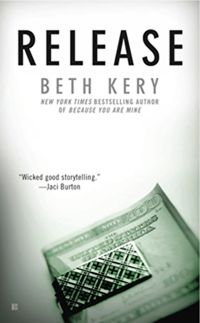
Despite not having an individual book or series that cracked the top 30 (books that were mentioned six times or more) in my online examination of 50 Shades readalikes, Beth Kery's name came up a combined ten times. The most popular readalike mentioned was Wicked Burn, but my library happened to have a mass market copy of Release on the shelf--ordered by me--so I checked it out and read it in one afternoon. A variety of spoilers below.
Genevieve's husband Max, a security firm honcho and professional secret-keeper, was murdered over three years ago. Now someone seems to think that Genevieve has something to hide--her house has burned down, her business has been burgled, her storage unit ransacked--and her life may be in danger. Genevieve seeks refuge in the penthouse apartment attached the the firm and finds it unexpectedly occupied by Sean Kennedy. Although her marriage to Max was functional, Sean was the man who attracted her, and it was with him (at Max's instigation, and with his participation) that she spent a night of breathtaking pleasure . . . shortly before her husband's death. Seeing Sean again stirs up all sorts of feelings in Genevieve, especially desire. The trouble is, she's always assumed that Sean was the one who killed Max.
Sean still has feelings for Genevieve, even though they haven't spoken for years. When she arrives at the penthouse in the midst of a Chicago blizzard, he's determined not to let her go until they work through the past and make a fresh start together. The trouble is, he's pretty sure that Genny killed her husband. I'm not a fan of romance novels in which a fundamental misunderstanding persists between the protagonists, particularly when it could be resolved by a simple conversation, and this one lingers until page 268 of a 312 page book. By the time I hit that page, I was actively rooting for one of them to have committed the murder and turn out to be a psychopath, but I suppose that might have interfered with the Happily Ever After. Despite the obfuscation around the circumstances of Max's death, the identity of his killer--suspected by Sean from the beginning of the novel--is a complete non-surprise. Kery does throw in a last-minute twist, but the "tension" is so drawn out that it falls flat when everything is finally revealed.
So, you've got a woman who thinks her husband was killed by a man she was in love with at the time. She interrupts him with a bound and naked woman in the midst of a sexual scene, and he promptly escorts the woman out and locks Genny in the penthouse with him. Rather than call him out on any of his behavior or question him about Max's death, she consistently says she doesn't want to talk about it and quickly becomes intimate with him instead. While I understand that this behavior might be an indication that she doesn't want to hear Sean confirm he committed murder for her, it's not as if he's taken any real steps in the past three years to connect with her, or that she has used her position of power as co-owner of the firm to do anything at all, such as have him fired or sent elsewhere. Rather than address any of this, they have sex. Lots of sex. And she refuses to believe that she might be in danger, despite the fact that all signs point that direction.
Why was this book set three-plus years after Max's death if none of the characters have done anything to advance their lives in the intervening time? Genevieve has a boyfriend who is addressed so little by the text that she constantly forgets about him, until Sean forces their breakup by bringing her to orgasm on speakerphone. Super classy, right? As with many of these erotic romances that try to incorporate suspenseful elements, the plot always seems secondary to the sex, and neither of them make a ton of sense when examined in the light of day.
Grade: D+
It's probably very clear by now that I was not a fan of the book, despite the fact that it edged into "so bad it's good" territory--the "toast porn" scene being the most salient example of this. It has less in common with the EL James trilogy than it does with books like Forbidden Pleasure and, especially, Mine to Hold, which has a similar husband-initiated threesome and adheres to the concept that it's perfectly fine for men to force women into admitting their feelings through sexual intercourse/withholding. Plus, Sean is from New Orleans and spends a lot of the book calling her "girl." The annoying nickname at least is in line with 50 Shades, and many of the other books I've read for this project.
I wouldn't class it as a good readalike for 50 Shades, and not only because both Christian and Ana have a great deal more sense than Sean and Genevieve. I know that I can't judge Kery's oeuvre based on this example, but--despite the sexual content--the book just doesn't work very well and doesn't have the same appeal factors. However, it does seem like Kery might be a great fit for fans of Lora Leigh and Shayla Black.
Book Review Index
Showing posts with label Suspense. Show all posts
Tuesday, June 4, 2013
Tuesday, October 18, 2011
Book Review: Wake [2008]
On my way out of town for vacation with no audiobooks in the car, I cruised though the Young Adult department at my library and picked up the audio version of Wake, by Lisa McMann.
Janie Hannagan can't avoid being sucked into other people's dreams. It's especially problematic in study hall after lunch, where she is witness to an endless cycle of "naked in front of class" nightmares and sexual fantasies. Janie lives with her alcoholic mother and works as much as possible at a local nursing home, hoping to make enough money to go to college and escape. Cabel Strumheller is a seemingly slacker student who lives near Janie and generally keeps to himself, although Janie has established a tentative friendship with him. When an overnight class trip exposes Janie's secret to Cabe, their burgeoning romantic relationship takes a serious hit. Rumors swirl that Cabe has become a drug dealer even as Janie starts to gain control over her abilities, leading her into a situation she never could have predicted.
Grade: B-
Wake was an interesting "what-if" exercise for one kind of paranormal power, but I'm not sure I'll keep reading the series. The explanation for Cabe's strange behavior [SPOILER] is that he's working for the police to bust a local dealer, which was fairly unbelievable. I know, I was perfectly content to believe that someone might see other people's dreams, but I apparently draw the line at the idea of high school students going undercover. I can't tell from this story, for example, whether they used actual high school students to help with the bust. There's also this fascinating story from twenty years ago--and maybe that's the problem, as a plot device it feels a little weak and dated. Apparently there are academic articles about this stuff. ANYWAY TANGENT OVER.
In addition, I'm not sure what my problem is, but I don't like having to deal with "experimental" tenses when I read. Wake is written in a diary-like format with a third-person present tense that conveys an immediacy ("Janie shakes her head to clear it.") that consistently throws me out of the story. The only time I've ever liked a book that attempted something similar, it was the audio version of The Knife of Never Letting Go. The narrator was competent, if stilted, coming across as very young. All that aside, I would categorize this as a good young adult suspense, and give it to a patron who was looking for something scary but not gory.
Dead Mother: No
Book Review Index
Janie Hannagan can't avoid being sucked into other people's dreams. It's especially problematic in study hall after lunch, where she is witness to an endless cycle of "naked in front of class" nightmares and sexual fantasies. Janie lives with her alcoholic mother and works as much as possible at a local nursing home, hoping to make enough money to go to college and escape. Cabel Strumheller is a seemingly slacker student who lives near Janie and generally keeps to himself, although Janie has established a tentative friendship with him. When an overnight class trip exposes Janie's secret to Cabe, their burgeoning romantic relationship takes a serious hit. Rumors swirl that Cabe has become a drug dealer even as Janie starts to gain control over her abilities, leading her into a situation she never could have predicted.
Grade: B-
Wake was an interesting "what-if" exercise for one kind of paranormal power, but I'm not sure I'll keep reading the series. The explanation for Cabe's strange behavior [SPOILER] is that he's working for the police to bust a local dealer, which was fairly unbelievable. I know, I was perfectly content to believe that someone might see other people's dreams, but I apparently draw the line at the idea of high school students going undercover. I can't tell from this story, for example, whether they used actual high school students to help with the bust. There's also this fascinating story from twenty years ago--and maybe that's the problem, as a plot device it feels a little weak and dated. Apparently there are academic articles about this stuff. ANYWAY TANGENT OVER.
In addition, I'm not sure what my problem is, but I don't like having to deal with "experimental" tenses when I read. Wake is written in a diary-like format with a third-person present tense that conveys an immediacy ("Janie shakes her head to clear it.") that consistently throws me out of the story. The only time I've ever liked a book that attempted something similar, it was the audio version of The Knife of Never Letting Go. The narrator was competent, if stilted, coming across as very young. All that aside, I would categorize this as a good young adult suspense, and give it to a patron who was looking for something scary but not gory.
Dead Mother: No
Book Review Index
Thursday, August 4, 2011
Book Review: The Snowman [2010]
At some point this summer, The Snowman, a mystery/thriller originally published by Norwegian author Jo Nesbø in 2007, became a hot item. It was even featured on Good Morning America. The seventh book in an ongoing series featuring detective Harry Hole, The Snowman's popularity is understandable in a post-Girl With the Dragon Tattoo world intrigued by Scandinavian noir. I found it curious that the book being pushed is not the first in the series (and mentions events that presumably happened in earlier books), but it does have a suspenseful, self-contained story that doesn't require much background to appreciate. There is also something refreshing about spending time in the sweltering heat of July reading about snow and ice in Norway.
Norway has always been known as a land of peace and prosperity, and it's never been home to a serial killer . . . until now. Known as the Snowman, this person abducts and kills married women with children and leaves behind only a sinister sculpture in the snow. Until recently, the killings were spaced far enough apart that no one noticed a pattern, but two consecutive disappearances draw the attention of the Oslo police and hard-bitten detective Harry Hole. Harry is a recovering alcoholic who is constantly in trouble with his bosses; the love of his life left him because he couldn't separate his life from the job; and he's the only policeman in the country who's ever been involved in catching a serial killer. As the trail of clues leads Harry closer and closer to the killer, it becomes clear that this is a very personal game that the Snowman intends to play out between them.
Grade: B
If you're up for a thriller with some interesting twists and turns, this would be a good book to choose. If you're a fan of "damaged" protagonists who can't seem to get their lives together but somehow prevail, Harry Hole is definitely your man. Unfortunately, I wasn't really in the mood to read about a detective as deeply dysfunctional as Harry. There are times I favor gritty realism in my mysteries, and there are times I prefer to escape with a Lord Peter, and in this case there were too many scenes in which "seed" was running somewhere for me to really like The Snowman. The mystery wasn't extremely opaque--I had figured out most of the key points by halfway through--but its resolution was suspenseful enough that I was gripping my steering wheel and involuntarily slowed down to 55 miles an hour on the Mass Pike as the last disc played.
Random Thoughts:
I once visited Norway, but of course Nesbø's descriptions of Oslo's seedy underbelly didn't jive well with my memories. Still, it was interesting to read about Oslo, and Bergen, and even Voss (very briefly mentioned, but important to my family history as site of the Rokne family reunion!) and know that I had actually been to those places.
The audiobook was read by Robin Sachs, known to Buffy fans as Ethan Rayne, and he did a good job at pronunciation. If they don't cast Daniel Craig in the theoretical future movie of the book, they're crazy. Yes, I know he's already in the Girl movies, but Harry Hole is a much more likely character for his craggy face.
The book is threaded through with music, much of it American and recognizable to me. I guess this makes sense, since Nesbø is also a rock musician and songwriter. He also wrote about recent tragic events in Norway for the New York Times.
Book Review Index
Dead mother: Multiple
Norway has always been known as a land of peace and prosperity, and it's never been home to a serial killer . . . until now. Known as the Snowman, this person abducts and kills married women with children and leaves behind only a sinister sculpture in the snow. Until recently, the killings were spaced far enough apart that no one noticed a pattern, but two consecutive disappearances draw the attention of the Oslo police and hard-bitten detective Harry Hole. Harry is a recovering alcoholic who is constantly in trouble with his bosses; the love of his life left him because he couldn't separate his life from the job; and he's the only policeman in the country who's ever been involved in catching a serial killer. As the trail of clues leads Harry closer and closer to the killer, it becomes clear that this is a very personal game that the Snowman intends to play out between them.
Grade: B
If you're up for a thriller with some interesting twists and turns, this would be a good book to choose. If you're a fan of "damaged" protagonists who can't seem to get their lives together but somehow prevail, Harry Hole is definitely your man. Unfortunately, I wasn't really in the mood to read about a detective as deeply dysfunctional as Harry. There are times I favor gritty realism in my mysteries, and there are times I prefer to escape with a Lord Peter, and in this case there were too many scenes in which "seed" was running somewhere for me to really like The Snowman. The mystery wasn't extremely opaque--I had figured out most of the key points by halfway through--but its resolution was suspenseful enough that I was gripping my steering wheel and involuntarily slowed down to 55 miles an hour on the Mass Pike as the last disc played.
Random Thoughts:
I once visited Norway, but of course Nesbø's descriptions of Oslo's seedy underbelly didn't jive well with my memories. Still, it was interesting to read about Oslo, and Bergen, and even Voss (very briefly mentioned, but important to my family history as site of the Rokne family reunion!) and know that I had actually been to those places.
The audiobook was read by Robin Sachs, known to Buffy fans as Ethan Rayne, and he did a good job at pronunciation. If they don't cast Daniel Craig in the theoretical future movie of the book, they're crazy. Yes, I know he's already in the Girl movies, but Harry Hole is a much more likely character for his craggy face.
The book is threaded through with music, much of it American and recognizable to me. I guess this makes sense, since Nesbø is also a rock musician and songwriter. He also wrote about recent tragic events in Norway for the New York Times.
Book Review Index
Dead mother: Multiple
Tuesday, April 12, 2011
Book Review: The Likeness [2008]
I'm not sure what I would have done if I'd finished In the Woods and The Likeness hadn't been waiting for me at the library--gnashed my teeth and written an angry blog post, perhaps. Actually (gasp) run out and purchased the book? Thankfully, no drastic actions were necessary. As I said in my review of the first book, The Likeness actually caught my eye several years ago, but I thought I'd better start at the beginning.
Tana French's follow-up picks up in the aftermath of Operation Vestal with the story of Cassandra Maddox, whose relationship with the narrator of In the Woods ended in flaming ruin, largely because of his inability to deal with the past. Subsequently, Cassie left the murder squad and joined Domestic Violence, which she finds much less satisfying. When she is called to advise on a homicide case run by her new boyfriend Sam O'Neill and her old boss in Undercover, Frank Mackey, she is startled to find that the victim appears to be her exact double and was using an alias that she and Mackey created together many years ago.
Mackey comes up with an unorthodox plan to uncover her killer's identity: Cassie will revisit her undercover days and resume the victim's life as if she had been wounded, rather than killed. Although she first greets his scheme with understandable skepticism, going undercover also offers Cassie a much-needed break from the lingering effects of Operation Vestal. However, the downside is that the culprit is likely among the four people with whom the victim, Lexie Madison, shared an old mansion in the country. As Cassie gradually becomes comfortable in Lexie's life, she also grows close to her housemates--a group of inseparable, eccentric graduate students--and learns more about "Lexie's" life before she assumed her own false identity. Will the killer figure out Cassie's game before she has a chance to figure out the truth of what happened to Lexie?
Grade: A-
The Likeness has a fascinating premise that I'm not sure I ever fully embraced. This might be because I've never met someone who looks exactly like me; I have been mistaken for other people, however, and that's always a disconcerting feeling. Despite the fact that I was somewhat reluctant to buy in, The Likeness was easily one of the best books I've read recently, and an excellent follow-up to In the Woods. It has the same deft, location-oriented nostalgia and emotional resonance, although this time the setting is Whitethorn House rather than the woods. French does a masterful job of blurring the lines of Cassie's identity as her personality becomes subsumed into "Lexie." Even though the operation must have a finite end, the illusion of a fresh start is so powerful that she is tempted to embrace it as a safe haven, even as the housemates' relationships are more and more strained because of her presence. The Likeness is suspense of the most excruciating and drawn-out variety; its tension is not predicated on imminent danger and horrific acts, but on the slow breakdown of human relationships and the agony of inevitable endings.
Random Thoughts:
I listened to The Likeness on audio CD, and that was definitely a good decision. I can't testify for the accuracy of the various Irish accents employed by the narrator, but there's something about the rhythm of French's language and narrative description that lends itself to that medium.
French tends to weave a certain amount of commentary on Irish politics or the "state of the nation" into her novels, and The Likeness is no exception. Sometimes these are quick comments about the concept of land and ownership, and sometimes they're more lengthy discourses that can bring the plot (in this case, already very slow to unfold) to a grinding halt. Overall, it's fascinating to find out more about another culture that is similar to ours, yet very different at the same time.
Book Review Index
Dead Mother: Yes
Tana French's follow-up picks up in the aftermath of Operation Vestal with the story of Cassandra Maddox, whose relationship with the narrator of In the Woods ended in flaming ruin, largely because of his inability to deal with the past. Subsequently, Cassie left the murder squad and joined Domestic Violence, which she finds much less satisfying. When she is called to advise on a homicide case run by her new boyfriend Sam O'Neill and her old boss in Undercover, Frank Mackey, she is startled to find that the victim appears to be her exact double and was using an alias that she and Mackey created together many years ago.
Mackey comes up with an unorthodox plan to uncover her killer's identity: Cassie will revisit her undercover days and resume the victim's life as if she had been wounded, rather than killed. Although she first greets his scheme with understandable skepticism, going undercover also offers Cassie a much-needed break from the lingering effects of Operation Vestal. However, the downside is that the culprit is likely among the four people with whom the victim, Lexie Madison, shared an old mansion in the country. As Cassie gradually becomes comfortable in Lexie's life, she also grows close to her housemates--a group of inseparable, eccentric graduate students--and learns more about "Lexie's" life before she assumed her own false identity. Will the killer figure out Cassie's game before she has a chance to figure out the truth of what happened to Lexie?
Grade: A-
The Likeness has a fascinating premise that I'm not sure I ever fully embraced. This might be because I've never met someone who looks exactly like me; I have been mistaken for other people, however, and that's always a disconcerting feeling. Despite the fact that I was somewhat reluctant to buy in, The Likeness was easily one of the best books I've read recently, and an excellent follow-up to In the Woods. It has the same deft, location-oriented nostalgia and emotional resonance, although this time the setting is Whitethorn House rather than the woods. French does a masterful job of blurring the lines of Cassie's identity as her personality becomes subsumed into "Lexie." Even though the operation must have a finite end, the illusion of a fresh start is so powerful that she is tempted to embrace it as a safe haven, even as the housemates' relationships are more and more strained because of her presence. The Likeness is suspense of the most excruciating and drawn-out variety; its tension is not predicated on imminent danger and horrific acts, but on the slow breakdown of human relationships and the agony of inevitable endings.
Random Thoughts:
I listened to The Likeness on audio CD, and that was definitely a good decision. I can't testify for the accuracy of the various Irish accents employed by the narrator, but there's something about the rhythm of French's language and narrative description that lends itself to that medium.
French tends to weave a certain amount of commentary on Irish politics or the "state of the nation" into her novels, and The Likeness is no exception. Sometimes these are quick comments about the concept of land and ownership, and sometimes they're more lengthy discourses that can bring the plot (in this case, already very slow to unfold) to a grinding halt. Overall, it's fascinating to find out more about another culture that is similar to ours, yet very different at the same time.
Book Review Index
Dead Mother: Yes
Monday, February 28, 2011
Book Review: In the Woods [2007]
I've been intrigued by Irish author Tana French's The Likeness ever since I spotted it in reviews several years ago, but never had a good opportunity to pick it up. Then, a few weeks ago, Nancy Pearl said on Twitter: "Wish I could read Tana French's In the Woods again for the first time." In the Woods precedes The Likeness in French's fictional world, and Nancy Pearl's recommendation is more than enough for me, so I immediately requested it from my library on CD and checked out the book as well. This turned out to be a good thing, because I spent the next week listening to the CD in the car and then picking up where I had left off in the book, and vice versa--behavior that I reserve only for books that completely absorb my attention.
In the Woods is a first-person narrative from the perspective of Rob Ryan, a detective in Dublin's murder squad. Rob and his partner, Cassie Maddox, are young and confident, and their relationship has a special closeness rarely seen between platonic friends. Cassie is one of the few people who knows that Rob is actually Adam Ryan, one of three children who mysteriously disappeared in the Dublin subdivision of Knocknaree in the 1980s. Adam was the only child to reappear, his memory of events blank and shoes filled with blood that wasn't his own. When the book begins, another murder at Knocknaree brings Rob full circle on a case that involves a dead girl about the same age as he was when he disappeared. The results are devastating for Rob, his relationship with Cassie, and the family of the dead girl.
In the Woods is much more than a police procedural, it is a book steeped in nostalgia, both for Rob and Cassie's intense relationship, and for the more distant past--the friends that Rob has lost, and the experiences that he can never share with them. French evokes an elegant yearning with her prose; her lines are by turns wittily sarcastic (Rob's "voice") and deeply evocative, especially when she speaks of places:
Grade: A
I definitely agree with Nancy Pearl: I would really like to read this book again for the first time. It was such a great balance of humor and suspense and nostalgia. I wish all books were as moving and intriguing.
Book Review Index
Dead Mother: No
In the Woods is a first-person narrative from the perspective of Rob Ryan, a detective in Dublin's murder squad. Rob and his partner, Cassie Maddox, are young and confident, and their relationship has a special closeness rarely seen between platonic friends. Cassie is one of the few people who knows that Rob is actually Adam Ryan, one of three children who mysteriously disappeared in the Dublin subdivision of Knocknaree in the 1980s. Adam was the only child to reappear, his memory of events blank and shoes filled with blood that wasn't his own. When the book begins, another murder at Knocknaree brings Rob full circle on a case that involves a dead girl about the same age as he was when he disappeared. The results are devastating for Rob, his relationship with Cassie, and the family of the dead girl.
In the Woods is much more than a police procedural, it is a book steeped in nostalgia, both for Rob and Cassie's intense relationship, and for the more distant past--the friends that Rob has lost, and the experiences that he can never share with them. French evokes an elegant yearning with her prose; her lines are by turns wittily sarcastic (Rob's "voice") and deeply evocative, especially when she speaks of places:
It was like stumbling into the wreck of some great ancient city. The trees swooped higher than cathedral pillars; they wrestled for space, propped up great fallen trunks, leaned with the slope of the hill: oak, beech, ash, others I couldn't name. Long spears of light filtered, dim and sacred, through the arches of green. Swathes of ivy blurred the massive trunks, trailed in waterfalls from the branches, turned stumps into standing stones (272).While his official presence on the case is a textbook example of conflict of interest, Rob's need to pursue the demons of his past is understandable, if misguided. He has spent the bulk of the time between the incident in the woods and the present distancing himself from the little boy he once was, and the emotional and psychological consequences of that action are unknown, even to him.
Grade: A
I definitely agree with Nancy Pearl: I would really like to read this book again for the first time. It was such a great balance of humor and suspense and nostalgia. I wish all books were as moving and intriguing.
Book Review Index
Dead Mother: No
Monday, November 15, 2010
Book Review: The Girl Who Kicked the Hornet's Nest [2010]
The cliffhanger ending of The Girl Who Played with Fire left me relatively eager to read The Girl Who Kicked the Hornet's Nest when it came out earlier this year, completing Stieg Larsson's Millennium Trilogy. I know, I know, there's a possible fourth book, but it sounds like those will be mired in legal battles for the rest of time, so it's good that The Girl Who Kicked the Hornet's Nest wrapped up a lot of the loose ends. Things being as they usually are, I got the hardback from the library when it came out, had to return it because I ran out of time, and instead listened to the audio version narrated by Simon Vance! As I believe I expressed in another review, anything read by Simon Vance is an automatic WIN as far as I am concerned. I must confess, toward the end I was lugging my CDs from my car to my house so that I could keep listening. But after I was finished, I had to get the book back through ILL so that I could write this review and get all the Swedish spellings right. The things I go through for my art! [dramatic swoon]
The backstory of the second and third books is complicated enough that it is explained over and over again to new characters who are being brought in on the case, and I will try to summarize as best I can. Lisbeth Salander, our anti-heroine from The Girl With the Dragon Tattoo, is the daughter of an ex-Russian spy, Alexander Zalachenko, who had been protected by the Swedish secret police for years in exchange for valuable information on Soviet activities. This ongoing operation was carried out in complete secret by a very small group within the secret police known as the Section. Unfortunately, Zalachenko was an abusive bastard who regularly beat Salander's mother, eventually to the point where she was permanently disabled. The Section regularly cleaned up after this and other messes to make sure that his identity remained secret. Receiving no help from the authorities, Salander took matters into her own hands and firebombed her father when she was twelve, then was committed to a mental institution to keep anyone from believing her stories about Zalachenko. Most, if not all, of Salander's subsequent troubles (being assigned a guardian who raped her, for example) are a direct result of the Section's attempts to keep the Zalachenko story under wraps.
When the action of the third novel begins, Salander is in the hospital with a gunshot wound to the head (inflicted by her father), and Zalachenko is recovering in the room down the hall because she didn't quite manage to kill him with an axe to the face. It's a time of family bonding. With Salander slated to go to trial and Zalachenko threatening to expose everything, the aging members of the Section take swift action to head off threats to their anonymity, resulting in the deaths of several people. The story is an intricate tangle that intrepid Millennium magazine reporter Mikael Blomkvist must work day and night to unravel (with a double-digit supporting cast) before time runs out for Salander. The book's major subplot involves Millennium editor Erika Berger moving to take over editorial duties at Svenska Morgon-Posten, a prestigious career move that unfortunately results in her being sexually harassed.
Phew. After reading The Girl Who Played with Fire and The Girl Who Kicked the Hornet's Nest, I have now spent more time than I ever thought I would contemplating the workings of the Swedish secret police.
As I said above, the details of the Section's past and the slow process of tracking them down is a part of the novel that grows a bit wearing after the tenth time or so. The Girl Who Kicked the Hornet's Nest is a novel of small details. Larsson thought that people's stories were fascinating, so every character we meet (and there are many) is provided with a backstory, sometimes an extensive one. At times this careful explication bogs down the pace of the novel, and sometimes it provides additional depth. If you are looking for a fast-paced thriller stuffed with action, this is not the book for you. Berger's stalker subplot does provide some intermediate thrills while Blomkvist and Salander are busy working out their strategy for clearing her name and getting her full legal rights, but it is a resolution that unfolds in a courtroom, at a trial that takes nearly 500 pages to set up. For me, it was a worthwhile payoff after three books in the making.
Grade: B+
Random thoughts:
One of the best things about Larsson's books is the number and depth of the female characters. Certainly they are idealized; his women are usually victims and rarely villains, but it is a sad commentary on the rest of our fiction that having so many female police officers, lawyers, newspaper editors, etc. should be remarkable. Apart from Lisbeth Salander herself, who is a sort of manic pixie hacker girl that everyone feels sympathy for, despite her antisocial ways, Berger is a strong character who is given particular depth in this last novel. In addition, Blomkvist's sister Annika Giannini is enormously sympathetic as Salander's lawyer, while Larsson also spends a great deal of time examining the thoughts and motivations of two female police officers, Modig and Figuerola, as well as the security agent Susanne Linder. I do find it annoying, however, that women keep falling in love with Blomkvist. I suppose it adds a romantic element to the book, but it made my eyes roll more than it made my heart flutter.
It may sound silly, but it's kind of fascinating to read about Swedish history and politics and wonder how much of what Larsson is writing about is true. What if the United States had a department of Constitutional Protection? I also enjoy reading a crime novel in which the bad guys, especially the really bad guys, get their just desserts. Larsson isn't afraid to torture or kill off good people, but the major losses are definitely on the other side of the equation.
As I mentioned above, a lot of the loose ends were tied up in this volume, particularly those that had to do with Salander's family history. One important character that is left open-ended, however, is Salander's twin sister, who presumably is as clever and possibly as amoral as Lisbeth. It's a shame that Larsson died before he could write more books in the series, because it would be interesting to see where he planned to take it from this (relatively peaceful) point.
ETA: I think that Reg Keeland, who translated the books from the Swedish, did a great job. I don't think translators get enough props, given that the words they choose have such a huge impact on the atmosphere of a book.
Book Review Index
Dead Mother: Yes
The backstory of the second and third books is complicated enough that it is explained over and over again to new characters who are being brought in on the case, and I will try to summarize as best I can. Lisbeth Salander, our anti-heroine from The Girl With the Dragon Tattoo, is the daughter of an ex-Russian spy, Alexander Zalachenko, who had been protected by the Swedish secret police for years in exchange for valuable information on Soviet activities. This ongoing operation was carried out in complete secret by a very small group within the secret police known as the Section. Unfortunately, Zalachenko was an abusive bastard who regularly beat Salander's mother, eventually to the point where she was permanently disabled. The Section regularly cleaned up after this and other messes to make sure that his identity remained secret. Receiving no help from the authorities, Salander took matters into her own hands and firebombed her father when she was twelve, then was committed to a mental institution to keep anyone from believing her stories about Zalachenko. Most, if not all, of Salander's subsequent troubles (being assigned a guardian who raped her, for example) are a direct result of the Section's attempts to keep the Zalachenko story under wraps.
When the action of the third novel begins, Salander is in the hospital with a gunshot wound to the head (inflicted by her father), and Zalachenko is recovering in the room down the hall because she didn't quite manage to kill him with an axe to the face. It's a time of family bonding. With Salander slated to go to trial and Zalachenko threatening to expose everything, the aging members of the Section take swift action to head off threats to their anonymity, resulting in the deaths of several people. The story is an intricate tangle that intrepid Millennium magazine reporter Mikael Blomkvist must work day and night to unravel (with a double-digit supporting cast) before time runs out for Salander. The book's major subplot involves Millennium editor Erika Berger moving to take over editorial duties at Svenska Morgon-Posten, a prestigious career move that unfortunately results in her being sexually harassed.
Phew. After reading The Girl Who Played with Fire and The Girl Who Kicked the Hornet's Nest, I have now spent more time than I ever thought I would contemplating the workings of the Swedish secret police.
As I said above, the details of the Section's past and the slow process of tracking them down is a part of the novel that grows a bit wearing after the tenth time or so. The Girl Who Kicked the Hornet's Nest is a novel of small details. Larsson thought that people's stories were fascinating, so every character we meet (and there are many) is provided with a backstory, sometimes an extensive one. At times this careful explication bogs down the pace of the novel, and sometimes it provides additional depth. If you are looking for a fast-paced thriller stuffed with action, this is not the book for you. Berger's stalker subplot does provide some intermediate thrills while Blomkvist and Salander are busy working out their strategy for clearing her name and getting her full legal rights, but it is a resolution that unfolds in a courtroom, at a trial that takes nearly 500 pages to set up. For me, it was a worthwhile payoff after three books in the making.
Grade: B+
Random thoughts:
One of the best things about Larsson's books is the number and depth of the female characters. Certainly they are idealized; his women are usually victims and rarely villains, but it is a sad commentary on the rest of our fiction that having so many female police officers, lawyers, newspaper editors, etc. should be remarkable. Apart from Lisbeth Salander herself, who is a sort of manic pixie hacker girl that everyone feels sympathy for, despite her antisocial ways, Berger is a strong character who is given particular depth in this last novel. In addition, Blomkvist's sister Annika Giannini is enormously sympathetic as Salander's lawyer, while Larsson also spends a great deal of time examining the thoughts and motivations of two female police officers, Modig and Figuerola, as well as the security agent Susanne Linder. I do find it annoying, however, that women keep falling in love with Blomkvist. I suppose it adds a romantic element to the book, but it made my eyes roll more than it made my heart flutter.
It may sound silly, but it's kind of fascinating to read about Swedish history and politics and wonder how much of what Larsson is writing about is true. What if the United States had a department of Constitutional Protection? I also enjoy reading a crime novel in which the bad guys, especially the really bad guys, get their just desserts. Larsson isn't afraid to torture or kill off good people, but the major losses are definitely on the other side of the equation.
As I mentioned above, a lot of the loose ends were tied up in this volume, particularly those that had to do with Salander's family history. One important character that is left open-ended, however, is Salander's twin sister, who presumably is as clever and possibly as amoral as Lisbeth. It's a shame that Larsson died before he could write more books in the series, because it would be interesting to see where he planned to take it from this (relatively peaceful) point.
ETA: I think that Reg Keeland, who translated the books from the Swedish, did a great job. I don't think translators get enough props, given that the words they choose have such a huge impact on the atmosphere of a book.
Book Review Index
Dead Mother: Yes
Sunday, August 9, 2009
Book Review: The Girl Who Played With Fire [2009]
I read and enjoyed The Girl with the Dragon Tattoo when it came out last year, although I felt that it was a bit heavy-handed at times. The Girl who Played with Fire is the second of the trilogy written by Swedish author Stieg Larsson before his untimely death. Fire, like the previous novel, features the characters of Lisbeth Salander (socially awkward hacker extraordinaire) and Mikael Blomkvist (investigative journalist and ladies' man). Larsson's characters are for the most part deeply flawed, and a refreshing number of them are women. This book, unlike the first, focuses on Salander's past and has as its main plot point her fugitive status after three mysterious killings shake Stockholm. As one of the victims is Salander's court-appointed guardian and her fingerprints are found at both crime scenes, she is naturally under suspicion from the outset. Blomkvist and the rest of the staff of Millennium magazine, the police department, and the security firm where Salander was once employed are all on the hunt for her, as well as a group of thugs that would rather she disappeared for good. I can't tell if I thought there were too many characters because there really were--several minor story lines seemed to disappear by the end of the book--or because they all had similar (and therefore somewhat confusing) Swedish names. I am all for Scandinavian naming conventions, but it was occasionally hard to remember who individual characters were when they popped up after being absent for some time. The book is gripping, however, and ended on a bit of a cliffhanger, leaving me eager for the final installment.
Grade: B+
Random Thoughts: There were lots of comparisons between Salander and Pippi Longstocking. I used to really love Pippi--I think I need to re-read those books. And I seem to remember a movie?
Grade: B+
Random Thoughts: There were lots of comparisons between Salander and Pippi Longstocking. I used to really love Pippi--I think I need to re-read those books. And I seem to remember a movie?
Labels:
Book Review,
Mystery,
Suspense,
Thriller,
Translation
Subscribe to:
Posts (Atom)