It's hard to believe that this is the fifth year I've done a post like this. I feel like I've done a good job taking control of my reading, at least in terms of tracking what happens, which has made it easier to compile stats. And who doesn't love stats? Don't answer that.
Read: 121 (including 24 audiobooks and 15 ebooks), about the same number as 2012. Goodreads says this is slightly over 40,000 pages. The longest book by far was Brandon Sanderson's The Way of Kings, which clocked in at 1,007 pages. More than half of the books I read were romances, so I'm going to break that down into more categories this year.
Romance, general: 18
Romance, historical: 17
Romance, lesbian: 17
Romance, erotic: 14
Fantasy: 21
Young Adult: 9 (4 Fantasy, 5 Science Fiction)
Manga/Graphic Novels: 6
Nonfiction: 4
Mystery/Suspense: 4
Middle Grade: 3
Science Fiction: 3
Historical Fiction: 2
General Fiction: 2
Picture books read to Little G: still ∞
My goal for 2013 was to read 125 books, and I didn't quite make it there, despite spending November reading furiously. I would have easily reached my goal if not for the siren call of fanfiction, which reappeared in my life at the end of 2013 after a long absence. In any case, I think 125 is the outer limit of what I can read in one year--not surprising, since it requires reading at a rate of more than two books a week. For the first time in many years, I didn't read any Young Adult books with LGBTQ emphasis. I'm not sure why, but nothing seemed to grab my attention. Some of the YA books I read refused to address LGBTQ issues at all. Last year was very light on nonfiction as well.
Compared to 2012, the number of audiobooks went down slightly, from 29 to 24, and the number of ebooks went up from 10 to 15. This is at least partially due to the fact that I chose the audio format to plow through some long works, such as the aforementioned Way of Kings. It takes a long time to get through 36 CDs, even with a half hour commute. On this front, I'm pleased to announce that I picked up an assignment, mid-year, as an audiobook reviewer for Library Journal. So far it's been very enjoyable!
My Fifty Shades of Grey readalike project (recap forthcoming) was the primary reason that I read so many erotic romances, and my Reading Roulette project (recap also forthcoming) led to reading several entire series--mostly fantasy and romance. This year I decided to look at the breakdown between male and female authors among the books I read, and the outcome was very heavily skewed toward female authors. I read 98 books by women, 22 books by men, and one book, Freedom & Necessity, that was co-written by a man and woman. I am completely on board with this trend and hope it continues in 2014. I'm not rejecting books written by men out of hand, but there tend to be more female characters in books written by women, and I'm past the point of wanting to read so much about dudes.
Looking forward, I am going to continue my Reading Roulette project into the new year. It's really expanded my horizons in terms of making me read things I would never choose on my own, which can only help me when it comes time for Reader's Advisory. I'm also going to try to participate in the Year in Reading, kicking off in January with a book from the year I was born. Some of the likely candidates so far: The Silmarillion (*sigh*), The Thorn Birds, and Agatha Christie: An Autobiography. I took my reading goal down to a more reasonable 100 books, as I am hoping to write some as well as read this year.
What were your favorite reads of 2013? What's your plan for 2014?
My favorite reads of the year:
Beautiful Bastard, Christina Lauren
Deep Deception, Cathy Pegau
Etiquette & Espionage and Curtsies & Conspiracies, Gail Carriger
For Darkness Shows the Stars and Across a Star-Swept Sea, Diana Peterfreund
Hyperbole and a Half, Allie Brosh
The Kat Series (Kat, Incorrigible, Renegade Magic, Stolen Magic), Stephanie Burgis
The Luckiest Lady in London, Sherry Thomas
A Natural History of Dragons: A Memoir by Lady Trent, Marie Brennan
The Republic of Thieves, Scott Lynch
The Rosie Project, Graeme Simsion
A Woman Entangled, Cecilia Grant
Meditation on my 2012 Year in Reading (117 books)
Meditation on my 2011 Year in Reading (62 books)
Meditation on my 2010 Year in Reading (51 books)
Meditation on my 2009 Year in Reading (87 books)
Meditation Index
Showing posts with label Meditation. Show all posts
Showing posts with label Meditation. Show all posts
Tuesday, January 7, 2014


Wednesday, October 23, 2013
Meditation on the Choice Not to Read
Yesterday on Tumblr I shared this image:

(via piratespook) adding the comment "or for not reading!" It seemed sensible to me, from my perspective as a public librarian, that not everyone wants to read. I got some pushback for this position, including a response that said if a person is proud of not reading, if they actively denigrate it, then "F them."
I find it hard to imagine myself being in a situation where someone I'm interacting with is trumpeting their hatred of reading. However, let me stretch my imagination a bit. I'm going to confine my scenario to the adult patrons I help at my job. If I had a patron who volunteered how much he or she hated reading, I would not tell them to fuck off. I would assume that they have good reasons to feel that way, most likely because people in positions of authority like mine have been telling them for most of their lives that they need to read or have to read or that they should be reading something "good" for them.
Some people have learning disabilities that makes it very difficult for them to read. Some people have been systematically taught that reading is a chore that must be completed. Some people just don't like reading AND THAT IS OKAY. I have many, many adult patrons who do not use the library for books. But if I wanted information about the interesting movies that are going to be coming out soon, I know just who I would ask. If I wanted to know one patron's opinion of the best one-hit wonders of the 60s and 70s, he would tell me in a heartbeat. I may read more than 100 books a year, but they know a hell of a lot more than I do about the media they consume.
Modern libraries are about more than books,* they are about providing access to stories--both the stories people want or need to consume, and those they create using the tools we provide them (with their tax dollars). If we limit ourselves to a rigid definition of "read or get the fuck out," we are doing ourselves, and our patrons, a great disservice. Let's not presume to judge any other person's reading, watching, listening, or internet browsing choices.**
The only choices that I am qualified to judge are my own.
There is nothing shameful about choosing not to read.
Meditation Index
*Note: I am not saying that libraries don't need books.
**And while we're at it, let's dispense with the concept of "guilty pleasures"--everyone is entitled to like what they like.
(via piratespook) adding the comment "or for not reading!" It seemed sensible to me, from my perspective as a public librarian, that not everyone wants to read. I got some pushback for this position, including a response that said if a person is proud of not reading, if they actively denigrate it, then "F them."
I find it hard to imagine myself being in a situation where someone I'm interacting with is trumpeting their hatred of reading. However, let me stretch my imagination a bit. I'm going to confine my scenario to the adult patrons I help at my job. If I had a patron who volunteered how much he or she hated reading, I would not tell them to fuck off. I would assume that they have good reasons to feel that way, most likely because people in positions of authority like mine have been telling them for most of their lives that they need to read or have to read or that they should be reading something "good" for them.
Some people have learning disabilities that makes it very difficult for them to read. Some people have been systematically taught that reading is a chore that must be completed. Some people just don't like reading AND THAT IS OKAY. I have many, many adult patrons who do not use the library for books. But if I wanted information about the interesting movies that are going to be coming out soon, I know just who I would ask. If I wanted to know one patron's opinion of the best one-hit wonders of the 60s and 70s, he would tell me in a heartbeat. I may read more than 100 books a year, but they know a hell of a lot more than I do about the media they consume.
Modern libraries are about more than books,* they are about providing access to stories--both the stories people want or need to consume, and those they create using the tools we provide them (with their tax dollars). If we limit ourselves to a rigid definition of "read or get the fuck out," we are doing ourselves, and our patrons, a great disservice. Let's not presume to judge any other person's reading, watching, listening, or internet browsing choices.**
The only choices that I am qualified to judge are my own.
There is nothing shameful about choosing not to read.
Meditation Index
*Note: I am not saying that libraries don't need books.
**And while we're at it, let's dispense with the concept of "guilty pleasures"--everyone is entitled to like what they like.
Monday, July 8, 2013
In Search of Anna Mickelsen
One of my objectives for driving the 900 miles to Chicago for the ALA conference (aside from proving my insanity) was to have a car for my own nefarious purposes. I have several relatives from earlier generations buried in Chicago cemeteries. To me, the most intriguing is my great-grandmother and namesake, Anna Kristensen Mickelsen, who died in the flu pandemic of 1918. After the conference was over, I dragged Kristi with me to Mt. Olive Cemetery on the north side of Chicago before we started our long drive back east.
The first thing I had to do after we got there was find out where in the cemetery her stone was located. I had previously visited her grave site at some point in the late 90s with the rest of my family, which resulted in zero useful recollections. My father told me that she died October 22, 1918, and that and her name was the only information I had to give to the cemetery office. The person helping me had some difficulty finding the information, bringing me a few possibilities on 4x6 notecards: an Anna Mickelsen (d. 1929) and an Anna Mickelson. After I politely rejected these, he brought out the big guns, a huge book with a label that read something like "Internments 1911-1921."

After some confusion about October vs. December, we found the right page and the right name (pardon the photographer's shadow):
 The listing had precise coordinates for her grave site, which he then tried to show me on a map of both the cemetery and the specific section (20). Unfortunately, looking at a map and knowing the general location did not prepare us for the search that followed. There was a good deal of wandering about and peering at tombstones:
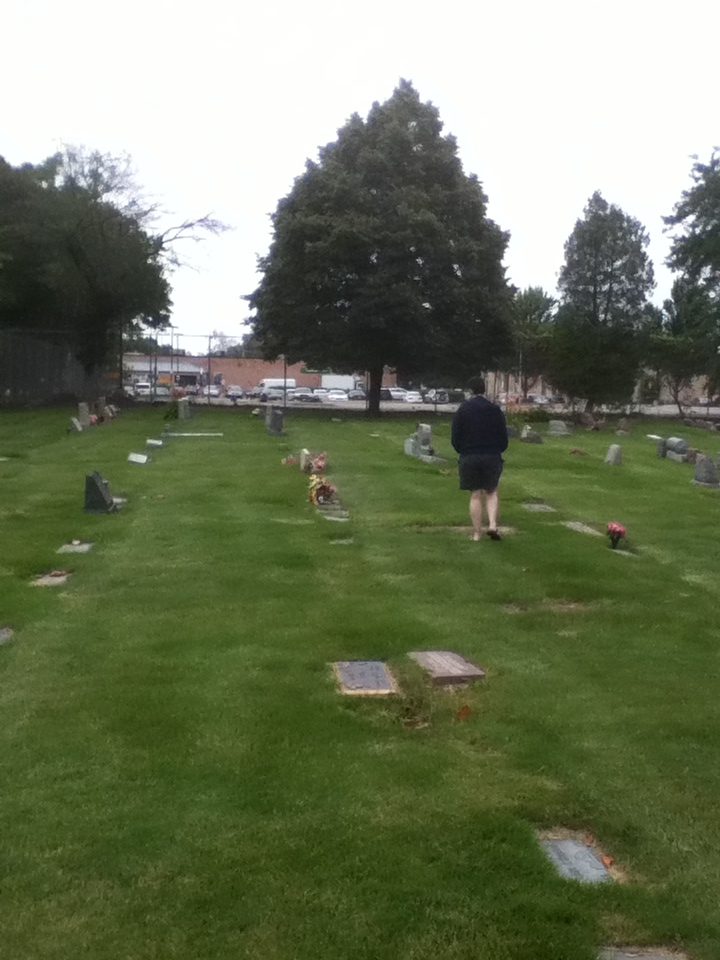
There were a lot of Annas in this part of the cemetery, and a lot of people with variations of the Mickelsen (Mickelson, Michaelsen, Mikkelsen) surname. After fifteen minutes of fruitless searching as it threatened rain, I began to identify strongly with the inhabitants:
 Then, just as I was about to give up hope, Kristi spotted it!
The stone was under a tree, which I had sort-of-not-really remembered from my last visit. It's a peaceful spot:
 Seeing the physical stone brought me a sense of accomplishment as well as a wistful sort of feeling about how much I don't know in terms of family history. I have lost three grandparents and my mother since college, and neither my father's mother nor mine have a concrete place they are buried. Approximately half of my mother's ashes are in a tupperware container on my bookshelves, which works fine for me because I knew her. But what about my grandchildren? Is it better for them to have a bunch of dust or a few square feet of stone? I guess that the loved ones we are missing exist in neither place, but it was still nice to make this pilgrimage to find Anna Mickelsen.
The first thing I had to do after we got there was find out where in the cemetery her stone was located. I had previously visited her grave site at some point in the late 90s with the rest of my family, which resulted in zero useful recollections. My father told me that she died October 22, 1918, and that and her name was the only information I had to give to the cemetery office. The person helping me had some difficulty finding the information, bringing me a few possibilities on 4x6 notecards: an Anna Mickelsen (d. 1929) and an Anna Mickelson. After I politely rejected these, he brought out the big guns, a huge book with a label that read something like "Internments 1911-1921."
 |
| Who says print is dead? |

After some confusion about October vs. December, we found the right page and the right name (pardon the photographer's shadow):

 |
| Kristi proves her devotion to me. |

 |
| Located within twenty feet of the place where we parked the car. |

Tuesday, January 15, 2013
Meditation on Being a Librarian in Public
My road to becoming a librarian was somewhat winding and involved a few false starts, but most days I'm very content with the job I have now. A few recent posts by my friends about egotism and recognition have made me think a bit about why I talk so much about my job online. Why isn't it enough for me just to be a good reference librarian who helps the patrons at my library? I know I'm not in it for the money, but maybe it's for the glory?
My experience as a full-time librarian has coincided with the rise of social media. I joined Twitter in 2007, but it took me a few years to figure out what to do with it. For the past several years, however, my goal with Twitter and other forms of social media has been to relate what it is that I do every day as a librarian. Yes, I use Twitter as a way to meet other librarians of all kinds and to have my burning collection development questions answered, but what I want to be known for is the "slice of life" posts that I make. This is the same reason I participate in Library Day in the Life and other similar projects--I want to be known as a librarian, and I want people to understand what librarians actually do. That's why I put library-related updates on Facebook; update on Tumblr; write here and co-write a blog on collection development, and spend a good chunk of every day broadcasting my life at work. When interacting with librarians, this can lead to cathartic commiseration, but many of my posts seem to strike a chord with my non-librarian contacts as well.
There are never-ending debates about the future of libraries, the future of books, and the future of librarianship. How do we make ourselves relevant? How do we "reinvent" ourselves? Should we go completely paperless? (No.) But libraries and librarians are doing awesome things with their collections and programming every day. The greatest barrier to the future of libraries, in my opinion, is the fact that many of our patrons have no idea what we are already doing. I can't tell you how many times I've had someone say to me "I didn't know I could do that here!," which is unfortunately often coupled with "I haven't been to the library in forever" . . . Even though we should definitely be aware of the next big thing, we also need to do a better job of marketing the resources that we've already got, and have always had: books (in whatever format) and programming. Experienced librarians with reader's advisory skills. Awesome children's librarians, who often see more kids and families in a day than I see in a week.
When it comes down to ego, yes, I admit to having one. I want people to pay attention to my work. And I'm not perfect, either. Some of the posts I make may tend toward the snarky, but I hope that some love for my patrons shines through. I hope it's clear that if I had to choose between presenting at ALA and helping someone learn how to cut and paste, I would choose the latter every time. I'm happy to be known as a librarian by people I went to high school with, people I interact with on twitter who are not in the field, and people I meet on the street who ask me how late the library is open. Many of my patrons don't have computers and can't afford a device that would allow them to read ebooks. They're looking for jobs. They want something to read or watch for education and entertainment. They don't care about the next best thing, they just want us to be open as many hours as we can. I don't give a damn if I'm famous in the field if I can help someone with their résumé.
Last week, a non-librarian that I interact with occasionally on Twitter sent me a direct message to ask if I could look something up for her that she'd had no luck finding herself online. We don't talk much, but she knows I'm a librarian. This is what being a librarian in public should be--helping people understand that the library is a resource waiting for them to make use of it. Reminding people that libraries still exist, and that they're pretty damn cool. That's why I'm going to keep tweeting from the trenches, and appreciating people who do the same. As far as I'm concerned, they're the real rock star librarians.
@helgagrace
Patron Debris
Collection Reflection
Meditation Index
My experience as a full-time librarian has coincided with the rise of social media. I joined Twitter in 2007, but it took me a few years to figure out what to do with it. For the past several years, however, my goal with Twitter and other forms of social media has been to relate what it is that I do every day as a librarian. Yes, I use Twitter as a way to meet other librarians of all kinds and to have my burning collection development questions answered, but what I want to be known for is the "slice of life" posts that I make. This is the same reason I participate in Library Day in the Life and other similar projects--I want to be known as a librarian, and I want people to understand what librarians actually do. That's why I put library-related updates on Facebook; update on Tumblr; write here and co-write a blog on collection development, and spend a good chunk of every day broadcasting my life at work. When interacting with librarians, this can lead to cathartic commiseration, but many of my posts seem to strike a chord with my non-librarian contacts as well.
There are never-ending debates about the future of libraries, the future of books, and the future of librarianship. How do we make ourselves relevant? How do we "reinvent" ourselves? Should we go completely paperless? (No.) But libraries and librarians are doing awesome things with their collections and programming every day. The greatest barrier to the future of libraries, in my opinion, is the fact that many of our patrons have no idea what we are already doing. I can't tell you how many times I've had someone say to me "I didn't know I could do that here!," which is unfortunately often coupled with "I haven't been to the library in forever" . . . Even though we should definitely be aware of the next big thing, we also need to do a better job of marketing the resources that we've already got, and have always had: books (in whatever format) and programming. Experienced librarians with reader's advisory skills. Awesome children's librarians, who often see more kids and families in a day than I see in a week.
When it comes down to ego, yes, I admit to having one. I want people to pay attention to my work. And I'm not perfect, either. Some of the posts I make may tend toward the snarky, but I hope that some love for my patrons shines through. I hope it's clear that if I had to choose between presenting at ALA and helping someone learn how to cut and paste, I would choose the latter every time. I'm happy to be known as a librarian by people I went to high school with, people I interact with on twitter who are not in the field, and people I meet on the street who ask me how late the library is open. Many of my patrons don't have computers and can't afford a device that would allow them to read ebooks. They're looking for jobs. They want something to read or watch for education and entertainment. They don't care about the next best thing, they just want us to be open as many hours as we can. I don't give a damn if I'm famous in the field if I can help someone with their résumé.
Last week, a non-librarian that I interact with occasionally on Twitter sent me a direct message to ask if I could look something up for her that she'd had no luck finding herself online. We don't talk much, but she knows I'm a librarian. This is what being a librarian in public should be--helping people understand that the library is a resource waiting for them to make use of it. Reminding people that libraries still exist, and that they're pretty damn cool. That's why I'm going to keep tweeting from the trenches, and appreciating people who do the same. As far as I'm concerned, they're the real rock star librarians.
@helgagrace
Patron Debris
Collection Reflection
Meditation Index
Wednesday, January 2, 2013
Meditation on my 2012 Year in Reading
This year, I challenged myself to read 100 books (since I easily exceeded last year's goal of 50), and--to my surprise--met that goal by the end of November. My other goal was to read as much nonfiction as fiction, which . . . emphatically did not happen, although I did read five times more than last year, thanks to my participation in an ALA panel on nonfiction readalikes. On to the stats!
Read: 117 (including 29 audiobooks and 10 ebooks), almost twice as many as 2011. Goodreads says this is almost 40,000 pages. Interesting.
Romance of the non-lesbian variety: 25
Nonfiction: 20
Lesbian romance: 21
Fantasy: 16
Young Adult: 13 (7 LGBT, 4 historical, 1 paranormal, 1 contemporary)
Science Fiction: 10
Mystery/Suspense: 4
Historical Fiction: 1
General Fiction ("literary" or otherwise): 3
Manga/Graphic Novels: 2
Picture books read to my son: ∞
Difficult to categorize: The Rook, Timeless
The number of ebooks I read this year held steady, and the increase in the number of audiobooks is largely due to the fact that my library consortium has all of Lois McMaster Bujold's books available for download in audio format. I read 14 of her works in 2012, and many of those I devoured in both audio and print, whichever was most convenient at the time. She alone was responsible for more than 10% of my reading for the year. Henceforth it shall be known as the Year of Lois.
I really stepped up my romance consumption this year; lesbian romances, historical romances, and contemporary sports romances accounted for almost 40% of my total. I was pleased to discover several new (to me) authors, including Sherry Thomas and Cecilia Grant, who will be on my TBR list in the future. I also took several hints and read some Jennifer Crusie books, which was a great idea.
I read several books, such as the Fifty Shades trilogy and Gone Girl, simply because they were "buzz" books and I wanted to get a handle on them for myself and my patrons. I probably would have gotten around to them eventually, but in this case the publicity nudged me into reading them in 2012. For a full list of books I read in 2012, visit my Goodreads page. I continued my trend of not writing long reviews--in favor of reading more--but I did rate and review things there.
As for 2013, I am embarking on a project in which I randomly select books off of my To Be Read list. I am going to make a few exceptions for books that are already on my holds list (such as A Memory of Light, which I have essentially been waiting for since the early 90s), but my overall goal is to broaden my horizons. My list is now stocked with more than 350 books that have cluttered up my list for many years, been recommended to me, or looked interesting when I was ordering books for the library. Let the randomization begin!
My favorite reads of the year:
Historical Fiction: The Game of Kings, Dorothy Dunnett
General Awesomeness: The Rook, Daniel O'Malley
Fantasy: Paladin of Souls, Lois McMaster Bujold
Lesbian Romance: Jericho, Ann McMan (featuring a lesbian librarian!)
Romance: Bet Me, Jennifer Crusie
YA: The Miseducation of Cameron Post, emily m. danforth & Unspoken, Sarah Rees Brennan
What were your favorites?
Meditation on my 2011 Year in Reading (62 books)
Meditation on my 2010 Year in Reading (51 books)
Meditation Index
Read: 117 (including 29 audiobooks and 10 ebooks), almost twice as many as 2011. Goodreads says this is almost 40,000 pages. Interesting.
Romance of the non-lesbian variety: 25
Nonfiction: 20
Lesbian romance: 21
Fantasy: 16
Young Adult: 13 (7 LGBT, 4 historical, 1 paranormal, 1 contemporary)
Science Fiction: 10
Mystery/Suspense: 4
Historical Fiction: 1
General Fiction ("literary" or otherwise): 3
Manga/Graphic Novels: 2
Picture books read to my son: ∞
Difficult to categorize: The Rook, Timeless
The number of ebooks I read this year held steady, and the increase in the number of audiobooks is largely due to the fact that my library consortium has all of Lois McMaster Bujold's books available for download in audio format. I read 14 of her works in 2012, and many of those I devoured in both audio and print, whichever was most convenient at the time. She alone was responsible for more than 10% of my reading for the year. Henceforth it shall be known as the Year of Lois.
I really stepped up my romance consumption this year; lesbian romances, historical romances, and contemporary sports romances accounted for almost 40% of my total. I was pleased to discover several new (to me) authors, including Sherry Thomas and Cecilia Grant, who will be on my TBR list in the future. I also took several hints and read some Jennifer Crusie books, which was a great idea.
I read several books, such as the Fifty Shades trilogy and Gone Girl, simply because they were "buzz" books and I wanted to get a handle on them for myself and my patrons. I probably would have gotten around to them eventually, but in this case the publicity nudged me into reading them in 2012. For a full list of books I read in 2012, visit my Goodreads page. I continued my trend of not writing long reviews--in favor of reading more--but I did rate and review things there.
As for 2013, I am embarking on a project in which I randomly select books off of my To Be Read list. I am going to make a few exceptions for books that are already on my holds list (such as A Memory of Light, which I have essentially been waiting for since the early 90s), but my overall goal is to broaden my horizons. My list is now stocked with more than 350 books that have cluttered up my list for many years, been recommended to me, or looked interesting when I was ordering books for the library. Let the randomization begin!
My favorite reads of the year:
Historical Fiction: The Game of Kings, Dorothy Dunnett
General Awesomeness: The Rook, Daniel O'Malley
Fantasy: Paladin of Souls, Lois McMaster Bujold
Lesbian Romance: Jericho, Ann McMan (featuring a lesbian librarian!)
Romance: Bet Me, Jennifer Crusie
YA: The Miseducation of Cameron Post, emily m. danforth & Unspoken, Sarah Rees Brennan
What were your favorites?
Meditation on my 2011 Year in Reading (62 books)
Meditation on my 2010 Year in Reading (51 books)
Meditation Index
Tuesday, December 11, 2012
Meditation on 2011-2012 Romance Novel Titles
It has been far too long since I've gazed deeply into the heaving bosom of romance novel titles, as I did in these previous posts.
I'm about half a year behind schedule, in fact. The good news: this means I
have TWO sets of Romantic Times award
nominees to draw from (2011 and 2012), in addition to the Romance
Writers of America 2012 RITA and Golden
Heart awards list. The bad news is that this means I really can't compare
this crop of titles to previous years. However, this project is based on my
whims rather than any real degree of statistical accuracy. Onward!
Methodology: I copied and pasted all the titles of romance novels into an Excel spreadsheet, de-duplicated, and searched on various keyword stems based on my previous findings and anything else that struck me as relevant while I skimmed the list. That process looks like this:

There are 677 award-nominated titles on my list (some of which are short works rather than novels), and these are my favorites (links go to covers and descriptions):
A Misplaced Cowboy, like a comma, can end up where he shouldn't be.
What an Earl Wants is responsible for an insidious earworm every time it appears.
When You Give a Duke a Diamond, which I always imagine as part of this series.
Lady Doctor Wyre is the first in the Jane Austen Space Opera series. Think on that a moment.
Best Puns: Bathtub Jinn and The Sexorcist
Head:Desk: Daring to Date the Boss and Sheikh Surgeon Claims His Bride
WTF: Reclaiming His Pregnant Widow and Cat on a Hot Steel Flight Deck
Continuing Trends:
Nobility: As usual, being of noble birth is an excellent way to get yourself into a romance novel. Dukes were the clear winner last time, but this time they were supplanted by Ladies, who featured in 16 titles [followed by Duke and Lord, each with 11, Earl: 6, Heiress and Prince: 5, King: 4, and a variety of stragglers with two or three titles]. As for Sheikhs, there were three (plus one harem). Overall, more than 10% of all the nominated titles featured a mention of one or more nobles.
Scots: After a somewhat disappointing showing last year, the highlanders were back in force! Ten titles had "Highlander" in them. In addition, there were six "Scot" titles, one "Laird," and one "Kilt."
Punctuation: I can't help it, it's my favorite trend. This year, there were seven colons (Rancher's Twins: Mom Needed); five dashes, one question mark (Not Fit for a King?), and one ampersand.
Professions of Love:
I also scanned the titles to see what people's jobs were (beyond being noble). Mostly it's the men that get actual jobs, usually in some kind of protective capacity. There were the usual cowboys (7), soldiers (7), and warriors (5), as well as assorted rangers, ranchers, mavericks, and so on. Interestingly, there was one mention of a homesteader and one of a farmer. Some of the women allowed to have professions were three governesses and one nanny, most likely so that they could be seduced against their will from their subservient positions (Seducing the Governess). However, there was also one cowgirl and one lady doctor, so perhaps there's hope after all.
Rogues (7), rakes (1), renegades(2), rebels (3), and scoundrels (2) continued to be popular, although perhaps the low number is some indication that "rake," with its negative connotation, may be falling out of favor?
Notable:
Most notably, the economic downturn seems to have finally penetrated the world of the romance novel, as there was no mention of millionaires, billionaires, tycoons, or magnates. There was also only one "Boss" title.
I definitely spotted a "how to" trend among the titles I scanned. Some novels gave contradictory advice, such as How to Seduce a Rogue and Never Seduce a Rogue, but the advisory urge was strong. There were six titles that begin with "How To," two "Guides" and one featuring "Rules," as well as three "Lessons." By picking up one of these books, you could learn:
How to Bake a Perfect Life
How to Dance with a Duke
How to Flirt with a Naked Werewolf
How to Marry a Duke
How to Seduce a Scoundrel
How to Woo a Reluctant Lady
Gender and Power Divides:
Breaking the titles down along gender lines required a little chart-making:

Almost all categories are dominated by the female-identified descriptor, which is . . . completely unsurprising.
I also wanted to talk a little about the language being used, which implies some value judgments. Love, it seems, is usually a scandalous enterprise:

These sin-ful titles make up almost 8% of the total. Many of them are likely historical romances, but I wanted to include them before this chart:

Mixed in with generic words such as "love" and "desire" are some that suggest lack of control and powerlessness. Generally, a loss of agency is exemplified by boss romances, but is also a prominent feature of many other romance subgenres. Combined with the previous chart, we can see a focus on surrendering, possibly against your will, to a scandalous desire. Again, not surprising.
Miscellaneous:
Based on my findings, the most popular trends across all subcategories (occupations, atmospheric, descriptive, etc.) are:

Therefore, my suggested can't-miss titles for 2013, according to my crystal ball algorithm (drumroll):
Bride of Scandal, Lady of the Secret Dark
Seducing the Scandalous Lady by Nightfall: Her Secret Bride's Lover (this plot is super complicated)
If you're an author, these titles are free for the taking. Strike while the iron is hot! Feel free to leave your own suggestions in the comments.
Meditation Index
Methodology: I copied and pasted all the titles of romance novels into an Excel spreadsheet, de-duplicated, and searched on various keyword stems based on my previous findings and anything else that struck me as relevant while I skimmed the list. That process looks like this:

There are 677 award-nominated titles on my list (some of which are short works rather than novels), and these are my favorites (links go to covers and descriptions):
A Misplaced Cowboy, like a comma, can end up where he shouldn't be.
What an Earl Wants is responsible for an insidious earworm every time it appears.
When You Give a Duke a Diamond, which I always imagine as part of this series.
Lady Doctor Wyre is the first in the Jane Austen Space Opera series. Think on that a moment.
Best Puns: Bathtub Jinn and The Sexorcist
Head:Desk: Daring to Date the Boss and Sheikh Surgeon Claims His Bride
WTF: Reclaiming His Pregnant Widow and Cat on a Hot Steel Flight Deck
Continuing Trends:
Nobility: As usual, being of noble birth is an excellent way to get yourself into a romance novel. Dukes were the clear winner last time, but this time they were supplanted by Ladies, who featured in 16 titles [followed by Duke and Lord, each with 11, Earl: 6, Heiress and Prince: 5, King: 4, and a variety of stragglers with two or three titles]. As for Sheikhs, there were three (plus one harem). Overall, more than 10% of all the nominated titles featured a mention of one or more nobles.
Scots: After a somewhat disappointing showing last year, the highlanders were back in force! Ten titles had "Highlander" in them. In addition, there were six "Scot" titles, one "Laird," and one "Kilt."
Punctuation: I can't help it, it's my favorite trend. This year, there were seven colons (Rancher's Twins: Mom Needed); five dashes, one question mark (Not Fit for a King?), and one ampersand.
Professions of Love:
I also scanned the titles to see what people's jobs were (beyond being noble). Mostly it's the men that get actual jobs, usually in some kind of protective capacity. There were the usual cowboys (7), soldiers (7), and warriors (5), as well as assorted rangers, ranchers, mavericks, and so on. Interestingly, there was one mention of a homesteader and one of a farmer. Some of the women allowed to have professions were three governesses and one nanny, most likely so that they could be seduced against their will from their subservient positions (Seducing the Governess). However, there was also one cowgirl and one lady doctor, so perhaps there's hope after all.
Rogues (7), rakes (1), renegades(2), rebels (3), and scoundrels (2) continued to be popular, although perhaps the low number is some indication that "rake," with its negative connotation, may be falling out of favor?
Notable:
Most notably, the economic downturn seems to have finally penetrated the world of the romance novel, as there was no mention of millionaires, billionaires, tycoons, or magnates. There was also only one "Boss" title.
I definitely spotted a "how to" trend among the titles I scanned. Some novels gave contradictory advice, such as How to Seduce a Rogue and Never Seduce a Rogue, but the advisory urge was strong. There were six titles that begin with "How To," two "Guides" and one featuring "Rules," as well as three "Lessons." By picking up one of these books, you could learn:
How to Bake a Perfect Life
How to Dance with a Duke
How to Flirt with a Naked Werewolf
How to Marry a Duke
How to Seduce a Scoundrel
How to Woo a Reluctant Lady
Gender and Power Divides:
Breaking the titles down along gender lines required a little chart-making:

Almost all categories are dominated by the female-identified descriptor, which is . . . completely unsurprising.
I also wanted to talk a little about the language being used, which implies some value judgments. Love, it seems, is usually a scandalous enterprise:

These sin-ful titles make up almost 8% of the total. Many of them are likely historical romances, but I wanted to include them before this chart:

Mixed in with generic words such as "love" and "desire" are some that suggest lack of control and powerlessness. Generally, a loss of agency is exemplified by boss romances, but is also a prominent feature of many other romance subgenres. Combined with the previous chart, we can see a focus on surrendering, possibly against your will, to a scandalous desire. Again, not surprising.
Miscellaneous:
- Werewolves and vampires seem to be trending downward, with only three mentions of each (in addition to a "Wolf" and an "Alpha," giving the werewolves a dubious victory).
- There were six mentions of angels and archangels and six mentions of devils or "devilish," which is likely an adjective rather than a demonic protagonist.
- There were 11 mentions of homes, houses, and homecomings.
- The sea and sea-related things, which seemed to be trending last year, only made it to four titles.
- There were only 9 Christmas titles listed, plus two mistletoe titles and one Valentine's Day title.
- Unsurprisingly, titles were much more likely to feature dark* (17) than light (1) or sun (2), with various iterations: moonlight (4), starlight (1), twilight (2), midnight (5), and of course night/nightfall (13). Things were also hotter (10) than they were cold (2).
- There was also a certain amount of blood (7) and death (10). Romance can be hard.
Based on my findings, the most popular trends across all subcategories (occupations, atmospheric, descriptive, etc.) are:

Therefore, my suggested can't-miss titles for 2013, according to my crystal ball algorithm (drumroll):
Bride of Scandal, Lady of the Secret Dark
Seducing the Scandalous Lady by Nightfall: Her Secret Bride's Lover (this plot is super complicated)
If you're an author, these titles are free for the taking. Strike while the iron is hot! Feel free to leave your own suggestions in the comments.
Meditation Index
Tuesday, July 10, 2012
Meditation on My Ideal Book Format
It would be an unusual day if I didn't encounter a new article on ebooks, format wars, or a dire warning about the death of libraries, publishing, and print. As I've written here before, I prefer to read books on paper, but I do move around a lot and I want to be able to read everywhere all the time (yes, even the bathroom) so that I can squeeze as many books as possible into my life. I have been envisioning a comprehensive package that would allow me the tactile experience I love about print books, but also enable me to listen to same book in the car or read the ebook version in line at the grocery store, even if I haven't planned ahead to borrow the same book in three formats at the same time.
My first concept would probably be a nightmare to manufacture and would no doubt be immediately obsolete, but it made me giggle:
I have been idly contemplating this for a while, but what brought me back to it was a news item that Angry Robot will be giving away ebook versions of their items--at select stores--when customers purchase the print version. Why is this option not automatically made available for all newly published books? With both audio and electronic versions accessible (when they've been created) at the click of a button, having some kind of tiered pricing/package system for consumers like me should not be impossible.[1]
My pipe dream:
For a new hardback title, I would be happy to pay from $15-20 for the "base" book, which would be whatever edition I purchase first, whether print or electronic or audio. Let's say I bought a print version of Lois McMaster Bujold's upcoming book Captain Vorpatril's Alliance (hardback list price: $25.00), preordering it as I usually do through my local independent bookseller. On the eve of publication, I become so overwhelmed by desire to read the book that I pay an additional $5-$7 on top of the list price for the ebook version to be delivered immediately. I have to sleep sometime, though, and I don't finish the book before it's time to drive to work in the morning. I don't want to stop reading or call in sick, so I purchase the audio version for an additional $5-$7 on top of what I've already invested. I'm happy that I'll be picking up the print version, because I know this is a book I want to keep and re-read, but I'm willing to pay $10+ for a short-lived (format-wise) electronic and audio experience. I think it's pretty clear that my child will not be inheriting my ebooks.
Unlike a library, I don't have the money to spend on the print book and the ebook and the audiobook if they are all packaged and priced separately (around $75.00 minimum). Nor do I think that I should have to; they are the same intellectual property and the shelf-life of anything electronic is questionable at best. However, I do understand that artists should be compensated for their work, and I know that ebooks and audiobooks come with their own associated production costs. I am willing to contribute money to offset those costs and indicate that they are valuable to me.
In my vision, any of the three versions could serve as the "base" version . . . if I buy the audiobook at $15-20 and subsequently decide that I really want the print version as well, I should be able to "add it on" through my local bookstore or the publisher for a fractional cost.
I realize that I may a bit of an oddball, because I will not be buying anything from Amazon or a large retailer at a deep discount; I pretty much always pay list price unless I find something used. But I am very willing to pay that price to support both my favorite authors and local businesses, especially if I could have the format flexibility that would fit my peripatetic lifestyle. In the meantime, I'm happy patronizing the library and buying books that I've already read.
Am I completely insane? Obviously, the numbers would have to be adjusted for mass market books. I would love to have a discussion about this.
Meditation Index
[1] Entitled, internet-having, and willing to spend a chunk of cash on books.
My first concept would probably be a nightmare to manufacture and would no doubt be immediately obsolete, but it made me giggle:
 |
| Drawn when I still had a car with a stick shift. |
My pipe dream:
For a new hardback title, I would be happy to pay from $15-20 for the "base" book, which would be whatever edition I purchase first, whether print or electronic or audio. Let's say I bought a print version of Lois McMaster Bujold's upcoming book Captain Vorpatril's Alliance (hardback list price: $25.00), preordering it as I usually do through my local independent bookseller. On the eve of publication, I become so overwhelmed by desire to read the book that I pay an additional $5-$7 on top of the list price for the ebook version to be delivered immediately. I have to sleep sometime, though, and I don't finish the book before it's time to drive to work in the morning. I don't want to stop reading or call in sick, so I purchase the audio version for an additional $5-$7 on top of what I've already invested. I'm happy that I'll be picking up the print version, because I know this is a book I want to keep and re-read, but I'm willing to pay $10+ for a short-lived (format-wise) electronic and audio experience. I think it's pretty clear that my child will not be inheriting my ebooks.
Unlike a library, I don't have the money to spend on the print book and the ebook and the audiobook if they are all packaged and priced separately (around $75.00 minimum). Nor do I think that I should have to; they are the same intellectual property and the shelf-life of anything electronic is questionable at best. However, I do understand that artists should be compensated for their work, and I know that ebooks and audiobooks come with their own associated production costs. I am willing to contribute money to offset those costs and indicate that they are valuable to me.
In my vision, any of the three versions could serve as the "base" version . . . if I buy the audiobook at $15-20 and subsequently decide that I really want the print version as well, I should be able to "add it on" through my local bookstore or the publisher for a fractional cost.
I realize that I may a bit of an oddball, because I will not be buying anything from Amazon or a large retailer at a deep discount; I pretty much always pay list price unless I find something used. But I am very willing to pay that price to support both my favorite authors and local businesses, especially if I could have the format flexibility that would fit my peripatetic lifestyle. In the meantime, I'm happy patronizing the library and buying books that I've already read.
Am I completely insane? Obviously, the numbers would have to be adjusted for mass market books. I would love to have a discussion about this.
Meditation Index
[1] Entitled, internet-having, and willing to spend a chunk of cash on books.
Thursday, July 5, 2012
Meditation on Reading Deadlines
I recently participated in a panel at the American Library Association conference which required me to read (or at least familiarize myself with) a large chunk of nonfiction books by a certain deadline. I am not a very good skimmer--I tend to get caught up in reading from wherever my eyes land--and I'm not a very fast reader, either. I knew I had to buckle down. What I discovered when faced with this hard deadline was amazing diversity in my procrastination methods.
With a large pile of sports books to read (most of which I actually wanted to read), I:
With a large pile of sports books to read (most of which I actually wanted to read), I:
- Perused the new fiction section at work
- Perused the romance section at work
- Perused the science fiction and fantasy section at work
- Requested books I knew I didn't have time to read through interlibrary loan
- Requested audiobooks, which I thought I could justify a little more easily, through interlibrary loan--even though I had a pile of sports audiobooks as well
- Eyed the books on my shelves at home and contemplated re-reading, which I haven't allowed myself to do for several years
- Started at least five non-assigned nonfiction books that looked interesting
- Started and finished several romance novels
- Started and finished Fifty Shades of Grey
- Checked Twitter
- Checked Google Reader
- Checked Facebook
- Checked Twitter again (x100)
- Reorganized my To Be Read list
Many times I wouldn't even consciously realize I was procrastinating until another day had passed and the pile of unread books remained at the same daunting height. It would simply "slip my mind" that I had a lot of reading to do, given the weight of important tasks such as laundry. I spent more than twenty years of my life in school. I remember being able to do my homework in a timely manner. No more.
I guess I also remember working on projects the night before they were due, as a matter of course.
Should I just declare myself incapable of reading things "on time"? Please don't put me on an awards committee (I blanched when they described the rigorous selection process at the Carnegie medal award ceremony) unless I have an entire year to read fewer than fifty books. My habits of reading slowly and reading ten things at once is one reason that I don't seek out a lot of advanced copies of books; by the time I get around to actually reading them, the book has been published and any buzz has long since dissipated. However, I do actually get around to reading books that have been recommended to me, even if it takes two, three, or even more years.
I guess I also remember working on projects the night before they were due, as a matter of course.
Should I just declare myself incapable of reading things "on time"? Please don't put me on an awards committee (I blanched when they described the rigorous selection process at the Carnegie medal award ceremony) unless I have an entire year to read fewer than fifty books. My habits of reading slowly and reading ten things at once is one reason that I don't seek out a lot of advanced copies of books; by the time I get around to actually reading them, the book has been published and any buzz has long since dissipated. However, I do actually get around to reading books that have been recommended to me, even if it takes two, three, or even more years.
I am happy to report that I did eventually get all the required reading done for my panel, so maybe I'm not completely hopeless. How did I manage it? By creatively procrastinating until the pressure was intense enough to spur me into action. This graphic seems appropriate: I've done a lot of perseveering and persavowing during the last few months. It's good to know that I can do it, even if I always take the long way around.
Meditation Index
Meditation Index
Saturday, April 28, 2012
Meditation on the Joys of Reading Alone (Together)
Book Riot recently published a post called "What I Hate About Being a Reader," in which item four was "Reading Alone":
It is possible, perhaps even desirable, to read quietly to yourself in a room in which other people are reading, and to feel like you are spending quality time with those people.
That's right, I am talking about reading as a social activity. Imagine spending a few hours at a friend's house, reading on comfortable furniture and occasionally going for more snacks. One friend chuckles as she hits a particularly delectable passage. Another is completely absorbed in her book, which she is reading on her e-reader. A third has finished his book and moved on to one of his backups. The predominating sounds are pages turning and cats purring (it's my fantasy, so there are cats).
After some time has passed, reading time may end in favor of games and conversation. For some people, it may not end until they prepare to go home. Far be it from me to interrupt someone who is nearing the end of their book. At some point, the readers may wish to discuss books in a spoiler-free manner. This kind of gathering--a shortened version of which could be held at a local coffee shop--would counter both kinds of isolation described above. Not only does it provide a built-in discussion group, but when you see friends reading (and enjoying) books, it acts as a forum for recommendation.
At my library, one of my co-workers hosts a book discussion group in which she previews upcoming titles and each member comes prepared to talk about the books they've been reading. A "book discussion" doesn't necessarily mean that all present have read the same book. At many of the personal book club meetings I've attended, there are usually several people who haven't read or finished the assigned book, which somewhat defeats the purpose of meeting to discuss it. Why not have a gathering in which everyone gets to read what they want to read, and discuss it if they feel like talking about it?
Suggested guidelines for social reading (conceived with assistance from friends on Twitter):
Meditation Index
Reading can be doubly isolating. First, it is inherently a solitary practice. But there is also the secondary isolation that comes from reading’s cultural marginalization: the difficulty of finding people who not only read as you do, but read what you do. I think most serious readers have a desire to discuss what they’ve read with others, but those others can be so hard to find. The internet has been a boon for this, but I think we also know that online discussion doesn’t compare to in-person discussion.I would like to make a case for social reading. A lot of people seem to view picking up a book in a social context as exclusionary, or even rude. Beyond the simple remedy of reading aloud, or listening to an audiobook as a group, reading can also be a social activity. Here is the radical premise:
It is possible, perhaps even desirable, to read quietly to yourself in a room in which other people are reading, and to feel like you are spending quality time with those people.
That's right, I am talking about reading as a social activity. Imagine spending a few hours at a friend's house, reading on comfortable furniture and occasionally going for more snacks. One friend chuckles as she hits a particularly delectable passage. Another is completely absorbed in her book, which she is reading on her e-reader. A third has finished his book and moved on to one of his backups. The predominating sounds are pages turning and cats purring (it's my fantasy, so there are cats).
After some time has passed, reading time may end in favor of games and conversation. For some people, it may not end until they prepare to go home. Far be it from me to interrupt someone who is nearing the end of their book. At some point, the readers may wish to discuss books in a spoiler-free manner. This kind of gathering--a shortened version of which could be held at a local coffee shop--would counter both kinds of isolation described above. Not only does it provide a built-in discussion group, but when you see friends reading (and enjoying) books, it acts as a forum for recommendation.
At my library, one of my co-workers hosts a book discussion group in which she previews upcoming titles and each member comes prepared to talk about the books they've been reading. A "book discussion" doesn't necessarily mean that all present have read the same book. At many of the personal book club meetings I've attended, there are usually several people who haven't read or finished the assigned book, which somewhat defeats the purpose of meeting to discuss it. Why not have a gathering in which everyone gets to read what they want to read, and discuss it if they feel like talking about it?
Suggested guidelines for social reading (conceived with assistance from friends on Twitter):
- Limit reading aloud, even if the passages are the best ever. Mark them to share later.
- Avoid talking. Most people like to read in relative quiet.
- No spoilers during discussion time.
- Bring a backup book or three.
- Turn off the wireless capability.
Meditation Index
Tuesday, April 17, 2012
Clutching the Obsolete: A Meditation On The Stick Shift
I recently purchased a new (to me) car. It was definitely time--my old car, a 1998 Honda Civic, had finally reached the point where the cost to repair its many problems far outweighed its actual value. With the assistance of my girlfriend, I auditioned new cars and found one that seemed like an acceptable replacement. In many ways the new car is a huge upgrade over my previous car. First and foremost, it has air conditioning. It has power windows and locks! It's a hybrid! It's also a Honda Civic! It doesn't have over 200,000 miles! You can't pick off rusty pieces from its side in an idle moment! It has a USB port! It has a trunk that actually stays closed! However...
However.
It's an automatic. I've never had a car that was my car that didn't have a standard transmission. My mother taught me to drive stick on our family's Honda Civic (sensing a trend yet?) station wagon, which was a tearful and sometimes frustrating process for both of us, but ultimately I mastered the ability to shift. Sure, I went to Driver's Ed as well, but I really learned to drive when I was in that car with my mom. Once you've stalled in the middle of a busy intersection and can't get going again, or in the middle of a large hill--unable to continue, but afraid to roll back--it all comes together fairly quickly. It takes longer for the remembered panic to fade, however. I never quite pushed the envelope the way that she did, whipping around corners in third gear, but I relished the control over my cars that shifting seemed to impart.
I discovered after leaving home that driving a stick was not really a . . . standard skill to have, especially as a woman. Demand for manual transmissions is down, as are the numbers of people who know how to drive them. Most new cars aren't even made with manual transmissions, and fewer than 7% of cars sold are standards. When I was making my car purchase, I actually did make a conscious choice between a manual Honda Fit and an automatic Civic. I went with the automatic for a lot of reasons that continue to make sense. But a certain portion of me--personified while I'm driving by my restless, useless left foot--regrets the choice.
While I'm enjoying my new automatic, I also miss that tie to my mother, especially my ability to pass on the knowledge to the next generation. My toddler and I used to sit in my old car and roll the windows up and down, push and pull the locks, and play with the gear shift. These are things that will soon be as obsolete as dialing a rotary telephone or owning VHS tapes. Even though I knew I was going to have to buy a new car in the next thirteen or fourteen years, I had a romantic notion of teaching my son to drive a stick shift. Obsolete skills, like DNA, have a strong urge for self-perpetuation. A small voice argues that it might be useful someday, wherever his life eventually takes him.
Aside from the opportunity for parental instruction, I regret the fact that I am no longer a part of the club of stick shift drivers, even though my exit was voluntary. I've always loved coming to a stop on a hill and keeping perfect balance between my clutch and gas, standing still without needing a brake. I loved listening to my car and figuring out the perfect time to change gears. When I graduated from college, I got a car from my family. It was a four-speed Honda Civic (surprise!), and I adored it and promptly drove it across the country and back again. Using my car, I taught (or tried to teach) several people to drive a stick. I relish the idea that I can drive pretty much any car that's parked in front of me, once I have the keys in hand. It feels independent. I miss the feeling of control, the nuance, the fact that you are forced to pay attention to the car and not the phone or the drink.
Luckily, I have a plan. In fourteen years, I will go to Europe. I can teach my son to drive a standard and sight-see at the same time. My mother would definitely approve.
Further Reading:
Check the Manual (Transmission): Stick Shift Cars Going Away
Death to the Stick Shift (ouch)
Parents Hope Stick Shifts Will Keep Kids Minds on Driving (ah, local news)
Meditation Index
However.
It's an automatic. I've never had a car that was my car that didn't have a standard transmission. My mother taught me to drive stick on our family's Honda Civic (sensing a trend yet?) station wagon, which was a tearful and sometimes frustrating process for both of us, but ultimately I mastered the ability to shift. Sure, I went to Driver's Ed as well, but I really learned to drive when I was in that car with my mom. Once you've stalled in the middle of a busy intersection and can't get going again, or in the middle of a large hill--unable to continue, but afraid to roll back--it all comes together fairly quickly. It takes longer for the remembered panic to fade, however. I never quite pushed the envelope the way that she did, whipping around corners in third gear, but I relished the control over my cars that shifting seemed to impart.
I discovered after leaving home that driving a stick was not really a . . . standard skill to have, especially as a woman. Demand for manual transmissions is down, as are the numbers of people who know how to drive them. Most new cars aren't even made with manual transmissions, and fewer than 7% of cars sold are standards. When I was making my car purchase, I actually did make a conscious choice between a manual Honda Fit and an automatic Civic. I went with the automatic for a lot of reasons that continue to make sense. But a certain portion of me--personified while I'm driving by my restless, useless left foot--regrets the choice.
 |
| Late, lamented |
Aside from the opportunity for parental instruction, I regret the fact that I am no longer a part of the club of stick shift drivers, even though my exit was voluntary. I've always loved coming to a stop on a hill and keeping perfect balance between my clutch and gas, standing still without needing a brake. I loved listening to my car and figuring out the perfect time to change gears. When I graduated from college, I got a car from my family. It was a four-speed Honda Civic (surprise!), and I adored it and promptly drove it across the country and back again. Using my car, I taught (or tried to teach) several people to drive a stick. I relish the idea that I can drive pretty much any car that's parked in front of me, once I have the keys in hand. It feels independent. I miss the feeling of control, the nuance, the fact that you are forced to pay attention to the car and not the phone or the drink.
Luckily, I have a plan. In fourteen years, I will go to Europe. I can teach my son to drive a standard and sight-see at the same time. My mother would definitely approve.
Further Reading:
Check the Manual (Transmission): Stick Shift Cars Going Away
Death to the Stick Shift (ouch)
Parents Hope Stick Shifts Will Keep Kids Minds on Driving (ah, local news)
Meditation Index
Monday, February 6, 2012
A Meditation on Cautionary Sayings
"Liquor before beer, never fear. Beer before liquor, never sicker."
"Red sky at night, sailor's delight. Red sky at morning, sailor's warning."
"Leaves of three, let them be."
Helpful warnings, couched in rhyme. Judging by the search results on Google, that first one is confusing to many people, and an urban legend to boot.
But what about sayings that are relevant to life today? We are not sailors, except on the tides of social media. We do not encounter poison ivy, because we never go outside except to get in our cars to drive somewhere and go inside again. Where are the rhymes for our times?
I've taken it upon myself to come up with some that I hope will catch on like (virtual) wildfire.
First and foremost: "Meet them online, everything's fine. Meet them in person, things may worsen." This, coupled with "Make it funny, you're in the money; if it's lame, you're to blame" should just about cover any social situation you might find yourself in.
More general advice for modern living:
"Aiming for nonagenarian? Go vegetarian!"
"Red as a beet? Don't eat that meat!"
"If it has lime, it's worth your time." (Electric Company, anyone? Anyone?)
"If the zombies are walkin', don't go a-knockin'"
"If he's flashing fang, don't tap that thang."
"Leaves of seventy-one, isn't counting fun?"
"Cat on the lap, prepare to nap. Cat on the floor, OK to adore. Cat on the 'nip, prepare for a trip."
Given five or ten years, I'm pretty sure that these too will be myths that NBC Today Health will be happy to debunk for us.
Additional cautionary sayings encouraged in the comments.
ETA: "Neither a borrower nor a lender be, unless you work at a library."
Meditation Index
"Red sky at night, sailor's delight. Red sky at morning, sailor's warning."
"Leaves of three, let them be."
Helpful warnings, couched in rhyme. Judging by the search results on Google, that first one is confusing to many people, and an urban legend to boot.
But what about sayings that are relevant to life today? We are not sailors, except on the tides of social media. We do not encounter poison ivy, because we never go outside except to get in our cars to drive somewhere and go inside again. Where are the rhymes for our times?
I've taken it upon myself to come up with some that I hope will catch on like (virtual) wildfire.
First and foremost: "Meet them online, everything's fine. Meet them in person, things may worsen." This, coupled with "Make it funny, you're in the money; if it's lame, you're to blame" should just about cover any social situation you might find yourself in.
More general advice for modern living:
"Aiming for nonagenarian? Go vegetarian!"
"Red as a beet? Don't eat that meat!"
"If it has lime, it's worth your time." (Electric Company, anyone? Anyone?)
"If the zombies are walkin', don't go a-knockin'"
"If he's flashing fang, don't tap that thang."
"Leaves of seventy-one, isn't counting fun?"
"Cat on the lap, prepare to nap. Cat on the floor, OK to adore. Cat on the 'nip, prepare for a trip."
Given five or ten years, I'm pretty sure that these too will be myths that NBC Today Health will be happy to debunk for us.
Additional cautionary sayings encouraged in the comments.
ETA: "Neither a borrower nor a lender be, unless you work at a library."
Meditation Index
Tuesday, January 3, 2012
Meditation on My 2011 Year in Reading
It's hard to believe that another year has come to a close, and with so many books on my TBR list still unread! This past year I challenged myself to read 50 books, and I exceeded that goal handily, so obviously I am going to have to up the ante for 2012.* As usual, I did a significant chunk of my reading in audio format. This was the first year that I read a significant number of books--more than one or two--in electronic format. I can't say I prefer reading on a screen, but I appreciate the convenience factor, especially where review copies are concerned. I've been keeping track of books I've read using Goodreads, because I no longer have the time or energy to write reviews here for everything I read. Here is the breakdown:
Read: 62 books + one awful novella (including 19 audiobooks and 10 ebooks)
Lesbian Fiction: 12
Fantasy: 11
Science Fiction: 8
Young Adult: 8
Mystery: 5
Romance of the non-lesbian variety: 5
General Fiction ("literary" or otherwise): 5
Nonfiction: 4
Humor: 2
Manga: 2
Children's: 1
I read fewer Young Adult books this year in my attempt to branch out, and those I did read were generally SF or Fantasy. Some of the books I finished, such as Reamde and A Dance With Dragons, were real doorstops, and I read several SF works that collected 2-3 books in one volume (Goodreads estimates the total page numbers as over 23,000, but of course the audio factor complicates that statistic).
I read many first volumes of a series and failed to read the next installment, even if it had already been published (Wake, The Penderwicks, The Name of the Wind, Acacia, The Red Wolf Conspiracy, Dust, Leviathan). My uptick in lesbian fiction reading was due largely to signing on as a reviewer at the Lesbrary. In that capacity I now have a monthly deadline to read books that I'd probably read at some point anyway. Everyone wins. For a full list of the books I read last year, visit my Goodreads page.
In last year's meditation on my reading year, I claimed that I would read more books that were recommended to me, and that I wanted to participate in the "Women of Science Fiction" online book group. I did in fact read several books that were out the usual way, placing impulse holds on things when I came across a review that particularly appealed to me. The online book group started well but my attention petered out quickly as my priorities wandered. It turns out that I am terrible at reading books on a schedule now that I've been out of school a few years, and the Lesbrary takes up all of my minimal power in that regard. However, I did read Cordelia's Honor as part of that group, which led me to the Vorkosigan universe in which I am still happily enmeshed.
In the coming year, my goal is to read as much nonfiction as I do fiction, not only because reading The Swerve reminded me that I love history (there's a reason I had a History minor to go along with my English major), but because I'm participating in a panel at ALA 2012 entitled "The Great Non-Fiction Readalike: If You Like This, You’ll LOVE That!" I have ideas on what makes for good reader's advisory in nonfiction, of course, but I would like to do a little more personal experimentation as I prepare.
I am looking forward to a year full of books and discussion!
ETA my favorite books of the year:
In the Woods
The Spymaster's Lady
The Long Goodbye
Cotillion
Cordelia's Honor
The Swerve
*Although if I counted the many, many picture books I've read to my son in the past year, I'm sure I'd be in the 200s.
Read: 62 books + one awful novella (including 19 audiobooks and 10 ebooks)
Lesbian Fiction: 12
Fantasy: 11
Science Fiction: 8
Young Adult: 8
Mystery: 5
Romance of the non-lesbian variety: 5
General Fiction ("literary" or otherwise): 5
Nonfiction: 4
Humor: 2
Manga: 2
Children's: 1
I read fewer Young Adult books this year in my attempt to branch out, and those I did read were generally SF or Fantasy. Some of the books I finished, such as Reamde and A Dance With Dragons, were real doorstops, and I read several SF works that collected 2-3 books in one volume (Goodreads estimates the total page numbers as over 23,000, but of course the audio factor complicates that statistic).
I read many first volumes of a series and failed to read the next installment, even if it had already been published (Wake, The Penderwicks, The Name of the Wind, Acacia, The Red Wolf Conspiracy, Dust, Leviathan). My uptick in lesbian fiction reading was due largely to signing on as a reviewer at the Lesbrary. In that capacity I now have a monthly deadline to read books that I'd probably read at some point anyway. Everyone wins. For a full list of the books I read last year, visit my Goodreads page.
In last year's meditation on my reading year, I claimed that I would read more books that were recommended to me, and that I wanted to participate in the "Women of Science Fiction" online book group. I did in fact read several books that were out the usual way, placing impulse holds on things when I came across a review that particularly appealed to me. The online book group started well but my attention petered out quickly as my priorities wandered. It turns out that I am terrible at reading books on a schedule now that I've been out of school a few years, and the Lesbrary takes up all of my minimal power in that regard. However, I did read Cordelia's Honor as part of that group, which led me to the Vorkosigan universe in which I am still happily enmeshed.
In the coming year, my goal is to read as much nonfiction as I do fiction, not only because reading The Swerve reminded me that I love history (there's a reason I had a History minor to go along with my English major), but because I'm participating in a panel at ALA 2012 entitled "The Great Non-Fiction Readalike: If You Like This, You’ll LOVE That!" I have ideas on what makes for good reader's advisory in nonfiction, of course, but I would like to do a little more personal experimentation as I prepare.
I am looking forward to a year full of books and discussion!
ETA my favorite books of the year:
In the Woods
The Spymaster's Lady
The Long Goodbye
Cotillion
Cordelia's Honor
The Swerve
*Although if I counted the many, many picture books I've read to my son in the past year, I'm sure I'd be in the 200s.
Monday, November 28, 2011
Helga Recommends: Paper Books
This is not going to be a curmudgeonly anti-ebook rant, because electronic books certainly have their (growing) place in the world, and I have and will continue to make use of them. If your object is simply to read and not to own a book, either format will do, and an ebook will often end up being more convenient. But when it comes to investing in pieces of intellectual and cultural capital, physical books have any number of advantages over their electronic counterparts:
Feel free to argue with me or provide additional support in the comments.
*There is, however, an app for that.
- Batteries. During the recent power outage in the northeast, I was able to read by candlelight even when I was trying desperately to conserve the remaining power on my various devices. I do not have to have my computer turned on in order to look up a word origin or the history of Norway. In the coming global superpocalypse, I'll still be able to read via the ray of sunshine coming through the bunker airholes, whether or not I have a charge or a signal. (Note to self: Pack Apocalypse Books)
- Possession. Once I have it in my hot little hands, a book is mine and no one can relieve me of it unless they break into my house and figure out my shelving system. What Amazon and Barnes and Noble give, they have the power to take away. That being said, a house fire would take out both my paper books and all of my electronics. (Note to self: Pack Apocalypse Books in Fireproof Box)
- Longevity. I can sit down with my son and read books that were read to me as a child. Yes, the same books. Technology is not yet to the point where he will be able to say to his children "this is the ebook that grandma used to read to me when I was little--we can't read it because that file format is obsolete, but there it is on my ancient backup drive." I also have many of my mother's books, including her Regency romance novels, and reading them gives me the feeling of being close to her.
- Marginalia. In college, developed a complex system of symbols and notes that enabled me to very quickly find relevant pages in the books I had read and, of course, amuse myself with my own witty commentary. Physical books can be marked, tabbed, folded, inscribed, and lent to others who may add their additional commentary. If necessary, they can be thrown across a room in a fit of pique. Someday, ebooks may catch up on this front, but they're not quite there yet.
- Sharing. I'm sure that it's possible to give the gift of an ebook. One might even be able to e-write some nice sentiment in the front before emailing it to one's friend or relative. But the paper book has a physical presence that says "pay attention to me, the person who gave me thinks I'm important." A physical book can be shared with others, it can be re-gifted, it can be sold to a used bookstore, it can be donated to the library, it can be used to prop up a wobbly table, it can be turned into a purse. The afterlife of paper books is full of possibilities.
- Price. Bear with me on this one. Ebooks are, in general, less expensive than their newly published counterparts. However, they aren't less expensive enough to make the investment worthwhile, given their instability . . . once purchased, they should be backed up (especially if Amazon moves farther from "sales" to "licensing" and begins removing content again). If the purchaser wants to keep the material for a longer period of time, ebooks will have to be transferred from device to device. The common format today will no doubt be superseded by future formats, which may not be compatible, and so on . . . $1.99 is the maximum price I put on this hassle. If it disappears from my computer, I haven't spent enough to be driven to tears by it. I will bend this rule to get a book by a favorite author that I absolutely couldn't get in any other format without selling a minor body part, as I have to purchase older novellas by Connie Willis.
- Proximity. When I think about paper books, I think about my collection as a whole. How I have ordered it and re-ordered it. How I can glance at a shelf and pull down a book to see my notes or read a particular passage. How I can easily see a stack of books (or five) I have yet to read, although I have the most sincere intentions toward them. A lot of people find their next read by browsing, and I like to spend time browsing my own shelves until something catches my attention.
Feel free to argue with me or provide additional support in the comments.
*There is, however, an app for that.
Tuesday, October 11, 2011
Meditation on Coming Out
FYI, I am a lesbian.
Today is National Coming Out Day, which usually passes without much acknowledgement on my part. It's an opportunity for people to say "hey, I'm gay!" in a large group, which is theoretically a little bit easier than doing it alone. It also provides an example for people who might not be ready to come out or who might think they don't know any LGBT folks. If you want an example of why coming out is important on a personal level, read this post from Dear Sugar.
The first person I came out to was myself, and man was that a long and complicated process. Despite being raised in a liberal home, homosexuality was not really a topic of discussion during my formative years. Being by nature non-confrontational, even with my own feelings, I opted for asexuality as the safest course of action throughout high school and most of college. I read a lot of my mother's (straight) romance novels. I formed close attachments to other women, but did my best not to analyze that pattern of behavior. In retrospect, I suffered from internalized homophobia and was afraid I would lose friends and family members if I talked about my feelings.
I remember coming out to my parents when I was 21. While I was bracing myself for some sort of strong reaction, they responded in such a mild way that I realized that they'd probably known for years and had just been waiting for me to figure it out. I realize that most people likely don't have such an anticlimactic time coming out to their family, especially if they're living in Utah, but I was lucky. I consider myself lucky, because every time I've come out, the most I've gotten is a skeptical look. Aside from my grandmother, most of my family members took the information in stride.
You don't just come out once, and then you're done. It's a process that repeats over and over as you move to new places, start new jobs, and make new friends. It's the moment you talk to an administrative assistant and explain that you have a wife and you're legally married and you're going to be opting for the family insurance plan. It's the crossroads at which your new co-worker asks if your son looks more like you or your husband. You can choose to change the subject, or explain that the kid is lucky enough to have two moms. It's true that the world is changing, and coming out isn't as agonizing or dangerous (job or life-threatening) for someone like me, in my liberal corner of liberal Massachusetts, as it once would have been. However, there are still plenty of places where it's not easy, and the mere act of being gay is deeply frightening to other people. Everyone's circumstances are different, but coming out is one thing we can all share with each other. And that's why National Coming Out Day is still important.
ETA: I am, of course, coming out about different things all of the time, as I think everyone is. I'm a mom, I'm getting a divorce, I'm dating someone new . . . "coming out" is a way of saying "sharing something personal about yourself that you can't be sure how people are going to react to."
Meditation Index
Today is National Coming Out Day, which usually passes without much acknowledgement on my part. It's an opportunity for people to say "hey, I'm gay!" in a large group, which is theoretically a little bit easier than doing it alone. It also provides an example for people who might not be ready to come out or who might think they don't know any LGBT folks. If you want an example of why coming out is important on a personal level, read this post from Dear Sugar.
The first person I came out to was myself, and man was that a long and complicated process. Despite being raised in a liberal home, homosexuality was not really a topic of discussion during my formative years. Being by nature non-confrontational, even with my own feelings, I opted for asexuality as the safest course of action throughout high school and most of college. I read a lot of my mother's (straight) romance novels. I formed close attachments to other women, but did my best not to analyze that pattern of behavior. In retrospect, I suffered from internalized homophobia and was afraid I would lose friends and family members if I talked about my feelings.
I remember coming out to my parents when I was 21. While I was bracing myself for some sort of strong reaction, they responded in such a mild way that I realized that they'd probably known for years and had just been waiting for me to figure it out. I realize that most people likely don't have such an anticlimactic time coming out to their family, especially if they're living in Utah, but I was lucky. I consider myself lucky, because every time I've come out, the most I've gotten is a skeptical look. Aside from my grandmother, most of my family members took the information in stride.
You don't just come out once, and then you're done. It's a process that repeats over and over as you move to new places, start new jobs, and make new friends. It's the moment you talk to an administrative assistant and explain that you have a wife and you're legally married and you're going to be opting for the family insurance plan. It's the crossroads at which your new co-worker asks if your son looks more like you or your husband. You can choose to change the subject, or explain that the kid is lucky enough to have two moms. It's true that the world is changing, and coming out isn't as agonizing or dangerous (job or life-threatening) for someone like me, in my liberal corner of liberal Massachusetts, as it once would have been. However, there are still plenty of places where it's not easy, and the mere act of being gay is deeply frightening to other people. Everyone's circumstances are different, but coming out is one thing we can all share with each other. And that's why National Coming Out Day is still important.
ETA: I am, of course, coming out about different things all of the time, as I think everyone is. I'm a mom, I'm getting a divorce, I'm dating someone new . . . "coming out" is a way of saying "sharing something personal about yourself that you can't be sure how people are going to react to."
Meditation Index
Wednesday, October 5, 2011
Meditation on Birthdays
Birthdays mark the passing of a discrete amount of time and always present an excellent opportunity for reflection. A few weeks ago, a day passed that represented for me both great joy (the birth of my son and my father) and sorrow (the death of my mother). Yesterday my own birthday came and went, leaving me to consider whether I am really where I want to be in my life. When I wrote a birthday post four years ago, I was still in library school. I had just bought a house with my partner and was a nervous first-time homeowner, worried about the lack of a landlord to blame/fix things. I was not yet a parent, and wasn't exactly clear on when that was going to happen, although I knew I wanted to have children. Today, I am separated from my spouse and still live in the house we bought, as often as possible with the vibrant company of our son. I have been working hard to move forward with my personal life, but parts of me remain in limbo while our family is officially divided by the gears of the legal system. I am looking forward to the end of this period of instability. In the meantime, I am happy in a new relationship and I love parenting my hilarious and sweet toddler.
Professionally, I know I am right where I want to be. I love my job as a reference librarian at a public library, and I've built a nice network of librarians and friends on Twitter to whom I can turn with almost any question (professional or personal) I might have. In the past year or so, I've really found my niche and started collaborating with other librarians and sharing that work online. I will soon be dipping another toe--maybe even a whole foot--into the world of library conferences. A co-authored book chapter is in the works. It feels like things are moving in a useful and interesting direction, and when I think about my previous life as an office manager and remember the seemingly endless days I came in to work feeling disconnected, I'm glad that I was pushed to change careers.
When I came into the world, I believe that there were two important witnesses: my parents (I am going to assume that I was too startled by coming out of the womb to act as a credible witness). It has now been five years since my mother's death. I can remember spending that first birthday without her, less than two weeks after cancer finally won their 30+ year struggle, being devastated and angry that she wasn't alive to celebrate the way she had on the day I was born. Unfortunately, there's nothing I can do to mend that wound entirely, no matter how many friends entreat me to have a wonderful day. However, since my father's retirement I've been able to spend the past several birthdays with him, since he spends his extended summers out here on the East Coast. After an adulthood of spending birthdays without either of my parents, it has definitely helped to have him here for both our birthdays, making this two-week stretch land solidly on the side of celebration rather than commiseration. Yesterday we spent a good chunk of time stapling wire mesh on to my garage eaves--in the rain--in a vain attempt to keep out squirrels, but somehow the ridiculousness of that activity pushed the day over the edge and made it a good birthday.
All these events--my mother's death, the dissolution of my marriage, the fact that my father just turned 70 and lives most of the year in Utah, a place that might as well be the moon for all its accessibility to me, and these birthday milestones--make me want to stop and hold on tight to every sensation I can. And be thankful.
Meditation Index
Professionally, I know I am right where I want to be. I love my job as a reference librarian at a public library, and I've built a nice network of librarians and friends on Twitter to whom I can turn with almost any question (professional or personal) I might have. In the past year or so, I've really found my niche and started collaborating with other librarians and sharing that work online. I will soon be dipping another toe--maybe even a whole foot--into the world of library conferences. A co-authored book chapter is in the works. It feels like things are moving in a useful and interesting direction, and when I think about my previous life as an office manager and remember the seemingly endless days I came in to work feeling disconnected, I'm glad that I was pushed to change careers.
When I came into the world, I believe that there were two important witnesses: my parents (I am going to assume that I was too startled by coming out of the womb to act as a credible witness). It has now been five years since my mother's death. I can remember spending that first birthday without her, less than two weeks after cancer finally won their 30+ year struggle, being devastated and angry that she wasn't alive to celebrate the way she had on the day I was born. Unfortunately, there's nothing I can do to mend that wound entirely, no matter how many friends entreat me to have a wonderful day. However, since my father's retirement I've been able to spend the past several birthdays with him, since he spends his extended summers out here on the East Coast. After an adulthood of spending birthdays without either of my parents, it has definitely helped to have him here for both our birthdays, making this two-week stretch land solidly on the side of celebration rather than commiseration. Yesterday we spent a good chunk of time stapling wire mesh on to my garage eaves--in the rain--in a vain attempt to keep out squirrels, but somehow the ridiculousness of that activity pushed the day over the edge and made it a good birthday.
All these events--my mother's death, the dissolution of my marriage, the fact that my father just turned 70 and lives most of the year in Utah, a place that might as well be the moon for all its accessibility to me, and these birthday milestones--make me want to stop and hold on tight to every sensation I can. And be thankful.
Meditation Index
Friday, May 27, 2011
Meditation on My Luxurious Leg Hair
How amazingly freeing it would be if hair removal — arguably the most deep-seated and impenetrable of all our beauty myths — became strictly optional, and being hairy was considered maybe a little hipster-ish (or insert your-favorite-youth-culture-group-here), but basically cool? -- Virginia Sole-Smith
I have never been super diligent about shaving my leg hair. When it first became A Thing To Do, I never quite understood the need to remove something that was so determined to grow on my body. In high school, when my entire basketball team decided to support one of our members in her pursuit of the Hairy Leg portion of the Smooth/Hairy Leg contest for Spirit Week, I was relieved that I would more easily blend in with my teammates when we were all wearing shorts. The looks on the faces of one opposing team in particular (whom we privately called the Microwave Barbies) were priceless to behold. We may even have gotten a few points off them before they crushed us with their superior firepower and uniformly perky blonde ponytails.
My mother's leg and arm hair had long since been stunted by radiation, and shaving was something that she rarely bothered to do. Nevertheless, I have always felt obliged to shave my legs (eventually), probably due to some unspoken social pressure. Like many women, I do less shaving during the winter, and I never wear skirts and therefore don't feel any obligation to have accordingly feminine-looking legs. I've never considered waxing or any other more extreme form of hair-removal, because I simply don't care that much whether there is hair on my legs at all. And I like to avoid pain wherever possible!
Last winter, I was stricken with a particularly painful full-body outbreak of psoriasis, which meant that I certainly wasn't going to apply a razor to any part of me, as it already looked and felt as if that had occurred. Several months and many treatments later, I was recovered enough to shave my left leg, but ran out of energy before I got to the other one. And then I kept shaving the left leg, and leaving the right leg. I idly wondered (although I knew better) if there would be some kind of crucial length of time where the growth would eventually stop, or whether I would have a braid-able quantity at some point. I enjoyed the contrast of one smooth leg and one . . . not. Recently, I went to the mall in shorts and noticed an older woman staring at my legs. I guess that unspoken social stigma is still in place for women with hairy legs, or maybe it only exists for women with one hairy leg?

This experimental phase of my life ended abruptly with the onset of summer weather and the brave sacrifice of two razor-heads. Did I end up shaving my right leg because of the aforementioned social pressure? I can't be sure. Part of me wants to grow it back out again expressly so I can find that lady at the mall and walk aggressively past her. Part of me just wanted my legs to match again, which, of course, they don't. I now have a smooth-shaven right leg and a few days of growth on the left leg.
Leg shaving: It's a lose-lose proposition.
Other reading: My other meditation on hair; Beauty Schooled on hairy legs and Reclaiming the Leg Wax; the frightening articles in Allure's Hair Removal section of the website; and an opinion piece on Feminism, Women Shaving & The Western Harem.
Meditation Index
Sunday, May 8, 2011
Meditation on Mother's Day
I have a bit of a conflicted relationship with Mother's Day. It's been five years now since my mother was alive on this "holiday," and thinking about mothers and hearing everyone else's mom appreciations always makes me miss her terribly. My grandmothers are no longer around either, creating a bit of a vacuum where once cards were mailed. We weren't exactly avid about celebrating Mother's Day in my childhood. Sure, we did the usual mandatory homemade cards and breakfast-cooking attempts, but after breakfast in bed it was pretty much business as usual. The idea of a day especially to honor mothers is both sweet and . . . kind of like Administrative Professionals Day. If we knew what was good for us, we'd probably make sure moms and office supply gatekeepers were soundly appreciated every day. However, since that doesn't happen, I feel that Mother's Day is a whack-upside-the-head kind of opportunity to reflect on the awesomeness of parents in general and moms in particular. I'm also going to take this opportunity to say an extremely early Happy Father's Day to my father, who was there every day when I got home from school while I was growing up, and who did the laundry and a great deal of cooking and other tasks traditionally assigned to mothers. I haven't remembered Father's Day for the past many moons, so this is likely the best he's going to get! And I am proud to have been raised by two people so adept at co-parenting.
My feelings about Mother's Day have recently been even more complicated by the fact that I became a mother a little less than two years ago. My son is lucky enough to have two mothers, in fact, so he will have to do double-duty on Mother's Day in the future. As with many landmarks in my life, my son's arrival makes it difficult to be cranky about the commercialism of holidays, because it's just fun to have him around. I can't be as sad about my mother's absence when he looks up and smiles so brilliantly at me or gives me a sweet kiss on the cheek as he did this morning. I do wish that my son and my mother had the opportunity to get to know each other and spend lazy Mother's Day mornings together, but since that's not possible, we'll do the best we can with what we have and try to approach every day as if it were a special day for parents and children.
In honor of my mother, some of the posts I've written that feature her:
Meditation on Hair Loss
Sports I Love: Figure Skating
Meditation on the Answering Machine
A Meditation on Dead Mothers (in Books I've Been Reading)
Meditation Index
My feelings about Mother's Day have recently been even more complicated by the fact that I became a mother a little less than two years ago. My son is lucky enough to have two mothers, in fact, so he will have to do double-duty on Mother's Day in the future. As with many landmarks in my life, my son's arrival makes it difficult to be cranky about the commercialism of holidays, because it's just fun to have him around. I can't be as sad about my mother's absence when he looks up and smiles so brilliantly at me or gives me a sweet kiss on the cheek as he did this morning. I do wish that my son and my mother had the opportunity to get to know each other and spend lazy Mother's Day mornings together, but since that's not possible, we'll do the best we can with what we have and try to approach every day as if it were a special day for parents and children.
In honor of my mother, some of the posts I've written that feature her:
Meditation on Hair Loss
Sports I Love: Figure Skating
Meditation on the Answering Machine
A Meditation on Dead Mothers (in Books I've Been Reading)
Meditation Index
Thursday, April 7, 2011
Meditation on Being a Teacher
There was a time in my life when I was absolutely convinced that I wasn't cut out to teach anything to anyone. In the summer of 2000, I had just earned my Master's degree in English Literature, but I was at a crossroads. If I wanted to continue into the PhD program, I was also required to attempt teaching college students how to write and, even more nerve-wracking, how to think critically (at least in theory). Considering I was twenty-two at the time and felt very nervous about teaching people not that much younger than me, and was also feeling other pressures to change the direction of my life, it's not surprising that I chose to end my academic career.
I don't regret the decision, because it ultimately led me to my work as a librarian, but I've always felt like I chickened out. I was sure that my parents, who were both teachers themselves, disapproved somehow. They had intimated that I would be good at teaching. My father was a tenured professor in the discipline I was abandoning, my linguist mother taught Spanish before moving on to her career as an editor, and my childhood was filled with looking things up in the dictionary and trying to understand out the difference between "lay" and "lie" as it was explained over the dinner table. That one still gives me trouble sometimes.
The teaching portion of my current job as a reference librarian in a large public library is fairly minimal, given all of the other things that I do at the library. It takes up a relatively small amount of my time; the classes are one-shot attempts to teach patrons how to use the programs and services that the library offers. When I first started teaching computer classes, beginning with Computer Basics, the easiest to conceive but sometimes the hardest to teach, I was terribly nervous. How could I be responsible for teaching people skills that might make a difference for them when applying for jobs? I started slowly, gained momentum, and eventually realized that I . . . was kind of good at what I was doing. People were actually learning things! It was amazing.
Library patrons are probably some of the easiest students to have because, unlike the college students that plague some of my friends who did not abandon English literature, they have very low expectations and absolutely no investment. The classes we offer are free, which also means that getting people to attend can be an uphill battle. My patrons are grateful if I answer their questions. They are happy if they learn anything at all in the course of the hour and a half I spend explaining things like how to use a mouse or how to minimize a window. I get immediate feedback in the form of evaluations that are handed back at the end of class. There are some hard realities that could be discussed here about economic differences, and the digital divide, and our educational system, but I will save that for another post. I am simply grateful to have the opportunity to share my knowledge with people who are so willing to embrace it.
Which brings me to my other teaching job, one that is both challenging and rewarding. My son is now more than 18 months old, and he is acquiring words and concepts almost faster than I can keep up with. It is tempting to want him frozen as an adorable toddler before he can develop into a rowdy (rowdier) boy or a teenage terror, but at the same time, watching him learn and grow is fascinating. He absorbs everything I say and everything he sees around him, and he reflects it back at unexpected moments. His other parent and I read to him every day and encourage his curiosity and engagement with the world, but it's difficult to determine . . . success? I'm sure most parents wonder if they are teaching their children the right things at the right time and place. Teaching someone the difference between right and wrong, or even teaching someone to say "cold" when they're not 100% clear on the concept, is a bit more difficult than teaching the right-click. Unlike my other job, I have no evaluation forms to tell me whether I'm going the right direction. I can only hope that the outcome will be similar to when he learns how to ride a bike. He will wobble a little, and maybe crash into a few parked cars, but eventually he will be ready to drive off around the block out of my sight as I sit on the porch steps. I will wait patiently for him to come back around to me, and hope that someday he can teach me the difference between "lay" and "lie."
Meditation Index
I don't regret the decision, because it ultimately led me to my work as a librarian, but I've always felt like I chickened out. I was sure that my parents, who were both teachers themselves, disapproved somehow. They had intimated that I would be good at teaching. My father was a tenured professor in the discipline I was abandoning, my linguist mother taught Spanish before moving on to her career as an editor, and my childhood was filled with looking things up in the dictionary and trying to understand out the difference between "lay" and "lie" as it was explained over the dinner table. That one still gives me trouble sometimes.
The teaching portion of my current job as a reference librarian in a large public library is fairly minimal, given all of the other things that I do at the library. It takes up a relatively small amount of my time; the classes are one-shot attempts to teach patrons how to use the programs and services that the library offers. When I first started teaching computer classes, beginning with Computer Basics, the easiest to conceive but sometimes the hardest to teach, I was terribly nervous. How could I be responsible for teaching people skills that might make a difference for them when applying for jobs? I started slowly, gained momentum, and eventually realized that I . . . was kind of good at what I was doing. People were actually learning things! It was amazing.
Library patrons are probably some of the easiest students to have because, unlike the college students that plague some of my friends who did not abandon English literature, they have very low expectations and absolutely no investment. The classes we offer are free, which also means that getting people to attend can be an uphill battle. My patrons are grateful if I answer their questions. They are happy if they learn anything at all in the course of the hour and a half I spend explaining things like how to use a mouse or how to minimize a window. I get immediate feedback in the form of evaluations that are handed back at the end of class. There are some hard realities that could be discussed here about economic differences, and the digital divide, and our educational system, but I will save that for another post. I am simply grateful to have the opportunity to share my knowledge with people who are so willing to embrace it.
Which brings me to my other teaching job, one that is both challenging and rewarding. My son is now more than 18 months old, and he is acquiring words and concepts almost faster than I can keep up with. It is tempting to want him frozen as an adorable toddler before he can develop into a rowdy (rowdier) boy or a teenage terror, but at the same time, watching him learn and grow is fascinating. He absorbs everything I say and everything he sees around him, and he reflects it back at unexpected moments. His other parent and I read to him every day and encourage his curiosity and engagement with the world, but it's difficult to determine . . . success? I'm sure most parents wonder if they are teaching their children the right things at the right time and place. Teaching someone the difference between right and wrong, or even teaching someone to say "cold" when they're not 100% clear on the concept, is a bit more difficult than teaching the right-click. Unlike my other job, I have no evaluation forms to tell me whether I'm going the right direction. I can only hope that the outcome will be similar to when he learns how to ride a bike. He will wobble a little, and maybe crash into a few parked cars, but eventually he will be ready to drive off around the block out of my sight as I sit on the porch steps. I will wait patiently for him to come back around to me, and hope that someday he can teach me the difference between "lay" and "lie."
Meditation Index
Wednesday, March 30, 2011
Meditation on 2010 Romance Novel Titles
In late 2009, I reviewed the Romantic Times list of award nominees for that year and came up with some conclusions about their titles, particularly about historical romances. This past year, I was late on the RT nominees, but that's fine, because I am just in time to evaluate their 2010 list and the
Romance Writers of America 2011 RITA and Golden Heart finalists (for books published in 2010; some titles appear on both lists). Last time, my approach was haphazard, to say the least, but this year I have a larger pool--let me pause to emphasize that these are all award-nominated books, and therefore I am being magnanimous by only evaluating the "best" titles out there--to work from, and I am prepared once again to come to Startling Conclusions about romance novel titles. My approach is still haphazard, but I've expanded the artificially-created categories that I'm arbitrarily using, so it's totally more scientific, right?
Notable Players:
Nobility: As usual, having a title is a big deal in romance-land (particularly for historicals), and the clear winner was Duke, with 8 titles. Er, should that be title-titles? [Followed by Lord: 4, Lady: 3, King, Prince, Earl, and Countess: 2, Queen, Duchess, Baron, Royal, and "Gentleman": 1] I'm going to go ahead and put the two "Heiress" titles here as well. Total: 30 titles. My favorite: I Kissed an Earl.
Punctuation: This is my favorite trend. There were, naturally, a ton of series romance books using colons in ill-advised ways (eight titles), but the question mark made a strong showing as well this year, appearing in five titles. There was also one title that sported an exclamation point! My favorites (I can't choose just one): Hired: Sassy Assistant and, doubling up on punctuation, Marriage: For Business or Pleasure? Total: 14 titles.
Rogues: There was some speculation on Twitter that Rogan (he prefers to be known as "Rogue") was "in" as a hero name after I posted my review of The Master's Mistress. Not only is Rogue popular as a name, "rogue" was big in titles as well, carrying five novels alone, and there were an additional four with the synonyms "rebel" or "renegade" to recommend them. My favorite: Red-Hot Renegade. [Related: There were also five book titles that referenced rakes, scoundrels, or libertines. Those words have a somewhat more unsavory flavor, however, so I didn't include them in "Rogue" proper. Feel free to disagree violently in the comments.]
Death: A surprising number of titles were "deadly," "fatal," "lethal," or had something else to do with killing. I am going to chalk this up to genrefusion and move on. This category is so boring that I don't have a favorite title.
Christmas: As I noted in an earlier post on Christmas titles, they're the gift that keeps on giving. From the gag-worthy Christmas with Her Boss (... award-nominated, remember?) to my personal favorite, A Cop in Her Stocking, these books are apparently year-round favorites. Total: 10 + 2 novellas.
Notably Absent or Diminished:

 These are the themes or words that came up most often in the pool of 100+ nominees. Someone interested in publishing the next big romance novel would be wise to include ALL of them, or at least as many as possible. For example:
The Roguish Duke's Midnight Seduction: Island of the Deadly Christmas Moon?
I think it has a nice ring to it. Feel free to submit your own Ideal Title in the comments.
ETA other favorite titles: Dad's E-mail Order Bride; Knight of Passion; They Almost Always Come Home; and Zoe and the Tormented Tycoon.
Meditation Index
Romance Writers of America 2011 RITA and Golden Heart finalists (for books published in 2010; some titles appear on both lists). Last time, my approach was haphazard, to say the least, but this year I have a larger pool--let me pause to emphasize that these are all award-nominated books, and therefore I am being magnanimous by only evaluating the "best" titles out there--to work from, and I am prepared once again to come to Startling Conclusions about romance novel titles. My approach is still haphazard, but I've expanded the artificially-created categories that I'm arbitrarily using, so it's totally more scientific, right?
Notable Players:
Nobility: As usual, having a title is a big deal in romance-land (particularly for historicals), and the clear winner was Duke, with 8 titles. Er, should that be title-titles? [Followed by Lord: 4, Lady: 3, King, Prince, Earl, and Countess: 2, Queen, Duchess, Baron, Royal, and "Gentleman": 1] I'm going to go ahead and put the two "Heiress" titles here as well. Total: 30 titles. My favorite: I Kissed an Earl.
Punctuation: This is my favorite trend. There were, naturally, a ton of series romance books using colons in ill-advised ways (eight titles), but the question mark made a strong showing as well this year, appearing in five titles. There was also one title that sported an exclamation point! My favorites (I can't choose just one): Hired: Sassy Assistant and, doubling up on punctuation, Marriage: For Business or Pleasure? Total: 14 titles.
Rogues: There was some speculation on Twitter that Rogan (he prefers to be known as "Rogue") was "in" as a hero name after I posted my review of The Master's Mistress. Not only is Rogue popular as a name, "rogue" was big in titles as well, carrying five novels alone, and there were an additional four with the synonyms "rebel" or "renegade" to recommend them. My favorite: Red-Hot Renegade. [Related: There were also five book titles that referenced rakes, scoundrels, or libertines. Those words have a somewhat more unsavory flavor, however, so I didn't include them in "Rogue" proper. Feel free to disagree violently in the comments.]
Death: A surprising number of titles were "deadly," "fatal," "lethal," or had something else to do with killing. I am going to chalk this up to genrefusion and move on. This category is so boring that I don't have a favorite title.
Christmas: As I noted in an earlier post on Christmas titles, they're the gift that keeps on giving. From the gag-worthy Christmas with Her Boss (... award-nominated, remember?) to my personal favorite, A Cop in Her Stocking, these books are apparently year-round favorites. Total: 10 + 2 novellas.
Notably Absent or Diminished:
- Only 3.5 (one was a novella) mentions of millionaires or billionaires or tycoons or magnates. This has to be an ALL-TIME LOW. And as much as I hate the boss-employee trend that is so hot right now, there were only six titles that overtly referenced it.
- Corollary: Only THREE Sheikh titles! What is this world coming to?
- Only seven Scots titles. I feel like I personally have ordered at least 10 "Highlander" books this past year, so it surprised me that there were so few, especially considering there is a whole category for "Scotland-Set Historical Romance" in the RT awards. There was one, ahem, rogue title that went Irish instead.
- Four "angel" titles. I don't think this is as much of a thing as we were led to believe it might be, and here is the evidence. Speaking of "evidence," that word was featured in two titles.
- The four "devil" titles pretty much cancel out the angel titles, right?
- Marriage or weddings were mentioned in eleven titles. Brides or wives were mentioned in an additional eight.
- A solid 15 titles contained the words "night" or "midnight," with an additional seven calling on "dark" or "darkness." I'll also throw the four "moon" or "moonlight" titles on top of that heap.
- Eleven titles referenced temptation or seduction in some way. Not surprising, as these are romance novels we're discussing. Another eight talked about kissing.
- Emphasizing the moral element, nine titles were "wicked" while four talked about sin.
- There were a few surrenders (4), some "forbidden" romances (3), and, interestingly (possibly only to me?), four "stranger" titles.
- There must be something in it, because several titles referenced the sea, or sailing, or islands, or water.


The Roguish Duke's Midnight Seduction: Island of the Deadly Christmas Moon?
I think it has a nice ring to it. Feel free to submit your own Ideal Title in the comments.
ETA other favorite titles: Dad's E-mail Order Bride; Knight of Passion; They Almost Always Come Home; and Zoe and the Tormented Tycoon.
Meditation Index
Tuesday, March 22, 2011
Sports I Love: Badminton
I had a dream last night about playing badminton. Badminton is a racquet sport, like tennis, but without many of the tedious trappings, such as a fixed court or well-known celebrities. And unlike tennis, given a brief introduction, most people could probably play badminton, although there will be those moments where the bird gets hilariously stuck in a racquet or the server misses hitting it altogether. The main appeal of badminton for non-sporty people like me is its portability; my family had a compact badminton set that we could haul with us and play at picnics or on vacation (not that we ever did, but we could have). For me, the idyllic nature of badminton goes hand in hand with soft grass and sunny days.
My childhood badminton set was a little worse for wear; the racquets were a mixture of electrical-taped wood and lightweight metal, and we had one "bird" that was made with actual feathers. It was just a conversation piece most of the time, until we lost track of the plastic ones or got them treed. The net had the holes it was supposed to have, and a few extra-large holes that were probably made by an over-enthusiastic participant. Along with croquet, badminton is a game that I remember playing semi-regularly during portions of my childhood, particularly with my mother. She wasn't particularly sporty, but we would set up the net in the front yard and stage epic badminton battles. I also seem to recall trying to teach the neighborhood children to play, but I'm sure that was about as successful as my attempt to play Dungeons & Dragons with them.
When I was in high school, one of our gym units was on badminton, and I had the advantage of already knowing how to play due to my rigorous mother-daughter sessions. At the end of the unit, we played a doubles tournament, and my partner and I (we were both named Anna) made it to the semifinals. Why is that tournament one of my favorite memories from high school? Because it's a great feeling to excel at a sport, and to work so smoothly with someone else in a way that made high school gym not only tolerable, but enjoyable. As opposed my time on the basketball team, I was actually able to play the game, and I was good at it.
The last time I played badminton, as far as I remember, was a picnic with co-workers from my tennis and literacy non-profit. Although I wouldn't ever give any of them a decent game on the tennis court (the racquets are too damn heavy . . . backhand, you say?), I am pleased to say that I managed to hold my own against the others on my boss's lawn. So yes, a large part of the reason I like badminton is because I'm good at it. Unlike many of the sports I've discussed here (see: figure skating), I can actually perform reasonably well. Of course, I'm not anything like those Olympic players who are so fascinating to watch, but I'm looking forward to the chance to play again. My family's badminton set--hole-y net, feathered bird, and all--is somewhere in my garage, and spring is finally here. Anyone want to play?
Meditation Index
My childhood badminton set was a little worse for wear; the racquets were a mixture of electrical-taped wood and lightweight metal, and we had one "bird" that was made with actual feathers. It was just a conversation piece most of the time, until we lost track of the plastic ones or got them treed. The net had the holes it was supposed to have, and a few extra-large holes that were probably made by an over-enthusiastic participant. Along with croquet, badminton is a game that I remember playing semi-regularly during portions of my childhood, particularly with my mother. She wasn't particularly sporty, but we would set up the net in the front yard and stage epic badminton battles. I also seem to recall trying to teach the neighborhood children to play, but I'm sure that was about as successful as my attempt to play Dungeons & Dragons with them.
When I was in high school, one of our gym units was on badminton, and I had the advantage of already knowing how to play due to my rigorous mother-daughter sessions. At the end of the unit, we played a doubles tournament, and my partner and I (we were both named Anna) made it to the semifinals. Why is that tournament one of my favorite memories from high school? Because it's a great feeling to excel at a sport, and to work so smoothly with someone else in a way that made high school gym not only tolerable, but enjoyable. As opposed my time on the basketball team, I was actually able to play the game, and I was good at it.
The last time I played badminton, as far as I remember, was a picnic with co-workers from my tennis and literacy non-profit. Although I wouldn't ever give any of them a decent game on the tennis court (the racquets are too damn heavy . . . backhand, you say?), I am pleased to say that I managed to hold my own against the others on my boss's lawn. So yes, a large part of the reason I like badminton is because I'm good at it. Unlike many of the sports I've discussed here (see: figure skating), I can actually perform reasonably well. Of course, I'm not anything like those Olympic players who are so fascinating to watch, but I'm looking forward to the chance to play again. My family's badminton set--hole-y net, feathered bird, and all--is somewhere in my garage, and spring is finally here. Anyone want to play?
Meditation Index
Subscribe to:
Posts (Atom)
