I read a bunch of books last month that were connected to this project when I was working my way through National Book Reading Month. The way things are going, though, this may be the last pick of the year!
The Laughter of Dead Kings, Elizabeth Peters (2008)
Who stole the mummy of King Tut? The brazen crime bears the earmarks of one Sir John Smythe, the international art thief. In fact, John Tregarth is the longtime significant other of Vicky Bliss. Innocent, he vows to clear his name by hunting down the true criminal.
Vicky loses faith. But her boss, Munich Museum director Anton Z. Schmidt, "the finest swordsman in Europe," pays their luxurious way from London to Munich then Cairo, also to defend his own reputation. Once Schmidt deflects his new paramour Suzi, who only wants his body to spy on John, the entourage swells with the Egyptian officials responsible, cousins - wealthy Ashraf and poorer Feisel - plus mummy-expert mistress Saida.
The Arab security guard, then a female middleman, both turn up dead. Dead hands, from her and from Tut, separately accompany notes, his is a ransom demand for millions. Kidnappers, murderers, and danger dog their way.
This is the sixth (and final, presumably) book in the Vicky Bliss series, which was one that my mother and I read with the same enthusiasm. When this book came out a few years after my mom's death, I immediately purchased it, thinking of her. Since then I've found myself unable to sit down and read it, knowing that I can't really share it with her. But I think that maybe it's been long enough. Maybe I can read it for both of us. RIP Elizabeth Peters/Barbara Mertz.
The Last Policeman, Benjamin Winters (2012)
What’s the point in solving murders if we’re all going to die soon, anyway? Detective Hank Palace has faced this question ever since asteroid 2011GV1 hovered into view. There’s no chance left. No hope. Just six precious months until impact.
The Last Policeman presents a fascinating portrait of a pre-apocalyptic United States. The economy spirals downward while crops rot in the fields. Churches and synagogues are packed. People all over the world are walking off the job—but not Hank Palace. He’s investigating a death by hanging in a city that sees a dozen suicides every week—except this one feels suspicious, and Palace is the only cop who cares.
The first in a trilogy, The Last Policeman offers a mystery set on the brink of an apocalypse. As Palace’s investigation plays out under the shadow of 2011GV1, we’re confronted by hard questions way beyond “whodunit.” What basis does civilization rest upon? What is life worth? What would any of us do, what would we really do, if our days were numbered?
I'm pretty sure I came across this as part of my collection development work, and added it to my list. That happens quite a lot.
Old Man's War, John Scalzi (2005)
John Perry did two things on his 75th birthday. First he visited his wife's grave. Then he joined the army. The good news is that humanity finally made it into interstellar space. The bad news is that planets fit to live on are scarce-- and alien races willing to fight us for them are common. So: we fight. To defend Earth, and to stake our own claim to planetary real estate. Far from Earth, the war has been going on for decades: brutal, bloody, unyielding.
Earth itself is a backwater. The bulk of humanity's resources are in the hands of the Colonial Defense Force. Everybody knows that when you reach retirement age, you can join the CDF. They don't want young people; they want people who carry the knowledge and skills of decades of living. You'll be taken off Earth and never allowed to return. You'll serve two years at the front. And if you survive, you'll be given a generous homestead stake of your own, on one of our hard-won colony planets. John Perry is taking that deal. He has only the vaguest idea what to expect. Because the actual fight, light-years from home, is far, far harder than he can imagine--and what he will become is far stranger.
I've seen Scalzi speak at two conferences now, and follow his Twitter feed and blog, but haven't managed to read any of his books yet. That changes now!
Why am I doing this?
Showing posts with label Roulette. Show all posts
Showing posts with label Roulette. Show all posts
Thursday, December 5, 2013


Wednesday, September 18, 2013
Reading Roulette: Seventh Pick
I feel like I am making some progress! It's probably an illusion, I realize.
The Lies of Locke Lamora, Scott Lynch (2006)
The Thorn of Camorr is said to be an unbeatable swordsman, a master thief, a ghost that walks through walls. Half the city believes him to be a legendary champion of the poor. The other half believe him to be a foolish myth. Nobody has it quite right. Slightly built, unlucky in love, and barely competent with a sword, Locke Lamora is, much to his annoyance, the fabled Thorn. He certainly didn't invite the rumors that swirl around his exploits, which are actually confidence games of the most intricate sort. And while Locke does indeed steal from the rich (who else, pray tell, would be worth stealing from?), the poor never see a penny of it. All of Locke's gains are strictly for himself and his tight-knit band of thieves, the Gentlemen Bastards.
Locke and company are con artists in an age where con artistry, as we understand it, is a new and unknown style of crime. The less attention anyone pays to them, the better! But a deadly mystery has begun to haunt the ancient city of Camorr, and a clandestine war is threatening to tear the city's underworld, the only home the Gentlemen Bastards have ever known, to bloody shreds. Caught up in a murderous game, Locke and his friends will find both their loyalty and their ingenuity tested to the breaking point as they struggle to stay alive...
First in a series that has been recommended in several locations. The audiobook is on its way to me right now, thanks to the magic of interlibrary loan.
The Amazing Adventures of Kavalier & Clay, Michael Chabon (2000)
Joe Kavalier, a young Jewish artist who has also been trained in the art of Houdini-esque escape, has just smuggled himself out of Nazi-invaded Prague and landed in New York City. His Brooklyn cousin Sammy Clay is looking for a partner to create heroes, stories, and art for the latest novelty to hit America - the comic book. Drawing on their own fears and dreams, Kavalier and Clay create the Escapist, the Monitor, and Luna Moth, inspired by the beautiful Rosa Saks, who will become linked by powerful ties to both men. With exhilarating style and grace, Michael Chabon tells an unforgettable story about American romance and possibility.
Various people have recommended this to me, and now I'll finally get around to reading it.
For Darkness Shows the Stars, Diana Peterfreund (2012)
It's been several generations since a genetic experiment gone wrong caused the Reduction, decimating humanity and giving rise to a Luddite nobility who outlawed most technology. Elliot North has always known her place in this world. Four years ago Elliot refused to run away with her childhood sweetheart, the servant Kai, choosing duty to her family's estate over love. Since then the world has changed: a new class of Post-Reductionists is jumpstarting the wheel of progress, and Elliot's estate is foundering, forcing her to rent land to the mysterious Cloud Fleet, a group of shipbuilders that includes renowned explorer Captain Malakai Wentforth--an almost unrecognizable Kai. And while Elliot wonders if this could be their second chance, Kai seems determined to show Elliot exactly what she gave up when she let him go.
But Elliot soon discovers her old friend carries a secret--one that could change their society . . . or bring it to its knees. And again, she's faced with a choice: cling to what she's been raised to believe, or cast her lot with the only boy she's ever loved, even if she's lost him forever. Inspired by Jane Austen's Persuasion, For Darkness Shows the Stars is a breathtaking romance about opening your mind to the future and your heart to the one person you know can break it.
I pre-ordered a copy of this from my local bookstore when it came out, and it's been waiting patiently on my shelf ever since. I may also have to throw in a re-read of Persuasion as well.
Why am I doing this?
The Lies of Locke Lamora, Scott Lynch (2006)
The Thorn of Camorr is said to be an unbeatable swordsman, a master thief, a ghost that walks through walls. Half the city believes him to be a legendary champion of the poor. The other half believe him to be a foolish myth. Nobody has it quite right. Slightly built, unlucky in love, and barely competent with a sword, Locke Lamora is, much to his annoyance, the fabled Thorn. He certainly didn't invite the rumors that swirl around his exploits, which are actually confidence games of the most intricate sort. And while Locke does indeed steal from the rich (who else, pray tell, would be worth stealing from?), the poor never see a penny of it. All of Locke's gains are strictly for himself and his tight-knit band of thieves, the Gentlemen Bastards.
Locke and company are con artists in an age where con artistry, as we understand it, is a new and unknown style of crime. The less attention anyone pays to them, the better! But a deadly mystery has begun to haunt the ancient city of Camorr, and a clandestine war is threatening to tear the city's underworld, the only home the Gentlemen Bastards have ever known, to bloody shreds. Caught up in a murderous game, Locke and his friends will find both their loyalty and their ingenuity tested to the breaking point as they struggle to stay alive...
First in a series that has been recommended in several locations. The audiobook is on its way to me right now, thanks to the magic of interlibrary loan.
The Amazing Adventures of Kavalier & Clay, Michael Chabon (2000)
Joe Kavalier, a young Jewish artist who has also been trained in the art of Houdini-esque escape, has just smuggled himself out of Nazi-invaded Prague and landed in New York City. His Brooklyn cousin Sammy Clay is looking for a partner to create heroes, stories, and art for the latest novelty to hit America - the comic book. Drawing on their own fears and dreams, Kavalier and Clay create the Escapist, the Monitor, and Luna Moth, inspired by the beautiful Rosa Saks, who will become linked by powerful ties to both men. With exhilarating style and grace, Michael Chabon tells an unforgettable story about American romance and possibility.
Various people have recommended this to me, and now I'll finally get around to reading it.
For Darkness Shows the Stars, Diana Peterfreund (2012)
It's been several generations since a genetic experiment gone wrong caused the Reduction, decimating humanity and giving rise to a Luddite nobility who outlawed most technology. Elliot North has always known her place in this world. Four years ago Elliot refused to run away with her childhood sweetheart, the servant Kai, choosing duty to her family's estate over love. Since then the world has changed: a new class of Post-Reductionists is jumpstarting the wheel of progress, and Elliot's estate is foundering, forcing her to rent land to the mysterious Cloud Fleet, a group of shipbuilders that includes renowned explorer Captain Malakai Wentforth--an almost unrecognizable Kai. And while Elliot wonders if this could be their second chance, Kai seems determined to show Elliot exactly what she gave up when she let him go.
But Elliot soon discovers her old friend carries a secret--one that could change their society . . . or bring it to its knees. And again, she's faced with a choice: cling to what she's been raised to believe, or cast her lot with the only boy she's ever loved, even if she's lost him forever. Inspired by Jane Austen's Persuasion, For Darkness Shows the Stars is a breathtaking romance about opening your mind to the future and your heart to the one person you know can break it.
I pre-ordered a copy of this from my local bookstore when it came out, and it's been waiting patiently on my shelf ever since. I may also have to throw in a re-read of Persuasion as well.
Why am I doing this?
Tuesday, August 27, 2013
Reading Roulette: Sixth Pick
I have been sidetracking myself with this project by reading entire series when one book was recommended (more on that in another post), but that didn't stop me from finishing everything from my last pick and spinning the wheel again!
A Fire Upon the Deep, Vernor Vinge (1993)
Thousands of years hence, many races inhabit a universe where a mind's potential is determined by its location in space, from superintelligent entities in the Transcend, to the limited minds of the Unthinking Depths, where only simple creatures and technology can function. Nobody knows what strange force partitioned space into these "regions of thought," but when the warring Straumli realm use an ancient Transcendent artifact as a weapon, they unwittingly unleash an awesome power that destroys thousands of worlds and enslaves all natural and artificial intelligence.
Fleeing the threat, a family of scientists, including two children, are taken captive by the Tines, an alien race with a harsh medieval culture, and used as pawns in a ruthless power struggle. A rescue mission, not entirely composed of humans, must rescue the children-and a secret that may save the rest of interstellar civilization.
Classic science fiction, here I come!
Hark! A Vagrant, Kate Beaton (2011)
Hark! A Vagrant is an uproarious romp through history and literature seen through the sharp, contemporary lens of New Yorker cartoonist and comics-sensation Kate Beaton. No era or tome emerges unscathed as Beaton rightly skewers the Western world's revolutionaries, leaders, sycophants, and suffragists while equally honing her wit on the hapless heroes, heroines, and villains of the best-loved fiction.
I had gotten this before and somehow never got around to reading it (although I've read individual strips online). I put it on my list to remind me to give myself a treat.
The Cardinal's Blades, Pierre Pevel (2007/2009)
Welcome to seventeenth-century Paris, where intrigue, duels, and spies are rife and Cardinal Richelieu's agents may be prevailed upon to risk life and limb in the name of France at a moment's notice. And with war on the horizon, the defense of the nation has never been more pressing.
Danger is rising from the south—an insidious plot that could end with a huge dragon-shaped shadow falling over France, a shadow cast by dragons quite unlike the pet dragonets that roam the cities like stray cats, or the tame wyverns men ride like horses, high over the Parisian rooftops. These dragons and their descendants are ancient, terrible, and powerful ... and their plans contain little room for the lives or freedom of puny humans.
Cardinal Richelieu has nowhere else to turn; Captain La Fargue and his elite group of agents, the Cardinal's Blades, must turn the tide. They must hold the deadly Black Claw cult at bay, root out traitors to the crown, rescue prisoners, and fulfill their mission for the Cardinal, for their country, but above all for themselves.
It's death or victory. And the victory has never been less certain. (Translated from French by Tom Clegg.)
This one can be attributed to my childhood obsession with The Three Musketeers.
Why am I doing this?
A Fire Upon the Deep, Vernor Vinge (1993)
Thousands of years hence, many races inhabit a universe where a mind's potential is determined by its location in space, from superintelligent entities in the Transcend, to the limited minds of the Unthinking Depths, where only simple creatures and technology can function. Nobody knows what strange force partitioned space into these "regions of thought," but when the warring Straumli realm use an ancient Transcendent artifact as a weapon, they unwittingly unleash an awesome power that destroys thousands of worlds and enslaves all natural and artificial intelligence.
Fleeing the threat, a family of scientists, including two children, are taken captive by the Tines, an alien race with a harsh medieval culture, and used as pawns in a ruthless power struggle. A rescue mission, not entirely composed of humans, must rescue the children-and a secret that may save the rest of interstellar civilization.
Classic science fiction, here I come!
Hark! A Vagrant, Kate Beaton (2011)
Hark! A Vagrant is an uproarious romp through history and literature seen through the sharp, contemporary lens of New Yorker cartoonist and comics-sensation Kate Beaton. No era or tome emerges unscathed as Beaton rightly skewers the Western world's revolutionaries, leaders, sycophants, and suffragists while equally honing her wit on the hapless heroes, heroines, and villains of the best-loved fiction.
I had gotten this before and somehow never got around to reading it (although I've read individual strips online). I put it on my list to remind me to give myself a treat.
The Cardinal's Blades, Pierre Pevel (2007/2009)
Welcome to seventeenth-century Paris, where intrigue, duels, and spies are rife and Cardinal Richelieu's agents may be prevailed upon to risk life and limb in the name of France at a moment's notice. And with war on the horizon, the defense of the nation has never been more pressing.
Danger is rising from the south—an insidious plot that could end with a huge dragon-shaped shadow falling over France, a shadow cast by dragons quite unlike the pet dragonets that roam the cities like stray cats, or the tame wyverns men ride like horses, high over the Parisian rooftops. These dragons and their descendants are ancient, terrible, and powerful ... and their plans contain little room for the lives or freedom of puny humans.
Cardinal Richelieu has nowhere else to turn; Captain La Fargue and his elite group of agents, the Cardinal's Blades, must turn the tide. They must hold the deadly Black Claw cult at bay, root out traitors to the crown, rescue prisoners, and fulfill their mission for the Cardinal, for their country, but above all for themselves.
It's death or victory. And the victory has never been less certain. (Translated from French by Tom Clegg.)
This one can be attributed to my childhood obsession with The Three Musketeers.
Why am I doing this?
Wednesday, July 24, 2013
Reading Roulette: Fifth Pick
I am starting to pick up the pace on this project, especially now that I'm not reading quite so many erotic romances for my other project. Having a week-long vacation didn't hurt, either. However, no matter how many books I read, I seem to add three to take their place. When this project started, my TBR list was at 355 books. It is now at a hopeless 459, despite my earnest attempts to reduce it. I've created a Book Hydra.
My next three picks are:
Noble Falling, Sara Gaines
Duchess Aleana Melora of Eniva, future queen of Halvaria, is resigned to the gilded cage of her life, facing a loveless marriage to Tallak, the prospective king, and struggling under the pressure to carry on the family name despite her wish to find a woman to love.
When her convoy is attacked on the journey to Tallak's palace, Aleana is saved by her guard, Ori, only to discover her people have turned against her and joined forces with the kingdom of Dakmor, Halvaria's greatest enemy. Her only hope is to reach Tallak, but she and Ori don’t make it far before another attack and an unlikely rescue by Kahira, a Dakmoran woman banished from her kingdom for reasons she is hesitant to share.
Though Kahira is marked as a criminal, Aleana’s heart makes itself known. Aleana is facing danger and betrayal at every turn, and she fears giving in to her desires will mean she will enter her marriage knowing exactly the kind of passion she will never have as the Halvarian Queen—if she survives long enough to be crowned.
I'm pretty sure this ended up on my list because of Danika's Lesbrary review. It wasn't available through any of my usual library sources, so I spent the $6.99 on the ebook, buying it directly from the publisher, who has it listed as a YA book.
A Broken Vessel, Kate Ross
No detection team was ever more mismatched: Julian Kestrel, the debonair and elegant Regency dandy, and Sally Stokes, a bold and bewitching Cockney prostitute and thief. But one night Fate throws them together, giving them the only clue that can unmask a diabolical killer. It all starts in London's notorious Haymarket district, where Sally picks up three men one after the other and nicknames them Bristles, Blue Eyes, and Blinkers. From each of them Sally steals a handkerchief - and from one she mistakenly steals a letter that contains an urgent appeal for help as well. But which man did she get the letter from? Who is the distraught young woman who wrote it? And where is she being held against her will? These questions take on a new urgency when Sally finds the writer of the letter - dead. Luckily, Sally's brother is none other than Dipper, reformed pickpocket and now valet to gifted amateur sleuth Julian Kestrel. The authorities dismiss the girl's death as suicide, but to Kestrel it looks more like murder. To prove it, he must track down Bristles, Blue Eyes, and Blinkers, and find out which of them had the dead girl's letter. Sally uses all her ingenuity and daring to help Kestrel solve this case. But she is out to solve another mystery as well: Is there a man of flesh and blood under Kestrel's impeccable clothes?
This is the second in Ross's series, added to my TBR this year after I finished Cut to the Quick for this project on the recommendation of my friend Margaret. The wonder of random selection!
Revealed, Kate Noble
Phillippa Benning is the unrivaled beauty of the Season. But when another lady challenges her for a marquis's attentions, Phillippa entices him to a secret rendezvous - only to stumble upon The Blue Raven, England's most famous spy, lurking at the site of her planned tryst.
The Blue Raven has uncovered an enemy plot directed at upcoming society functions, but he's unable to infiltrate London society. Phillippa makes an offer: in exchange for entrée among the ton, he agrees to have his true identity revealed at the Benning Ball - guaranteeing her unrivaled notoriety. As the danger draws closer, the mysterious spy and Phillippa give in to mutual desire. But when the game turns deadly, betrayal waits around the corner, and Phillippa must decide once and for all - is it the myth that captured her heart, or the man?
The random pick was actually the third book in this series, Follow My Lead, but I loathe reading series out of order, so I am going to read the first book instead. No doubt this attitude is part of the reason my TBR list keeps ballooning. I think this might be Margaret's recommendation as well. There is only one paper copy in my library system, but it's also available in ebook format--score!
Why am I doing this?
My next three picks are:
Noble Falling, Sara Gaines
Duchess Aleana Melora of Eniva, future queen of Halvaria, is resigned to the gilded cage of her life, facing a loveless marriage to Tallak, the prospective king, and struggling under the pressure to carry on the family name despite her wish to find a woman to love.
When her convoy is attacked on the journey to Tallak's palace, Aleana is saved by her guard, Ori, only to discover her people have turned against her and joined forces with the kingdom of Dakmor, Halvaria's greatest enemy. Her only hope is to reach Tallak, but she and Ori don’t make it far before another attack and an unlikely rescue by Kahira, a Dakmoran woman banished from her kingdom for reasons she is hesitant to share.
Though Kahira is marked as a criminal, Aleana’s heart makes itself known. Aleana is facing danger and betrayal at every turn, and she fears giving in to her desires will mean she will enter her marriage knowing exactly the kind of passion she will never have as the Halvarian Queen—if she survives long enough to be crowned.
I'm pretty sure this ended up on my list because of Danika's Lesbrary review. It wasn't available through any of my usual library sources, so I spent the $6.99 on the ebook, buying it directly from the publisher, who has it listed as a YA book.
A Broken Vessel, Kate Ross
No detection team was ever more mismatched: Julian Kestrel, the debonair and elegant Regency dandy, and Sally Stokes, a bold and bewitching Cockney prostitute and thief. But one night Fate throws them together, giving them the only clue that can unmask a diabolical killer. It all starts in London's notorious Haymarket district, where Sally picks up three men one after the other and nicknames them Bristles, Blue Eyes, and Blinkers. From each of them Sally steals a handkerchief - and from one she mistakenly steals a letter that contains an urgent appeal for help as well. But which man did she get the letter from? Who is the distraught young woman who wrote it? And where is she being held against her will? These questions take on a new urgency when Sally finds the writer of the letter - dead. Luckily, Sally's brother is none other than Dipper, reformed pickpocket and now valet to gifted amateur sleuth Julian Kestrel. The authorities dismiss the girl's death as suicide, but to Kestrel it looks more like murder. To prove it, he must track down Bristles, Blue Eyes, and Blinkers, and find out which of them had the dead girl's letter. Sally uses all her ingenuity and daring to help Kestrel solve this case. But she is out to solve another mystery as well: Is there a man of flesh and blood under Kestrel's impeccable clothes?
This is the second in Ross's series, added to my TBR this year after I finished Cut to the Quick for this project on the recommendation of my friend Margaret. The wonder of random selection!
Revealed, Kate Noble
Phillippa Benning is the unrivaled beauty of the Season. But when another lady challenges her for a marquis's attentions, Phillippa entices him to a secret rendezvous - only to stumble upon The Blue Raven, England's most famous spy, lurking at the site of her planned tryst.
The Blue Raven has uncovered an enemy plot directed at upcoming society functions, but he's unable to infiltrate London society. Phillippa makes an offer: in exchange for entrée among the ton, he agrees to have his true identity revealed at the Benning Ball - guaranteeing her unrivaled notoriety. As the danger draws closer, the mysterious spy and Phillippa give in to mutual desire. But when the game turns deadly, betrayal waits around the corner, and Phillippa must decide once and for all - is it the myth that captured her heart, or the man?
The random pick was actually the third book in this series, Follow My Lead, but I loathe reading series out of order, so I am going to read the first book instead. No doubt this attitude is part of the reason my TBR list keeps ballooning. I think this might be Margaret's recommendation as well. There is only one paper copy in my library system, but it's also available in ebook format--score!
Why am I doing this?
Monday, July 22, 2013
Book Reviews: Series Books and Readalikes
Consider this a corollary to my general series on 50 Shades readalikes, as most of these books were read in the course of that project. Some spoilers below.
Entwined with You, Sylvia Day (2013)

This book is the third (but NOT LAST) in the Crossfire series. As I got farther and farther in to the book, I kept thinking about how many loose ends Day seemed to be leaving and wondering how on earth she was going to bring them all to a satisfactory conclusion within the bounds of the supposed trilogy. It turns out she's not even going to try--the series will be a quintet. And I am fine with that! I enjoyed the book quite a lot, and still believe that Crossfire should be the first stop for most readers who are looking for 50 Shades readalikes.
Grade: A-
Entwined with You brings Eva and Gideon closer together, even as it increases the number of strains on their relationship, including but not limited to: exes, nosy detectives, tabloids, suggestive music videos, parental affairs of the heart, and of course FEELINGS.
Beautiful Stranger, Christina Lauren (2013)

This is a follow-up to Beautiful Bastard and has appearances by Bennett and Chloe, but the focus is on Chloe's friend Sara Dillon and the notorious British womanizer Max Stella, with whom she enjoys an heated (but anonymous) encounter at a club. Max is left with a sexy video of Sara dancing to obsess over, and only pure luck enables him to find out who she is and pursue her. Sara has recently left a cheating ex to start a new life in New York City, and forming an attachment to anyone, no matter how charming and sexy, is not on her agenda. For his part, Max is extremely gratified--at the beginning--to have found a woman who wants nothing more than to meet with him once a week and have sex in near-public locations. They also make a habit of recording their encounters with a camera. Although their original agreement might have been no-strings-attached, both Sara (determined not to be vulnerable) and Max (feeling like he wants to pursue a real relationship for the first time in a long time) know that there's something more between them than lust. But when some of their revealing photos are stolen and released to the tabloids, Sara must decide whether she can truly trust Max's intentions.
Grade: A-
This series totally has my number. Give me more! It's not a true readalike for 50 Shades, but it is a lot of fun and I wouldn't hesitate to recommend it.
The Red Diary, Toni Blake (2004)


As you can probably tell by the cover redesign, this book was reissued in January 2013 with an eye toward the Fifty Shades of Grey market. Unfortunately, although it's a fine romance with more strongly drawn minor characters than usual, it's not a great readalike for the EL James series. The Red Diary is the story of Lauren Ash, a wealthy accountant who will someday inherit the lucrative family business. Nick is a working-class painter whose father once owned half of the Ash company. Nick blames Lauren and her family for all the pain and heartache his family has gone through since his mother's death, including his father's alcoholism and its tragic consequences. When he stumbles upon a journal of her private sexual fantasies during a job painting her house, Nick thinks he's found the perfect way to take revenge. But Nick finds that being intimate with Lauren leads to pesky FEELINGS about Lauren as well as dimming his desire for revenge. Soon he has to decide whether to come clean about violating her privacy and risk their fledgling relationship. For her part, Lauren believes that she and Nick have a spiritual connection that allows him to bring her fantasies to life, and she tries to draw him out about his life and experiences. Can she recover when it turns out that he's not really the man she thought she fell in love with?
Grade: B-
There's some wealth and there's a lot of sex, a little of it kinky, and the hero does have a tragic past, but to me it just didn't feel like a 50 Shades readalike. Perhaps because the social positions are reversed and she is the wealthy and powerful one?
The Revenge of Lord Eberlin, Julia London

This is the follow up to The Year of Living Scandalously, which so aggravated me by not resolving the mystery that it set out in its first pages. Guess what? The Revenge of Lord Eberlin doesn't solve the mystery of the missing Ashwood jewels either, although it does advance the solution somewhat. Lord Eberlin, AKA Tobin Scott, returns to Hadley Green to get revenge on Lily Boudine, who is now the Countess at Ashwood. Tobin believes that Lily, who was eight at the time of the jewels' theft, is responsible for his innocent father's death--and he's determined to take the entire Ashwood estate down with the wealth and power that he's gained as a weapons dealer. As in The Red Diary, Tobin and Lily fall in love and she must decide whether it's worth being shunned by Society to be with a man who purchased a Danish title (*gasp*). London portrays Lily as primly self-conscious of Society at some times, and blithely uncaring at others, such as when she--an unmarried woman of quality--goes to dine with Tobin alone at his house. Inconsistencies like these, in addition to all the mentions of the "mud" inside Tobin's soul, AND THE FACT THAT THE DAMN MYSTERY IS STILL UNSOLVED, left me unsatisfied.
Grade: C+
I didn't realize before I put them next to each other that The Red Diary and The Revenge of Lord Eberlin were so similar, despite their settings. WEIRD. So let's call them readalikes.
It remains to be seen whether I'll be reading the next book. Someone please read it first and tell me if the missing jewels mystery is finally solved.
Entwined with You, Sylvia Day (2013)

This book is the third (but NOT LAST) in the Crossfire series. As I got farther and farther in to the book, I kept thinking about how many loose ends Day seemed to be leaving and wondering how on earth she was going to bring them all to a satisfactory conclusion within the bounds of the supposed trilogy. It turns out she's not even going to try--the series will be a quintet. And I am fine with that! I enjoyed the book quite a lot, and still believe that Crossfire should be the first stop for most readers who are looking for 50 Shades readalikes.
Grade: A-
Entwined with You brings Eva and Gideon closer together, even as it increases the number of strains on their relationship, including but not limited to: exes, nosy detectives, tabloids, suggestive music videos, parental affairs of the heart, and of course FEELINGS.
Beautiful Stranger, Christina Lauren (2013)
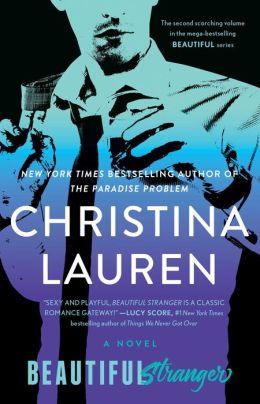
This is a follow-up to Beautiful Bastard and has appearances by Bennett and Chloe, but the focus is on Chloe's friend Sara Dillon and the notorious British womanizer Max Stella, with whom she enjoys an heated (but anonymous) encounter at a club. Max is left with a sexy video of Sara dancing to obsess over, and only pure luck enables him to find out who she is and pursue her. Sara has recently left a cheating ex to start a new life in New York City, and forming an attachment to anyone, no matter how charming and sexy, is not on her agenda. For his part, Max is extremely gratified--at the beginning--to have found a woman who wants nothing more than to meet with him once a week and have sex in near-public locations. They also make a habit of recording their encounters with a camera. Although their original agreement might have been no-strings-attached, both Sara (determined not to be vulnerable) and Max (feeling like he wants to pursue a real relationship for the first time in a long time) know that there's something more between them than lust. But when some of their revealing photos are stolen and released to the tabloids, Sara must decide whether she can truly trust Max's intentions.
Grade: A-
This series totally has my number. Give me more! It's not a true readalike for 50 Shades, but it is a lot of fun and I wouldn't hesitate to recommend it.
The Red Diary, Toni Blake (2004)
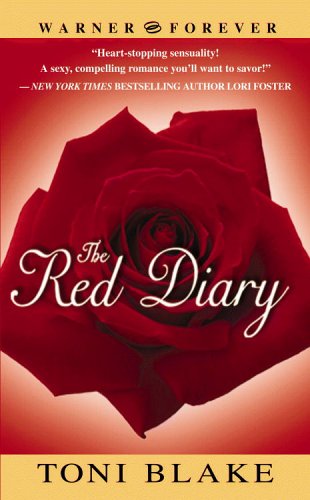

As you can probably tell by the cover redesign, this book was reissued in January 2013 with an eye toward the Fifty Shades of Grey market. Unfortunately, although it's a fine romance with more strongly drawn minor characters than usual, it's not a great readalike for the EL James series. The Red Diary is the story of Lauren Ash, a wealthy accountant who will someday inherit the lucrative family business. Nick is a working-class painter whose father once owned half of the Ash company. Nick blames Lauren and her family for all the pain and heartache his family has gone through since his mother's death, including his father's alcoholism and its tragic consequences. When he stumbles upon a journal of her private sexual fantasies during a job painting her house, Nick thinks he's found the perfect way to take revenge. But Nick finds that being intimate with Lauren leads to pesky FEELINGS about Lauren as well as dimming his desire for revenge. Soon he has to decide whether to come clean about violating her privacy and risk their fledgling relationship. For her part, Lauren believes that she and Nick have a spiritual connection that allows him to bring her fantasies to life, and she tries to draw him out about his life and experiences. Can she recover when it turns out that he's not really the man she thought she fell in love with?
Grade: B-
There's some wealth and there's a lot of sex, a little of it kinky, and the hero does have a tragic past, but to me it just didn't feel like a 50 Shades readalike. Perhaps because the social positions are reversed and she is the wealthy and powerful one?
The Revenge of Lord Eberlin, Julia London

This is the follow up to The Year of Living Scandalously, which so aggravated me by not resolving the mystery that it set out in its first pages. Guess what? The Revenge of Lord Eberlin doesn't solve the mystery of the missing Ashwood jewels either, although it does advance the solution somewhat. Lord Eberlin, AKA Tobin Scott, returns to Hadley Green to get revenge on Lily Boudine, who is now the Countess at Ashwood. Tobin believes that Lily, who was eight at the time of the jewels' theft, is responsible for his innocent father's death--and he's determined to take the entire Ashwood estate down with the wealth and power that he's gained as a weapons dealer. As in The Red Diary, Tobin and Lily fall in love and she must decide whether it's worth being shunned by Society to be with a man who purchased a Danish title (*gasp*). London portrays Lily as primly self-conscious of Society at some times, and blithely uncaring at others, such as when she--an unmarried woman of quality--goes to dine with Tobin alone at his house. Inconsistencies like these, in addition to all the mentions of the "mud" inside Tobin's soul, AND THE FACT THAT THE DAMN MYSTERY IS STILL UNSOLVED, left me unsatisfied.
Grade: C+
I didn't realize before I put them next to each other that The Red Diary and The Revenge of Lord Eberlin were so similar, despite their settings. WEIRD. So let's call them readalikes.
It remains to be seen whether I'll be reading the next book. Someone please read it first and tell me if the missing jewels mystery is finally solved.
Friday, July 5, 2013
Reading Roulette: Fourth Pick
The latest group of books to come up in my random selection of books to read includes a wide selection:
Coronets and Steel, Sherwood Smith
Aurelia Kim Murray is a California girl who wishes there were more to life. And there is. For Kim is part of a royal family from a tiny eastern European country, and soon finds herself swept up in the romance and mystery she always wanted-and more, because there's something very different about her bloodline and the magical nature of her ancestral country.
I am sure this got on to my list because of Crown Duel.
Kat, Incorrigible, Stephanie Burgis
Twelve-year-old Katherine Ann Stephenson has just discovered that she’s inherited her late mother’s magical talents, and despite Stepmama’s stern objections, she’s determined to learn how to use them. But with her eldest sister Elissa’s intended fiancé, the sinister Sir Neville, showing a dangerous interest in Kat’s magical potential; her other sister, Angeline, wreaking romantic havoc with her own witchcraft; and a highwayman lurking in the forest, Kat’s reckless heroism will be tested to the utmost. If she can learn to control her new powers, will Kat be able to rescue her family and win her sisters their true loves?
In this charming blend of Jane Austen–era culture, magical whimsy, and rollicking adventure, readers will find a true friend in the refreshingly unladylike Kat Stephenson.
Stephanie is an online friend and I have had this series in my sights for a while. Now I have the kick in the ass I needed to actually read the first one! I confess, I read the first 100 pages already while I was on vacation. It was the perfect choice.
The Rise of Rome: The Making of the World's Greatest Empire, Anthony Everitt
Emerging as a market town from a cluster of hill villages in the eighth and seventh centuries B.C., Rome grew to become the ancient world’s preeminent power. Everitt fashions the story of Rome’s rise to glory into an erudite page-turner filled with lasting lessons for our time. He chronicles the clash between patricians and plebeians that defined the politics of the Republic. He shows how Rome’s shrewd strategy of offering citizenship to her defeated subjects was instrumental in expanding the reach of her burgeoning empire. And he outlines the corrosion of constitutional norms that accompanied Rome’s imperial expansion, as old habits of political compromise gave way, leading to violence and civil war. In the end, unimaginable wealth and power corrupted the traditional virtues of the Republic, and Rome was left triumphant everywhere except within its own borders.
Everitt paints indelible portraits of the great Romans—and non-Romans—who left their mark on the world out of which the mighty empire grew: Cincinnatus, Rome’s George Washington, the very model of the patrician warrior/aristocrat; the brilliant general Scipio Africanus, who turned back a challenge from the Carthaginian legend Hannibal; and Alexander the Great, the invincible Macedonian conqueror who became a role model for generations of would-be Roman rulers. Here also are the intellectual and philosophical leaders whose observations on the art of government and “the good life” have inspired every Western power from antiquity to the present: Cato the Elder, the famously incorruptible statesman who spoke out against the decadence of his times, and Cicero, the consummate orator whose championing of republican institutions put him on a collision course with Julius Caesar and whose writings on justice and liberty continue to inform our political discourse today.
Rome’s decline and fall have long fascinated historians, but the story of how the empire was won is every bit as compelling. With The Rise of Rome, one of our most revered chroniclers of the ancient world tells that tale in a way that will galvanize, inform, and enlighten modern readers.
This one I requested on audio CD and will be going with me in the car to Chicago, since I have at least a fourteen-hour drive ahead of me. I very much enjoyed Everitt's biography of Hadrian.
Why am I doing this?
Coronets and Steel, Sherwood Smith
Aurelia Kim Murray is a California girl who wishes there were more to life. And there is. For Kim is part of a royal family from a tiny eastern European country, and soon finds herself swept up in the romance and mystery she always wanted-and more, because there's something very different about her bloodline and the magical nature of her ancestral country.
I am sure this got on to my list because of Crown Duel.
Kat, Incorrigible, Stephanie Burgis
Twelve-year-old Katherine Ann Stephenson has just discovered that she’s inherited her late mother’s magical talents, and despite Stepmama’s stern objections, she’s determined to learn how to use them. But with her eldest sister Elissa’s intended fiancé, the sinister Sir Neville, showing a dangerous interest in Kat’s magical potential; her other sister, Angeline, wreaking romantic havoc with her own witchcraft; and a highwayman lurking in the forest, Kat’s reckless heroism will be tested to the utmost. If she can learn to control her new powers, will Kat be able to rescue her family and win her sisters their true loves?
In this charming blend of Jane Austen–era culture, magical whimsy, and rollicking adventure, readers will find a true friend in the refreshingly unladylike Kat Stephenson.
Stephanie is an online friend and I have had this series in my sights for a while. Now I have the kick in the ass I needed to actually read the first one! I confess, I read the first 100 pages already while I was on vacation. It was the perfect choice.
The Rise of Rome: The Making of the World's Greatest Empire, Anthony Everitt
Emerging as a market town from a cluster of hill villages in the eighth and seventh centuries B.C., Rome grew to become the ancient world’s preeminent power. Everitt fashions the story of Rome’s rise to glory into an erudite page-turner filled with lasting lessons for our time. He chronicles the clash between patricians and plebeians that defined the politics of the Republic. He shows how Rome’s shrewd strategy of offering citizenship to her defeated subjects was instrumental in expanding the reach of her burgeoning empire. And he outlines the corrosion of constitutional norms that accompanied Rome’s imperial expansion, as old habits of political compromise gave way, leading to violence and civil war. In the end, unimaginable wealth and power corrupted the traditional virtues of the Republic, and Rome was left triumphant everywhere except within its own borders.
Everitt paints indelible portraits of the great Romans—and non-Romans—who left their mark on the world out of which the mighty empire grew: Cincinnatus, Rome’s George Washington, the very model of the patrician warrior/aristocrat; the brilliant general Scipio Africanus, who turned back a challenge from the Carthaginian legend Hannibal; and Alexander the Great, the invincible Macedonian conqueror who became a role model for generations of would-be Roman rulers. Here also are the intellectual and philosophical leaders whose observations on the art of government and “the good life” have inspired every Western power from antiquity to the present: Cato the Elder, the famously incorruptible statesman who spoke out against the decadence of his times, and Cicero, the consummate orator whose championing of republican institutions put him on a collision course with Julius Caesar and whose writings on justice and liberty continue to inform our political discourse today.
Rome’s decline and fall have long fascinated historians, but the story of how the empire was won is every bit as compelling. With The Rise of Rome, one of our most revered chroniclers of the ancient world tells that tale in a way that will galvanize, inform, and enlighten modern readers.
This one I requested on audio CD and will be going with me in the car to Chicago, since I have at least a fourteen-hour drive ahead of me. I very much enjoyed Everitt's biography of Hadrian.
Why am I doing this?
Tuesday, June 25, 2013
Reading Roulette: Update and Putting Books Down
At this point in my Reading Roulette challenge, I have randomly selected twelve books and given myself permission to put down two of them without finishing. The first was The Passage. The second was Thief's Covenant, from the third selection round. I made it through more than 100 pages before I admitted to myself that it just wasn't working for me and moved on. I have too many books I desperately want to read to spend valuable time slogging through one that isn't holding my attention.
Thief's Covenant had some elements I liked--a young female thief as the main character being the primary draw--but I was more than a third of the way through the book and still wondering what was going on (there were flashbacks with confusing timing) and when the plot was going to move significantly forward. Marmell also had some writing tics that reminded me of some of my own writing that I've done which, upon re-reading, made me want to change everything. The use of the word "vaguely," for example. I don't have bones to pick with Thief's Covenant, it just wasn't the book for me.
As I continue this project (and am gradually relieved of my self-imposed obligation to read erotic romances), I am happy about the way it's turning out. I have been reading a variety of books, some recent and some published more than twenty years ago. I've read in several different genres. I am enjoying the variety and the excitement that random selection is giving me. And I feel like I'm getting better at putting books down. Life is too short, and this isn't assigned reading.
I also thought when I gave myself the option of picking three books at a time that I would choose one of the three and then pick again, but every time I do a draw it's full of books I actually want to read. I'm still going to keep selecting three at a time, because the vagaries of my mood and interlibrary loan mean that I'm usually reading multiple books at once in different formats. I am not a book monogamist.
Thief's Covenant had some elements I liked--a young female thief as the main character being the primary draw--but I was more than a third of the way through the book and still wondering what was going on (there were flashbacks with confusing timing) and when the plot was going to move significantly forward. Marmell also had some writing tics that reminded me of some of my own writing that I've done which, upon re-reading, made me want to change everything. The use of the word "vaguely," for example. I don't have bones to pick with Thief's Covenant, it just wasn't the book for me.
As I continue this project (and am gradually relieved of my self-imposed obligation to read erotic romances), I am happy about the way it's turning out. I have been reading a variety of books, some recent and some published more than twenty years ago. I've read in several different genres. I am enjoying the variety and the excitement that random selection is giving me. And I feel like I'm getting better at putting books down. Life is too short, and this isn't assigned reading.
I also thought when I gave myself the option of picking three books at a time that I would choose one of the three and then pick again, but every time I do a draw it's full of books I actually want to read. I'm still going to keep selecting three at a time, because the vagaries of my mood and interlibrary loan mean that I'm usually reading multiple books at once in different formats. I am not a book monogamist.
Book Review: Rusalka [1989]
C.J. Cherryh's folktale-influenced historical fantasy Rusalka came up in my second Reading Roulette draw and was recommended by my friend Jessica. I've read and enjoyed some of Cherryh's science fiction, and had this series (known as "The Russian Stories") on my bookshelf forever. But I never read them! So thanks to Jessica and this project for giving me the push I needed.

Grade: B-
The setting and magic system employed by Cherryh were a refreshing change from the erotic romances I've been reading for my 50 Shades readalikes project, but there were moments when it seemed as if they were never going to get out of the forest. The characters seemed trapped in an infinite loop--fruitless searching, repeated conversations, and a depressing gradual loss of life and energy. Despite that, I did ultimately power through and enjoyed the book's climactic scenes.

In the world of Rusalka, magic is a matter of intent or "wishing." Sasha is an orphaned teen who has long kept his wishing abilities as tightly leashed as possible, living as he does on the mercy of his aunt and uncle. But when the town's layabout jokester lands himself in trouble and unwittingly involves Sasha, they must flee together. The wounded Pyetr Kochevikov, who once frolicked with the children of the nobility, finds in Sasha a true and unstinting friend. Although their theoretical destination is Kiev, the two refugees find themselves wandering through a blighted forest and eventually end up at the mercy of the cranky and elderly wizard Uulamets.
Uulamets agrees to heal Pyetr and teach Sasha in return for an undefined payment, which repeatedly leads the young men into peril. The old wizard's daughter Eveshka is a rusalka, a spirit that devours all living energy around it; Uulamets wants to bring her back to life, and Sasha and Pyetr become caught up in his magical workings. An emotional sympathy arises between Pyetr and Eveshka, despite the fact that her mere presence drains him of life without outside intervention. Budding wizard Sasha learns to negotiate the world with his awakening powers as the skeptical Pyetr comes to grips with the knowledge that much of what he's long scoffed at is not only real, but much more powerful than he can comprehend. This motley band must seek out the wizard who holds Eveshka's heart trapped, or they will all meet an untimely end.
Grade: B-
The setting and magic system employed by Cherryh were a refreshing change from the erotic romances I've been reading for my 50 Shades readalikes project, but there were moments when it seemed as if they were never going to get out of the forest. The characters seemed trapped in an infinite loop--fruitless searching, repeated conversations, and a depressing gradual loss of life and energy. Despite that, I did ultimately power through and enjoyed the book's climactic scenes.
The book was nominated for a Locus award, and Cherryh "extensively rewritten" the series--known collectively as the Russian Stories--and reissued them in ebook format. There were enough issues with pacing that I would be curious to read the updated version to see what she's done with the text, and if I go on to read Chernevog and Yvgenie, I will be buying the ebooks for sure.
Wednesday, June 12, 2013
Book Review: The Year of Living Scandalously [2010]
Julia London's (real name Dinah Dinwiddie) The Year of Living Scandalously is the first book in her Secrets of Hadley Green series. It came up in my third Reading Roulette selection, and I read it with blazing speed. Warning: spoilers abound in this review.

The primary mystery of Hadley Green is the disappearance of the Ashwood jewels, for which a talented carpenter named Mr. Scott was tried and executed in 1793. Miss Lily Boudine, upon whose testimony the conviction largely rested, has felt troubled ever since, although she left Ashwood and England soon after to be raised by her Irish relations. The jewels were never recovered.
Now, the year is 1808. Lily has inherited Ashwood and its mysteries, but is unwilling to disrupt her Continental travel plans to assume her responsibilities, sending her cousin Keira in her stead to look after things. Lily and Keira look enough alike to be mistaken for one another, which is just what the Ashwood servants do upon her arrival. An impulsive Keira allows the misapprehension to continue in order to make herself useful around the estate, which is close to financial ruin and requires an active manager. In the process of auctioning off some of the estate's horseflesh, she encounters Declan O'Connor, Earl of Donnelly. Keira and Declan have their own history of attraction and heartache in Ireland; while he trusts Keira's judgment not at all, Declan also does not reveal her charade.
After some persuasion, Keira actively enlists Declan's help in solving the mystery of the missing jewels and clearing Mr. Scott's name, as she has uncovered evidence that he was the former Lady Ashwood's lover. At the same time, Keira finds herself weighed down more and more by her deception as she grows close to the people of Hadley Green and works with them to plan a gala event for the benefit of the orphanage. Questions abound: When will Lily return and bring everything crashing down on Keira's head? Who is the mysterious and threatening Lord Eberlin who seems bent on destroying the estate? Will Keira and Declan's growing intimacy overwhelm their good sense and plunge them into a sexual relationship? (Yes.) What happened to the missing jewels?
Grade: B-
What The Year of Living Scandalously suffers from is a surfeit of everything. Not only is there a central mystery that is unresolved by the end of the book, but Keira and Declan have their own past to resolve and her current difficulties to untangle as best as possible. Since it's the first book of a romance series, characters are introduced who will clearly be featured in subsequent books, but in this one they don't have all that much to do. Scenes of Keira and Declan methodically investigating the mystery outweighed those with them giving in to desire, which was refreshing on one hand--but on the other, confusing. The payoff didn't seem to reward the investment.
Let's say that you're given a book which promises a mystery. The characters are all invested in solving that mystery, and it's the reason given by the heroine for involving the hero and for continuing to impersonate her cousin. All your energy as a reader is directed at two things: getting the hero and heroine together, and solving the mystery. But London leaves readers with a huge cliffhanger when she ends the book with Lily under threat from Lord Eberlin and the jewels still missing. While this made me request The Revenge of Lord Eberlin because I WANT TO KNOW what happened, it also left me grumpy.
Book Review Index
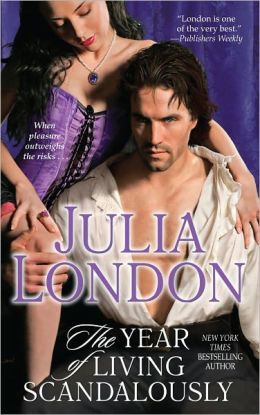
The primary mystery of Hadley Green is the disappearance of the Ashwood jewels, for which a talented carpenter named Mr. Scott was tried and executed in 1793. Miss Lily Boudine, upon whose testimony the conviction largely rested, has felt troubled ever since, although she left Ashwood and England soon after to be raised by her Irish relations. The jewels were never recovered.
Now, the year is 1808. Lily has inherited Ashwood and its mysteries, but is unwilling to disrupt her Continental travel plans to assume her responsibilities, sending her cousin Keira in her stead to look after things. Lily and Keira look enough alike to be mistaken for one another, which is just what the Ashwood servants do upon her arrival. An impulsive Keira allows the misapprehension to continue in order to make herself useful around the estate, which is close to financial ruin and requires an active manager. In the process of auctioning off some of the estate's horseflesh, she encounters Declan O'Connor, Earl of Donnelly. Keira and Declan have their own history of attraction and heartache in Ireland; while he trusts Keira's judgment not at all, Declan also does not reveal her charade.
After some persuasion, Keira actively enlists Declan's help in solving the mystery of the missing jewels and clearing Mr. Scott's name, as she has uncovered evidence that he was the former Lady Ashwood's lover. At the same time, Keira finds herself weighed down more and more by her deception as she grows close to the people of Hadley Green and works with them to plan a gala event for the benefit of the orphanage. Questions abound: When will Lily return and bring everything crashing down on Keira's head? Who is the mysterious and threatening Lord Eberlin who seems bent on destroying the estate? Will Keira and Declan's growing intimacy overwhelm their good sense and plunge them into a sexual relationship? (Yes.) What happened to the missing jewels?
Grade: B-
What The Year of Living Scandalously suffers from is a surfeit of everything. Not only is there a central mystery that is unresolved by the end of the book, but Keira and Declan have their own past to resolve and her current difficulties to untangle as best as possible. Since it's the first book of a romance series, characters are introduced who will clearly be featured in subsequent books, but in this one they don't have all that much to do. Scenes of Keira and Declan methodically investigating the mystery outweighed those with them giving in to desire, which was refreshing on one hand--but on the other, confusing. The payoff didn't seem to reward the investment.
Let's say that you're given a book which promises a mystery. The characters are all invested in solving that mystery, and it's the reason given by the heroine for involving the hero and for continuing to impersonate her cousin. All your energy as a reader is directed at two things: getting the hero and heroine together, and solving the mystery. But London leaves readers with a huge cliffhanger when she ends the book with Lily under threat from Lord Eberlin and the jewels still missing. While this made me request The Revenge of Lord Eberlin because I WANT TO KNOW what happened, it also left me grumpy.
Book Review Index
Monday, June 3, 2013
Reading Roulette: Third Pick
I am almost finished with Rusalka, so it's time to roll the dice again and discover what my next books will be! I spent much of the past several months reading 50 Shades readalikes, most of which were not on my TBR list, and in the interim my list has swollen from 373 to 448. That's my life.
52. The Year of Living Scandalously, Julia London (Secrets of Hadley Green #1)
In 1792, the village of Hadley Green executed a man for stealing the Countess of Ashwood’s historic jewels. Fifteen years later, questions still linger. Was it a crime of greed—or of passion?
When Declan O’Connor, Earl of Donnelly, arrives at Hadley Green to meet with Lily Boudine, the new countess of Ashwood, he knows instantly that the lovely woman who welcomes him is not who she pretends to be. In an attempt to avoid an unwanted marriage, Keira Hannigan has assumed her cousin’s identity and is staying at the estate while Lily is abroad. When Declan threatens to expose her, Keira convinces him to guard her secret, then enlists him in her investigation of the missing jewels, for she now believes an innocent man was hanged.
Unable to deny the beautiful, exasperating Keira—or their simmering passion—Declan reluctantly agrees. But neither is prepared for the dangerous stranger who threatens to reveal Keira’s lies . . . and Declan knows he must protect Keira at all costs, for she is the woman who now owns his heart.
I feel like I started this book and put it down for some reason.
172. Thief's Covenant, Ari Marmell (Widdershins Adventures #1)
Once she was Adrienne Satti. An orphan of Davillon, she had somehow escaped destitution and climbed to the ranks of the city's aristocracy in a rags-to-riches story straight from an ancient fairy tale. Until one horrid night, when a conspiracy of forces-human and other-stole it all away in a flurry of blood and murder. Today she is Widdershins, a thief making her way through Davillon's underbelly with a sharp blade, a sharper wit, and the mystical aid of Olgun, a foreign god with no other worshippers but Widdershins herself. It's not a great life, certainly nothing compared to the one she once had, but it's hers. But now, in the midst of Davillon's political turmoil, an array of hands are once again rising up against her, prepared to tear down all that she's built. The City Guard wants her in prison. Members of her own Guild want her dead. And something horrid, something dark, something ancient is reaching out for her, a past that refuses to let her go. Widdershins and Olgun are going to find answers, and justice, for what happened to her-but only if those who almost destroyed her in those years gone by don't finish the job first.
Anything that uses the word "widdershins" has an immediate advantage over other books.
298. All Clear, Connie Willis.
Since this is the second part of a duology that is meant to be read as one book, I am going to read Blackout first. Since Willis is my favorite author, this will not be a chore, although I did stall out on reading it the first time around (before All Clear was even available). I know that it's available in audio format, but all the copies in Massachusetts seem to be checked out. I may have to ILL it from out of state.
What is the Reading Roulette project?
52. The Year of Living Scandalously, Julia London (Secrets of Hadley Green #1)
In 1792, the village of Hadley Green executed a man for stealing the Countess of Ashwood’s historic jewels. Fifteen years later, questions still linger. Was it a crime of greed—or of passion?
When Declan O’Connor, Earl of Donnelly, arrives at Hadley Green to meet with Lily Boudine, the new countess of Ashwood, he knows instantly that the lovely woman who welcomes him is not who she pretends to be. In an attempt to avoid an unwanted marriage, Keira Hannigan has assumed her cousin’s identity and is staying at the estate while Lily is abroad. When Declan threatens to expose her, Keira convinces him to guard her secret, then enlists him in her investigation of the missing jewels, for she now believes an innocent man was hanged.
Unable to deny the beautiful, exasperating Keira—or their simmering passion—Declan reluctantly agrees. But neither is prepared for the dangerous stranger who threatens to reveal Keira’s lies . . . and Declan knows he must protect Keira at all costs, for she is the woman who now owns his heart.
I feel like I started this book and put it down for some reason.
172. Thief's Covenant, Ari Marmell (Widdershins Adventures #1)
Once she was Adrienne Satti. An orphan of Davillon, she had somehow escaped destitution and climbed to the ranks of the city's aristocracy in a rags-to-riches story straight from an ancient fairy tale. Until one horrid night, when a conspiracy of forces-human and other-stole it all away in a flurry of blood and murder. Today she is Widdershins, a thief making her way through Davillon's underbelly with a sharp blade, a sharper wit, and the mystical aid of Olgun, a foreign god with no other worshippers but Widdershins herself. It's not a great life, certainly nothing compared to the one she once had, but it's hers. But now, in the midst of Davillon's political turmoil, an array of hands are once again rising up against her, prepared to tear down all that she's built. The City Guard wants her in prison. Members of her own Guild want her dead. And something horrid, something dark, something ancient is reaching out for her, a past that refuses to let her go. Widdershins and Olgun are going to find answers, and justice, for what happened to her-but only if those who almost destroyed her in those years gone by don't finish the job first.
Anything that uses the word "widdershins" has an immediate advantage over other books.
298. All Clear, Connie Willis.
Since this is the second part of a duology that is meant to be read as one book, I am going to read Blackout first. Since Willis is my favorite author, this will not be a chore, although I did stall out on reading it the first time around (before All Clear was even available). I know that it's available in audio format, but all the copies in Massachusetts seem to be checked out. I may have to ILL it from out of state.
What is the Reading Roulette project?
Wednesday, May 22, 2013
Book Review: Freedom & Necessity [1997]
Several years ago, my sister gave me a copy of Freedom & Necessity, which came up in my second Reading Roulette* draw, enabling it to come off the bench and into the game at last. The book is an epistolary novel from science fiction fantasy heavyweights Steven Brust and Emma Bull that takes place, for the most part, in 1848 England.

As the novel opens, James Cobham--presumed dead, but in reality having recently escaped from captivity--writes his cousin Richard to enlist his assistance in uncovering the mystery of his "death." Their investigation evolves to include their cousins Kitty (romantically involved with Richard) and Susan. The story is told through letters between the four principal characters and their journal entries, with a few scattered newspaper clippings and book excerpts for good measure. Once the plot really gets going, it's rare to find any of the four in the same place at the same time, which makes the format choice logical, along with the fact that it was written by two authors.
The four relatives are all members of England's upper class, but it's revealed early on that James has long been living a double life as a radical and Chartist sympathizer. The identity of his pursuers, and whether they would prefer his death or recapture, is in doubt for most of the book and could be one of several groups. As questions continue to increase in number, with few answers forthcoming, the four work disparately and together to gather clues and put together information from their family's past to unravel the events of the present before it's too late.
It's difficult to describe the plot except to say that it involves revolutionaries and political intrigue, cross-country chases, family history, romance, and a group of people practicing a druidical magic. There is a great deal of discussion of Hegel, much of which went right over my head. The epistolary format sometimes lends itself to rambling and reflective passages that would definitely frustrate a reader looking for continuous action. However, the conclusion was well-plotted and satisfactory.
Grade: B+
While not precisely fantasy, the book does play with some fantastical elements, especially where the character of Kitty is concerned. If forced to put it in a genre, I'd call it historical fiction. Susan's character in particular was a delight to read, as she uses the mysterious events as a launching point to exercise a range of talents that she was never able to access in her role as a lady:
Book Review Index
*Which project has been sadly neglected in my attempt to read as many 50 Shades of Grey readalikes as possible, but which is now back on track as if those three months never happened. In my attempt to get this book (begun in February of this year) actually read, I resorted to keeping one copy at work, one at home, and one in my car.

As the novel opens, James Cobham--presumed dead, but in reality having recently escaped from captivity--writes his cousin Richard to enlist his assistance in uncovering the mystery of his "death." Their investigation evolves to include their cousins Kitty (romantically involved with Richard) and Susan. The story is told through letters between the four principal characters and their journal entries, with a few scattered newspaper clippings and book excerpts for good measure. Once the plot really gets going, it's rare to find any of the four in the same place at the same time, which makes the format choice logical, along with the fact that it was written by two authors.
The four relatives are all members of England's upper class, but it's revealed early on that James has long been living a double life as a radical and Chartist sympathizer. The identity of his pursuers, and whether they would prefer his death or recapture, is in doubt for most of the book and could be one of several groups. As questions continue to increase in number, with few answers forthcoming, the four work disparately and together to gather clues and put together information from their family's past to unravel the events of the present before it's too late.
It's difficult to describe the plot except to say that it involves revolutionaries and political intrigue, cross-country chases, family history, romance, and a group of people practicing a druidical magic. There is a great deal of discussion of Hegel, much of which went right over my head. The epistolary format sometimes lends itself to rambling and reflective passages that would definitely frustrate a reader looking for continuous action. However, the conclusion was well-plotted and satisfactory.
Grade: B+
While not precisely fantasy, the book does play with some fantastical elements, especially where the character of Kitty is concerned. If forced to put it in a genre, I'd call it historical fiction. Susan's character in particular was a delight to read, as she uses the mysterious events as a launching point to exercise a range of talents that she was never able to access in her role as a lady:
I'm doing this mostly because it's opened wide a door to a room inside me that before I could only guess at by the light along the sill and through the keyhole. It's a room in which all those things in me that, living the normal life of a well-bred woman, I could never use--strength and speed and hardiness; command over my mind and body; respect for the language of my senses; a certain ferocity of the spirit--are not only useful but essential (146).This book is definitely not for everyone. If you're not down with having Friedrich Engels as a supporting character, don't even bother. But if you're interested in mid-19th century English history, if you like complex characters with flawed relationships, if you don't mind the occasional philosophical ramble . . . this book is definitely a good choice.
Book Review Index
*Which project has been sadly neglected in my attempt to read as many 50 Shades of Grey readalikes as possible, but which is now back on track as if those three months never happened. In my attempt to get this book (begun in February of this year) actually read, I resorted to keeping one copy at work, one at home, and one in my car.
Monday, January 28, 2013
Reading Roulette: Second Pick
As of this next spin of the wheel, there are 373 books on my To Be Read list (I can't seem to stop adding them). The next three picks, after consulting the random.org number generator:
323. Cut to the Quick, by Kate Ross (Julian Kestrel mysteries #1). This will make my friend Margaret happy, as the copy she loaned me has been sitting on my dresser for the last two years.
Description: To the ranks of great sleuths of ages past, add a new candidate - Julian Kestrel - a detective as historically authentic as Brother Cadfael and as dashing as Lord Peter Wimsey. Kestrel is the reigning dandy of London in the 1820s, famous for his elegant clothes and his unflappable sangfroid. One night he rescues a young aristocrat named Hugh Fontclair from a gambling house, and in gratitude Hugh invites him to be best man at his wedding. But when Kestrel goes to stay with the Fontclairs at their sumptuous country house, he is caught in the crossfire of the bride's and groom's warring families. Soon, discord erupts into murder. In a world without fingerprinting, chemical analysis, or even police, murder poses a baffling challenge. Undaunted, Kestrel sets out to solve the crime. With the help of his Cockney manservant, Dipper a (mostly) reformed pickpocket, Kestrel delves beneath the Fontclairs' respectable surface. What he finds is a trail of crime, deception, and forbidden lust that leads him at last to the killer. The combination of a new author, a charming new sleuth, and a strikingly original setting adds up to a smashing mystery that moves with force and intelligence - and expert suspense - from beginning to end.
326. Freedom and Necessity, by Steven Brust and Emma Bull. My sister gave me this book, and it is also in the pile on my dresser.
Description: It is 1849. Across Europe, the high tide of revolution has crested, leaving recrimination and betrayal in its wake. From the high councils of Prussia to the corridors of Parliament, the powers-that-be breathe sighs of relief. But the powers-that-be are hardly unified among themselves. Far from it...
On the south coast of England, London man-about-town James Cobham comes to himself in a country inn, with no idea how he got there. Corresponding with his cousin, he discovers himself to have been presumed drowned in a boating accident. Together they decide that he should stay put for the moment, while they investigate what may have transpired. For James Cobham is a wanted man--wanted by conspiring factions of the government and the Chartists alike, and also the target of a magical conspiracy inside his own family.
And so the adventure begins...leading the reader through every corner of mid-nineteenth-century Britain, from the parlors of the elite to the dens of the underclass. Not since Wilkie Collins or Conan Doyle has there been such a profusion of guns, swordfights, family intrigues, women disguised as men, occult societies, philosophical discussions, and, of course, passionate romance.
Nor could any writing team but Steven Brust and Emma Bull make it quite so much fun...
351. Rusalka, by C.J. Cherryh (Russian Stories #1). Recommended by my friend Jessica. I used to own a copy of this book, but never managed to read it. Maybe this time will be different!
Description: This is Hugo-Award-winning author C.J. Cherryh's Del Rey debut—the story of Rusalka, the ghost of a murdered girl still seeking to exist by drawing the energy of life from all nearby living things, and the attempt to bring her back to life by her father Ulamets, and Pyetr, the young man who loved her.
None of these picks are available in audio format, which makes them more difficult to finish quickly. However, I will give all of them a chance. I'm not really sure what I'm in the mood to read right now. Feel free to help me choose.
Why am I doing this?
323. Cut to the Quick, by Kate Ross (Julian Kestrel mysteries #1). This will make my friend Margaret happy, as the copy she loaned me has been sitting on my dresser for the last two years.
Description: To the ranks of great sleuths of ages past, add a new candidate - Julian Kestrel - a detective as historically authentic as Brother Cadfael and as dashing as Lord Peter Wimsey. Kestrel is the reigning dandy of London in the 1820s, famous for his elegant clothes and his unflappable sangfroid. One night he rescues a young aristocrat named Hugh Fontclair from a gambling house, and in gratitude Hugh invites him to be best man at his wedding. But when Kestrel goes to stay with the Fontclairs at their sumptuous country house, he is caught in the crossfire of the bride's and groom's warring families. Soon, discord erupts into murder. In a world without fingerprinting, chemical analysis, or even police, murder poses a baffling challenge. Undaunted, Kestrel sets out to solve the crime. With the help of his Cockney manservant, Dipper a (mostly) reformed pickpocket, Kestrel delves beneath the Fontclairs' respectable surface. What he finds is a trail of crime, deception, and forbidden lust that leads him at last to the killer. The combination of a new author, a charming new sleuth, and a strikingly original setting adds up to a smashing mystery that moves with force and intelligence - and expert suspense - from beginning to end.
326. Freedom and Necessity, by Steven Brust and Emma Bull. My sister gave me this book, and it is also in the pile on my dresser.
Description: It is 1849. Across Europe, the high tide of revolution has crested, leaving recrimination and betrayal in its wake. From the high councils of Prussia to the corridors of Parliament, the powers-that-be breathe sighs of relief. But the powers-that-be are hardly unified among themselves. Far from it...
On the south coast of England, London man-about-town James Cobham comes to himself in a country inn, with no idea how he got there. Corresponding with his cousin, he discovers himself to have been presumed drowned in a boating accident. Together they decide that he should stay put for the moment, while they investigate what may have transpired. For James Cobham is a wanted man--wanted by conspiring factions of the government and the Chartists alike, and also the target of a magical conspiracy inside his own family.
And so the adventure begins...leading the reader through every corner of mid-nineteenth-century Britain, from the parlors of the elite to the dens of the underclass. Not since Wilkie Collins or Conan Doyle has there been such a profusion of guns, swordfights, family intrigues, women disguised as men, occult societies, philosophical discussions, and, of course, passionate romance.
Nor could any writing team but Steven Brust and Emma Bull make it quite so much fun...
351. Rusalka, by C.J. Cherryh (Russian Stories #1). Recommended by my friend Jessica. I used to own a copy of this book, but never managed to read it. Maybe this time will be different!
Description: This is Hugo-Award-winning author C.J. Cherryh's Del Rey debut—the story of Rusalka, the ghost of a murdered girl still seeking to exist by drawing the energy of life from all nearby living things, and the attempt to bring her back to life by her father Ulamets, and Pyetr, the young man who loved her.
None of these picks are available in audio format, which makes them more difficult to finish quickly. However, I will give all of them a chance. I'm not really sure what I'm in the mood to read right now. Feel free to help me choose.
Why am I doing this?
Saturday, January 26, 2013
Reading Roulette: Why I'm Not Finishing The Passage
Justin Cronin's sci-fi/vampire book The Passage was one of the three books that came up in my first Reading Roulette pick, and several friends and colleagues recommended it. I duly requested the audiobook through the library, and found the paperback on the shelves at work. I was pleased to find that the narrator of the audiobook was Edward Herrmann (aka Richard Gilmore from The Gilmore Girls), but I was startled to discover when I switched from the audio version to the print version that there was significantly more to the paper book.
It turns out that the audio version I requested was the abridged version, which clocks in at 12 discs (14.5 hours). The unabridged version consists of 29 discs (37+ hours) and is narrated by Scott Brick instead of Edward Herrmann. Per Nancy Pearl, I read past page 50, but by that point I knew that I didn't want to make myself read/listen to the entire 894-page book. My (grumpy editor) feeling is that if the book can stand to have more than half of its content removed and be marketed as a complete book, it probably needed a lot more revision before publication. I knew my feelings of resentment--about having to stop and start over, and switching narrators from one I loved to one I didn't know, and my unhappiness with the entire concept of abridgment--were going to make it very difficult for me to read with the kind of excitement and energy a book deserves. So I am putting it down (it will go back on my To Be Read list) and returning the library copies.
And I'll be a little more cautious about checking to see whether an audiobook is unabridged before I request it.
It turns out that the audio version I requested was the abridged version, which clocks in at 12 discs (14.5 hours). The unabridged version consists of 29 discs (37+ hours) and is narrated by Scott Brick instead of Edward Herrmann. Per Nancy Pearl, I read past page 50, but by that point I knew that I didn't want to make myself read/listen to the entire 894-page book. My (grumpy editor) feeling is that if the book can stand to have more than half of its content removed and be marketed as a complete book, it probably needed a lot more revision before publication. I knew my feelings of resentment--about having to stop and start over, and switching narrators from one I loved to one I didn't know, and my unhappiness with the entire concept of abridgment--were going to make it very difficult for me to read with the kind of excitement and energy a book deserves. So I am putting it down (it will go back on my To Be Read list) and returning the library copies.
And I'll be a little more cautious about checking to see whether an audiobook is unabridged before I request it.
Thursday, January 24, 2013
Book Review: The Black Tower [2008]
In addition to Call of the Mild and The Passage, Louis Bayard's The Black Tower also came up in my first Reading Roulette draw. I was able to get the audiobook through the library, and was pleased to discover that it was narrated by my perennial favorite Simon Vance. The book is one that's been on my list for a long time, but I never would have gotten around to reading it if not for this project. I even learned a bit about French history!
The year is 1818. In Restoration France (only recently delivered back into the hands of the monarchy after Napoleon's rule), medical student Hector Carpentier is startled out of his routine by the appearance of one Vidocq, the criminal-turned-policeman who was responsible for creating the first detective bureau. Vidocq is investigating the death of a man who bore a well-concealed paper with "Dr. Carpentier" and Hector's address on it. Vidocq, brusque, crass, and possessing qualities similar to a terrier, is convinced that Hector must know something, and brings him along as he makes inquiries. As they trace the dead man's contacts, they uncover leads that stretch back to the days of the French Republic, when Hector's father was called to minister to the ailing dauphin, held captive in the Black Tower. Official reports claimed that the boy, Louis-Charles, died in 1795 at the age of ten.
They discover that there are certain people who believe the dauphin, who would have been Louis XVII if not for the overthrow of the monarchy during the French Revolution, is still alive, and there are several dead bodies to prove their earnestness. Vidocq and Hector find themselves with someone who might be the presumed-dead dauphin, but with no way to prove or disprove his identity. Questions abound: Is this Charles the real prince? How did he get out of the tower? If he did, who died in the tower in 1795? How was Hector's father involved? Throw in a buried journal, disguises, the guillotine, a duel, the nobility, Mesmer, and family secrets, and you've got a fun and dramatic mix of elements.
Grade: B
I enjoyed this both as historical fiction and as a good detective story, although this one ends with some questions still unanswered. One of the best parts of the book was Hector's slow maturation from predictable pushover to surprisingly unreliable narrator.
What to Read Next:
Although he and Vidocq are nothing alike (aside from their aptitude for clever disguises), The Black Tower made me want to read some Sherlock Holmes. Hector Carpentier plays a role that's very similar to Watson's at times.
Edgar Allan Poe's short story "The Murders in the Rue Morgue," which actually mentions Vidocq by name.
And again, I will recommend Josephine Tey's The Daughter of Time. Princes in a tower!
In terms of nonfiction, I'd recommend The Suspicions of Mr. Whicher by Kate Summerscale (audiobook also narrated by Simon Vance), which concerns a country house murder and a celebrated London detective in the 1860s.
Book Review Index
The year is 1818. In Restoration France (only recently delivered back into the hands of the monarchy after Napoleon's rule), medical student Hector Carpentier is startled out of his routine by the appearance of one Vidocq, the criminal-turned-policeman who was responsible for creating the first detective bureau. Vidocq is investigating the death of a man who bore a well-concealed paper with "Dr. Carpentier" and Hector's address on it. Vidocq, brusque, crass, and possessing qualities similar to a terrier, is convinced that Hector must know something, and brings him along as he makes inquiries. As they trace the dead man's contacts, they uncover leads that stretch back to the days of the French Republic, when Hector's father was called to minister to the ailing dauphin, held captive in the Black Tower. Official reports claimed that the boy, Louis-Charles, died in 1795 at the age of ten.
They discover that there are certain people who believe the dauphin, who would have been Louis XVII if not for the overthrow of the monarchy during the French Revolution, is still alive, and there are several dead bodies to prove their earnestness. Vidocq and Hector find themselves with someone who might be the presumed-dead dauphin, but with no way to prove or disprove his identity. Questions abound: Is this Charles the real prince? How did he get out of the tower? If he did, who died in the tower in 1795? How was Hector's father involved? Throw in a buried journal, disguises, the guillotine, a duel, the nobility, Mesmer, and family secrets, and you've got a fun and dramatic mix of elements.
Grade: B
I enjoyed this both as historical fiction and as a good detective story, although this one ends with some questions still unanswered. One of the best parts of the book was Hector's slow maturation from predictable pushover to surprisingly unreliable narrator.
What to Read Next:
Although he and Vidocq are nothing alike (aside from their aptitude for clever disguises), The Black Tower made me want to read some Sherlock Holmes. Hector Carpentier plays a role that's very similar to Watson's at times.
Edgar Allan Poe's short story "The Murders in the Rue Morgue," which actually mentions Vidocq by name.
And again, I will recommend Josephine Tey's The Daughter of Time. Princes in a tower!
In terms of nonfiction, I'd recommend The Suspicions of Mr. Whicher by Kate Summerscale (audiobook also narrated by Simon Vance), which concerns a country house murder and a celebrated London detective in the 1860s.
Book Review Index
Saturday, January 12, 2013
Book Review: Call of the Mild [2012]
When Call of the Mild, by Lily Raff McCaulou, came up in my first Reading Roulette draw, I couldn't remember what had prompted me to put it on my To Be Read list in the first place. It's the account of an East Coast reporter in her early twenties who takes a job in Oregon and, after dipping some toes in the water via fly fishing, begins to hunt game.
I am not a hunter. I've never been hunting. In fact, I'm a vegetarian. I'm not really cool with killing things in order to eat them, although I know that the production of my tofu and so forth probably comes at the cost of some animal lives (see Michael Pollan, repeatedly quoted in Call of the Mild). Nevertheless, I approached this book as something that might broaden my horizons--both in terms of what I usually read, and the subject matter.
In addition to providing sometimes humorous descriptions of her first encounters with hunting and guns, McCaulou frequently describes her struggles with the ethics of hunting. Her thesis is encapsulated by these passages:
Grade: B-
It's not you, it's me. When it comes down to it, I just don't care that much about hunting, although McCaulou does make a compelling argument for hunting as a way of better understanding the natural world--and that hunters ought to be the staunchest of environmentalists. McCaulou's narrative of her activities is interspersed with many digressions on related topics and stories about friends and acquaintances, sometimes feeling like a series of essays rather than a cohesive whole. But I'm glad I read it, even though I never would have gotten through it if not for this project.
My favorite part of this book was completely unintentional. In a passage on cross-country skiing, she describes what she does to keep herself entertained during the seemingly repetitive exercise:
This is a thing in a lot of states, including MA, where I live: Becoming an Outdoors-Woman (BOW)
Book Review Index
ETA: Now I do remember how this book got on my TBR list--I read a review in the course of collection development, and thought it looked interesting. This is how a lot of books end up on my list.
I am not a hunter. I've never been hunting. In fact, I'm a vegetarian. I'm not really cool with killing things in order to eat them, although I know that the production of my tofu and so forth probably comes at the cost of some animal lives (see Michael Pollan, repeatedly quoted in Call of the Mild). Nevertheless, I approached this book as something that might broaden my horizons--both in terms of what I usually read, and the subject matter.
In addition to providing sometimes humorous descriptions of her first encounters with hunting and guns, McCaulou frequently describes her struggles with the ethics of hunting. Her thesis is encapsulated by these passages:
The chase fosters a special relationship, a direct connection between predator and prey. Yet that closeness does not infringe upon the predator's willingness to eat the prey. Instead, killing and eating the prey becomes an expression of that relationship's specialness. (207)
Animals die whether we acknowledge them or not, whether we eat them or not, whether we participate in their deaths willfully or indirectly. To me, hunting my own meat feels like saying grace before a meal and really, for the first time in my life, meaning it. (209)Whether you agree with this justification/explanation, her stories and tidbits were interesting enough to get me through the book. McCaulou never seems completely comfortable with her identity as hunter, no matter how much she works to understand it. Some of her assertions were downright troubling:
As a conservationist, it pains me to think of someone pulling the trigger on a rare tiger. But if the astronomical price tag for hunting one tiger raises enough money to protect hundreds of them, isn't that doing more good than harm? (172)I don't agree with the idea of sacrificing one for the good of the many, nor am I fully on board with "In a sense, hunting is a final frontier of feminism. As women make up a growing percentage of American hunters, we quietly lay claim to a party of humanity that has been dominated by men" (239). Still, this book does provide a lot of food for thought, and maybe McCaulou's continuing internal conflict over the act of taking animals' lives is what makes her a good hunter. Guilt is a continuous thread through the book, yet it doesn't dissuade her from continuing on her path--from rabbits to pheasant to larger birds and finally big game.
Grade: B-
It's not you, it's me. When it comes down to it, I just don't care that much about hunting, although McCaulou does make a compelling argument for hunting as a way of better understanding the natural world--and that hunters ought to be the staunchest of environmentalists. McCaulou's narrative of her activities is interspersed with many digressions on related topics and stories about friends and acquaintances, sometimes feeling like a series of essays rather than a cohesive whole. But I'm glad I read it, even though I never would have gotten through it if not for this project.
My favorite part of this book was completely unintentional. In a passage on cross-country skiing, she describes what she does to keep herself entertained during the seemingly repetitive exercise:
Once I get too tired to be anything but practical, I make mental lists of articles I want to write. Next, I compose pneumonic devices to remember my lists. (180)I'm going to file that typo away for a rainy day laugh.
This is a thing in a lot of states, including MA, where I live: Becoming an Outdoors-Woman (BOW)
Book Review Index
ETA: Now I do remember how this book got on my TBR list--I read a review in the course of collection development, and thought it looked interesting. This is how a lot of books end up on my list.
Thursday, January 3, 2013
Reading Roulette: First Pick
After cajoling people for recommendations, sculpting it carefully, and waiting patiently for the end of the year, I have a total of 355 books on my To Read list over at Goodreads. I used the random.org number generator to produce three numbers (drum roll), which correspond to these books:
91: The Black Tower, Louis Bayard
Vidocq. The name strikes terror in the Parisian underworld of 1818. As founder and chief of a newly created plainclothes police force, Vidocq has used his mastery of disguise and surveillance to capture some of France's most notorious and elusive criminals. Now he is hot on the trail of a tantalizing mystery--the fate of the young dauphin Louis-Charles, son of Marie-Antoinette and King Louis XVI.
Hector Carpentier, a medical student, lives with his widowed mother in her once-genteel home, now a boardinghouse, in Paris's Latin Quarter, helping the family make ends meet in the politically perilous days of the restoration. Three blocks away, a man has been murdered, and Hector's name has been found on a scrap of paper in the dead man's pocket: a case for the unparalleled deductive skills of Eugene Francois Vidocq, the most feared man in the Paris police. At first suspicious of Hector's role in the murder, Vidocq gradually draws him into an exhilarating--and dangerous--search that leads them to the true story of what happened to the son of the murdered royal family.
Officially, the Dauphin died a brutal death in Paris's dreaded Temple--a menacing black tower from which there could have been no escape--but speculation has long persisted that the ten-year-old heir may have been smuggled out of his prison cell. When Hector and Vidocq stumble across a man with no memory of who he is, they begin to wonder if he is the Dauphin himself, come back from the dead. Their suspicions deepen with the discovery of a diary that reveals Hector's own shocking link to the boy in the tower--and leaves him bound and determined to see justice done, no matter the cost.
In "The Black Tower," Bayard deftly interweaves political intrigue, epic treachery, cover-ups, and conspiracies into a gripping portrait of family redemption--and brings to life an indelible portrait of the mighty and profane Eugene Francois Vidocq, history's first great detective.
172: Call of the Mild: How I Learned to Hunt My Own Dinner, Lily Raff McCaulou
When Lily Raff McCaulou traded in an indie film production career in New York for a reporting job in central Oregon, she never imagined that she'd find herself picking up a gun and learning to hunt. She'd been raised as a gun-fearing environmentalist and an animal lover, and though a meat-eater, she'd always abided by the principle that harming animals is wrong. But Raff McCaulou's perspective shifted when she began spending weekends fly-fishing and weekdays interviewing hunters for her articles, realizing that many of them were more thoughtful about animals and the environment than she was.
So she embarked upon the project of learning to hunt from square one. From attending a Hunter Safety course designed for children to field dressing an elk and serving it for dinner, she explores the sport of hunting and all it entails, and tackles the big questions surrounding one of the most misunderstood American practices and pastimes. Not just a personal memoir, this book also explores the role of the hunter in the twenty-first century, the tension (at times artificial) between hunters and environmentalists, and new models of sustainable and ethical food procurement.
193: The Passage, Justin Cronin
First, the unthinkable: a security breach at a secret U.S. government facility unleashes the monstrous product of a chilling military experiment. Then, the unspeakable: a night of chaos and carnage gives way to sunrise on a nation, and ultimately a world, forever altered. All that remains for the stunned survivors is the long fight ahead and a future ruled by fear—of darkness, of death, of a fate far worse.
As civilization swiftly crumbles into a primal landscape of predators and prey, two people flee in search of sanctuary. FBI agent Brad Wolgast is a good man haunted by what he’s done in the line of duty. Six-year-old orphan Amy Harper Bellafonte is a refugee from the doomed scientific project that has triggered apocalypse. He is determined to protect her from the horror set loose by her captors. But for Amy, escaping the bloody fallout is only the beginning of a much longer odyssey—spanning miles and decades—towards the time and place where she must finish what should never have begun.
With The Passage, award-winning author Justin Cronin has written both a relentlessly suspenseful adventure and an epic chronicle of human endurance in the face of unprecedented catastrophe and unimaginable danger. Its inventive storytelling, masterful prose, and depth of human insight mark it as a crucial and transcendent work of modern fiction.
I generated three books because I'm a mood reader and I don't want to get mired on one choice if I can avoid it. I just put holds on The Black Tower and The Passage in audio format, we'll see which gets here first. There are only two copies of Call of the Mild in the system, but I placed a hold on that as well. At this point, I'm not sure which one I want to read most, but maybe it will become clearer when they're in front of me and I can read/listen to a few pages. You are welcome to press for one or another choice in the comments. I will update this post when I figure out which book I'm reading!
ETA: Call of the Mild best fits the underlying purpose of this challenge, which was to get me to read outside my comfort zone--and since I'm a vegetarian who doesn't like guns . . . however, I think I'll also listen to The Passage in the car, since the most people recommended it.
Why am I doing this?
91: The Black Tower, Louis Bayard
Vidocq. The name strikes terror in the Parisian underworld of 1818. As founder and chief of a newly created plainclothes police force, Vidocq has used his mastery of disguise and surveillance to capture some of France's most notorious and elusive criminals. Now he is hot on the trail of a tantalizing mystery--the fate of the young dauphin Louis-Charles, son of Marie-Antoinette and King Louis XVI.
Hector Carpentier, a medical student, lives with his widowed mother in her once-genteel home, now a boardinghouse, in Paris's Latin Quarter, helping the family make ends meet in the politically perilous days of the restoration. Three blocks away, a man has been murdered, and Hector's name has been found on a scrap of paper in the dead man's pocket: a case for the unparalleled deductive skills of Eugene Francois Vidocq, the most feared man in the Paris police. At first suspicious of Hector's role in the murder, Vidocq gradually draws him into an exhilarating--and dangerous--search that leads them to the true story of what happened to the son of the murdered royal family.
Officially, the Dauphin died a brutal death in Paris's dreaded Temple--a menacing black tower from which there could have been no escape--but speculation has long persisted that the ten-year-old heir may have been smuggled out of his prison cell. When Hector and Vidocq stumble across a man with no memory of who he is, they begin to wonder if he is the Dauphin himself, come back from the dead. Their suspicions deepen with the discovery of a diary that reveals Hector's own shocking link to the boy in the tower--and leaves him bound and determined to see justice done, no matter the cost.
In "The Black Tower," Bayard deftly interweaves political intrigue, epic treachery, cover-ups, and conspiracies into a gripping portrait of family redemption--and brings to life an indelible portrait of the mighty and profane Eugene Francois Vidocq, history's first great detective.
172: Call of the Mild: How I Learned to Hunt My Own Dinner, Lily Raff McCaulou
When Lily Raff McCaulou traded in an indie film production career in New York for a reporting job in central Oregon, she never imagined that she'd find herself picking up a gun and learning to hunt. She'd been raised as a gun-fearing environmentalist and an animal lover, and though a meat-eater, she'd always abided by the principle that harming animals is wrong. But Raff McCaulou's perspective shifted when she began spending weekends fly-fishing and weekdays interviewing hunters for her articles, realizing that many of them were more thoughtful about animals and the environment than she was.
So she embarked upon the project of learning to hunt from square one. From attending a Hunter Safety course designed for children to field dressing an elk and serving it for dinner, she explores the sport of hunting and all it entails, and tackles the big questions surrounding one of the most misunderstood American practices and pastimes. Not just a personal memoir, this book also explores the role of the hunter in the twenty-first century, the tension (at times artificial) between hunters and environmentalists, and new models of sustainable and ethical food procurement.
193: The Passage, Justin Cronin
First, the unthinkable: a security breach at a secret U.S. government facility unleashes the monstrous product of a chilling military experiment. Then, the unspeakable: a night of chaos and carnage gives way to sunrise on a nation, and ultimately a world, forever altered. All that remains for the stunned survivors is the long fight ahead and a future ruled by fear—of darkness, of death, of a fate far worse.
As civilization swiftly crumbles into a primal landscape of predators and prey, two people flee in search of sanctuary. FBI agent Brad Wolgast is a good man haunted by what he’s done in the line of duty. Six-year-old orphan Amy Harper Bellafonte is a refugee from the doomed scientific project that has triggered apocalypse. He is determined to protect her from the horror set loose by her captors. But for Amy, escaping the bloody fallout is only the beginning of a much longer odyssey—spanning miles and decades—towards the time and place where she must finish what should never have begun.
With The Passage, award-winning author Justin Cronin has written both a relentlessly suspenseful adventure and an epic chronicle of human endurance in the face of unprecedented catastrophe and unimaginable danger. Its inventive storytelling, masterful prose, and depth of human insight mark it as a crucial and transcendent work of modern fiction.
I generated three books because I'm a mood reader and I don't want to get mired on one choice if I can avoid it. I just put holds on The Black Tower and The Passage in audio format, we'll see which gets here first. There are only two copies of Call of the Mild in the system, but I placed a hold on that as well. At this point, I'm not sure which one I want to read most, but maybe it will become clearer when they're in front of me and I can read/listen to a few pages. You are welcome to press for one or another choice in the comments. I will update this post when I figure out which book I'm reading!
ETA: Call of the Mild best fits the underlying purpose of this challenge, which was to get me to read outside my comfort zone--and since I'm a vegetarian who doesn't like guns . . . however, I think I'll also listen to The Passage in the car, since the most people recommended it.
Why am I doing this?
Saturday, December 1, 2012
Reading Roulette
I've described before the feeling of never having enough time to read all the books that I want to read, even if I locked myself in a room (with snacks) and ignored the world. This year I did a much better job of reading the books I wanted to read, and next year I'm planning on keeping up the pace. To introduce more variety into my reading diet, however, I want to experiment with my TBR pile. This is where you come in. I'm asking people who read this post or follow me on Twitter to recommend one book that they think I should read/would enjoy--fiction, nonfiction, genre, picture book, classic, new release--the type of book doesn't matter to me, just the recommendation.
I'm going to put all the recommendations in my GoodReads account as "Want to Read" and select the next book I read using random.org's number generator. Because I am a creature of moods, I'm going to generate three numbers and pick each next book from the three random results. I will give each book at least 50 pages (per Nancy Pearl), after which I can decide to put it down and move to the next randomly generated book. I will report on my results here.
I already have several books on my "Want to Read" list that friends have been surprised I haven't read, such as The Handmaid's Tale and The Giver, so feel free to browse over there and see what shocking gaps I have.
Please leave me a comment on this post or @ me on Twitter, and let me know what I should read next! I will accept submissions until December 31st.
ETA: If it ends up being a later book in a series, I'll go back to the first book or the latest book I read in that series. If a book is prohibitively expensive for me (can't be acquired via ILL or purchased for a reasonable price, I will pick another option).
First Pick
Second Pick
Third Pick
Fourth Pick
I'm going to put all the recommendations in my GoodReads account as "Want to Read" and select the next book I read using random.org's number generator. Because I am a creature of moods, I'm going to generate three numbers and pick each next book from the three random results. I will give each book at least 50 pages (per Nancy Pearl), after which I can decide to put it down and move to the next randomly generated book. I will report on my results here.
I already have several books on my "Want to Read" list that friends have been surprised I haven't read, such as The Handmaid's Tale and The Giver, so feel free to browse over there and see what shocking gaps I have.
Please leave me a comment on this post or @ me on Twitter, and let me know what I should read next! I will accept submissions until December 31st.
ETA: If it ends up being a later book in a series, I'll go back to the first book or the latest book I read in that series. If a book is prohibitively expensive for me (can't be acquired via ILL or purchased for a reasonable price, I will pick another option).
First Pick
Second Pick
Third Pick
Fourth Pick
Subscribe to:
Posts (Atom)
