Tuesday, July 9, 2013

Book Review: Matched Trilogy

Ally Condie's Matched Trilogy consists of Matched, Crossed, and Reached. It's a dystopian YA series in the vein of The Hunger Games and Uglies. I listened to the majority of the books in the car and on my ipod, but also forged ahead with the books at times when I was too impatient to wait for another car trip.
This series is a textbook case for the pitfalls and frequently shifting landscape in the relationship between ebooks and libraries. I downloaded Matched from OverDrive in Mac-compatible MP3 format on a whim (it was on my list but had not come up on my Roulette list), then went back for Crossed. It was only available as a WMA file. Reached wasn't available at all, so I had to get those books on CD. Why? The series is published by Penguin, which doesn't play with OverDrive anymore. THANKS, PENGUIN!

All right, on to the review. Spoilers ahoy.


In the world of the Society, everything is predetermined: what you eat, where you go and the activities you do, even who you are supposed to love. The Officials who run the Society do their best to assign a probability to every possible event. As Matched begins, we follow seventeen-year old Cassia to her Match Banquet, at which she will be paired with her Society-selected perfect mate. There is a brief mention of people who decide not to participate in this process, but by and large, people in the Society choose to be matched. At the banquet, Cassia is surprised and pleased to find herself matched with her best friend and neighbor, Xander. It isn't until she's alone later that another picture flashes in Xander's place, that of the aloof Ky...is Ky her real match? How could the Society possibly make a mistake?

The first book focuses not only on Cassia's struggle to choose between the clever, patient Xander and the quiet, mysterious Ky (both of whom seem well-matched to her) but also on the details of the restrictive life of the Society. Although the Society has eliminated most diseases and optimized life for all its members, we learn through Cassia's interaction with her grandfather that all citizens are poisoned on their 80th birthday if they do not die of natural causes before then. Citizens do not know how to write, and all cultural artifacts--songs, paintings, poems, stories--have been reduced to a "top 100" of each category. There is a lively black market trade for items from before the Society was in power, known as artifacts. Before his death, Cassia's grandfather gives her two contraband poems (one by Dylan Thomas and one by Tennyson), putting her in the awkward position of having precious but illegal material. Knowledge of these words becomes one of the things that bind Cassia and Ky together, despite her ties with Xander. While there are some signs of societal strain in Matched, it isn't until Crossed that Cassia, Ky, and Xander become fully aware of and involved in any rebellion.

Condie uses first-person narration in each book, adding characters each volume--Matched is told solely from Cassia's point of view, Crossed incorporates Ky's story, and Reached features Xander as well. This slow expansion of the reader's knowledge about the characters mirrors their growth and understanding of the Society and their roles in its potential downfall. The love triangle aspect is essentially decided by the end of Matched, although it pops up from time to time in the subsequent books. I appreciated the fact that Xander was portrayed as a strong and sympathetic character with his own voice, despite being the odd man out. Through crisis, each of the three finds a role that they are suited to play, and the trilogy comes to a satisfactory conclusion--after an interesting veer into thriller territory, as they race against time to develop a successful vaccine. Condie's worldbuilding is excellent, and I would definitely recommend the trilogy to fans of dystopian YA.

However.

I was consistently bothered by the lack of LGBTQ characters in this series. The premise of the first book rests heavily on matching, and there is little to no explanation of what happens when citizens are not heterosexual. Are they the mysterious "singles" that are so briefly alluded to? Are they among the people that the Society has labeled aberrations and anomalies? Has the Society "fixed" the "problem" of homosexuality? How much stronger would the story have been if Condie had incorporated any queer characters, giving the already creepy prospect of matching yet another dimension? If you're writing a story set in a world that is obviously our own, there is absolutely no good reason for leaving out these kinds of characters, or for not addressing of the questions I posed above. As I recently wrote in a post for Gay YA, the ability of LGBTQ teens to find characters like themselves in fiction is incredibly important, and I know this trilogy is popular. It's been optioned by Disney for movie production. It's very disappointing that Condie chose not to tackle this subject when it only could have enriched her work.

Just as I'm totally over reading contemporary YA fiction without gay characters, I am so totally over reading YA in my favorite genres (SF and Fantasy) that doesn't include them.

Grade: B+

For posts on LGBTQ characters in YA dystopia, see Kirkus (Paolo Bacigalupi) and YALSA. The Outer Alliance purportedly has a list of gay YA dystopias, but their site seems to be down at the moment.

Book Review Index

Monday, July 8, 2013

In Search of Anna Mickelsen

One of my objectives for driving the 900 miles to Chicago for the ALA conference (aside from proving my insanity) was to have a car for my own nefarious purposes. I have several relatives from earlier generations buried in Chicago cemeteries. To me, the most intriguing is my great-grandmother and namesake, Anna Kristensen Mickelsen, who died in the flu pandemic of 1918. After the conference was over, I dragged Kristi with me to Mt. Olive Cemetery on the north side of Chicago before we started our long drive back east.

The first thing I had to do after we got there was find out where in the cemetery her stone was located. I had previously visited her grave site at some point in the late 90s with the rest of my family, which resulted in zero useful recollections. My father told me that she died October 22, 1918, and that and her name was the only information I had to give to the cemetery office. The person helping me had some difficulty finding the information, bringing me a few possibilities on 4x6 notecards: an Anna Mickelsen (d. 1929) and an Anna Mickelson. After I politely rejected these, he brought out the big guns, a huge book with a label that read something like "Internments 1911-1921."

Who says print is dead?

After some confusion about October vs. December, we found the right page and the right name (pardon the photographer's shadow):

The listing had precise coordinates for her grave site, which he then tried to show me on a map of both the cemetery and the specific section (20). Unfortunately, looking at a map and knowing the general location did not prepare us for the search that followed. There was a good deal of wandering about and peering at tombstones:

Kristi proves her devotion to me.
There were a lot of Annas in this part of the cemetery, and a lot of people with variations of the Mickelsen (Mickelson, Michaelsen, Mikkelsen) surname. After fifteen minutes of fruitless searching as it threatened rain, I began to identify strongly with the inhabitants:

Then, just as I was about to give up hope, Kristi spotted it!

Located within twenty feet of the place where we parked the car.
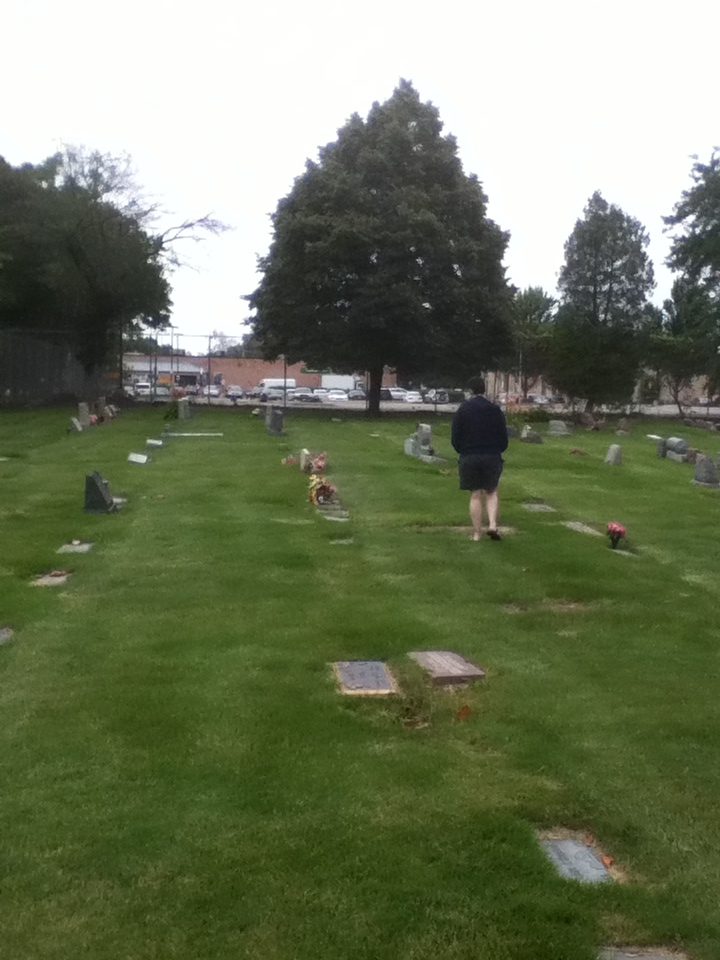
The stone was under a tree, which I had sort-of-not-really remembered from my last visit. It's a peaceful spot:

Seeing the physical stone brought me a sense of accomplishment as well as a wistful sort of feeling about how much I don't know in terms of family history. I have lost three grandparents and my mother since college, and neither my father's mother nor mine have a concrete place they are buried. Approximately half of my mother's ashes are in a tupperware container on my bookshelves, which works fine for me because I knew her. But what about my grandchildren? Is it better for them to have a bunch of dust or a few square feet of stone? I guess that the loved ones we are missing exist in neither place, but it was still nice to make this pilgrimage to find Anna Mickelsen.

Friday, July 5, 2013

Reading Roulette: Fourth Pick

The latest group of books to come up in my random selection of books to read includes a wide selection:

Coronets and Steel, Sherwood Smith

Aurelia Kim Murray is a California girl who wishes there were more to life. And there is. For Kim is part of a royal family from a tiny eastern European country, and soon finds herself swept up in the romance and mystery she always wanted-and more, because there's something very different about her bloodline and the magical nature of her ancestral country.

I am sure this got on to my list because of Crown Duel.


Kat, Incorrigible, Stephanie Burgis

Twelve-year-old Katherine Ann Stephenson has just discovered that she’s inherited her late mother’s magical talents, and despite Stepmama’s stern objections, she’s determined to learn how to use them. But with her eldest sister Elissa’s intended fiancĂ©, the sinister Sir Neville, showing a dangerous interest in Kat’s magical potential; her other sister, Angeline, wreaking romantic havoc with her own witchcraft; and a highwayman lurking in the forest, Kat’s reckless heroism will be tested to the utmost. If she can learn to control her new powers, will Kat be able to rescue her family and win her sisters their true loves?

In this charming blend of Jane Austen–era culture, magical whimsy, and rollicking adventure, readers will find a true friend in the refreshingly unladylike Kat Stephenson.

Stephanie is an online friend and I have had this series in my sights for a while. Now I have the kick in the ass I needed to actually read the first one! I confess, I read the first 100 pages already while I was on vacation. It was the perfect choice.


The Rise of Rome: The Making of the World's Greatest Empire, Anthony Everitt

Emerging as a market town from a cluster of hill villages in the eighth and seventh centuries B.C., Rome grew to become the ancient world’s preeminent power. Everitt fashions the story of Rome’s rise to glory into an erudite page-turner filled with lasting lessons for our time. He chronicles the clash between patricians and plebeians that defined the politics of the Republic. He shows how Rome’s shrewd strategy of offering citizenship to her defeated subjects was instrumental in expanding the reach of her burgeoning empire. And he outlines the corrosion of constitutional norms that accompanied Rome’s imperial expansion, as old habits of political compromise gave way, leading to violence and civil war. In the end, unimaginable wealth and power corrupted the traditional virtues of the Republic, and Rome was left triumphant everywhere except within its own borders.

Everitt paints indelible portraits of the great Romans—and non-Romans—who left their mark on the world out of which the mighty empire grew: Cincinnatus, Rome’s George Washington, the very model of the patrician warrior/aristocrat; the brilliant general Scipio Africanus, who turned back a challenge from the Carthaginian legend Hannibal; and Alexander the Great, the invincible Macedonian conqueror who became a role model for generations of would-be Roman rulers. Here also are the intellectual and philosophical leaders whose observations on the art of government and “the good life” have inspired every Western power from antiquity to the present: Cato the Elder, the famously incorruptible statesman who spoke out against the decadence of his times, and Cicero, the consummate orator whose championing of republican institutions put him on a collision course with Julius Caesar and whose writings on justice and liberty continue to inform our political discourse today.

Rome’s decline and fall have long fascinated historians, but the story of how the empire was won is every bit as compelling. With The Rise of Rome, one of our most revered chroniclers of the ancient world tells that tale in a way that will galvanize, inform, and enlighten modern readers.

This one I requested on audio CD and will be going with me in the car to Chicago, since I have at least a fourteen-hour drive ahead of me. I very much enjoyed Everitt's biography of Hadrian.

Why am I doing this?